




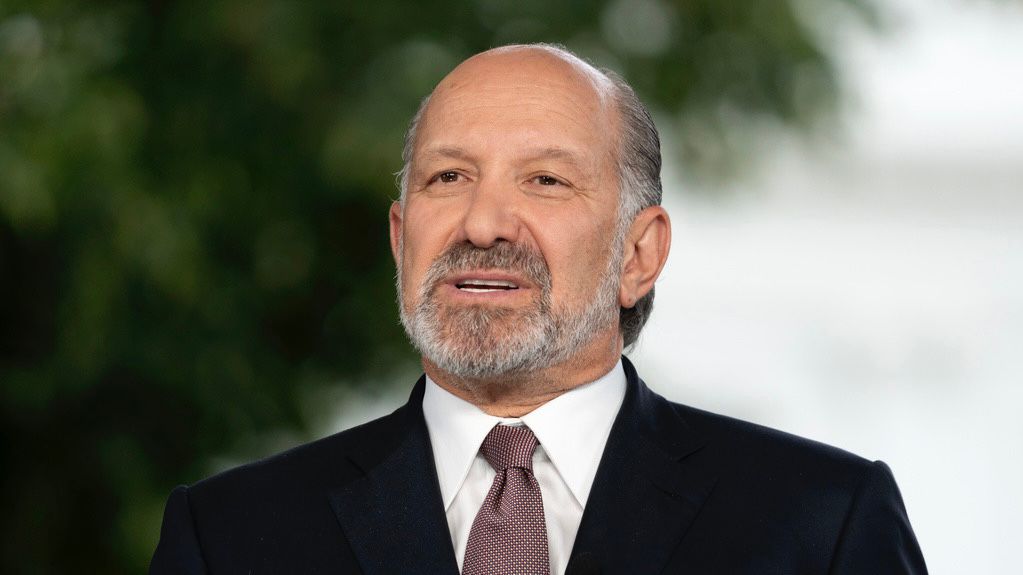
WASHINGTON — Commerce Secretary Howard Lutnick defended the Trump administration’s recent negotiations to take a 10% stake in Intel and a 15% share of Nvidia’s revenue from China sales, saying the U.S. should get the benefit of its investment in the semiconductor chipmakers.
Last year, as part of the $52.7 billion CHIPS and Science Act signed into law by then-President Joe Biden, the U.S. announced it would invest $8.5 billion in Intel to build factories in four states to bolster domestic chip manufacturing and $6.6 billion in the Arizona subsidiary of the Taiwan Semiconductor Manufacturing Co. to support Nvidia’s U.S. manufacturing.
In an interview with CNBC’s “Squawk on the Street” on Tuesday, Lutnick criticized the bipartisan CHIPS and Science Act, which aimed to bring semiconductor production back to the United States from Asia, calling it a “giveaway.”
Instead of “just giving grants away, Donald Trump’s view is we should get benefits for the economics that we put out.”
Lutnick dismissed the idea that the Trump administration’s equity deals are a form of state capitalism — a system like China’s where the government has control over much of the economy’s key industries.
He said the U.S. government’s 10% stake in Intel wouldn’t include governance over the company’s operations — unlike the “golden share” agreement the Trump administration struck for Nippon Steel’s acquisition of U.S. Steel, which allows the U.S. government veto power over some corporate decisions.
Last week, the Trump administration struck a deal to receive 15% of the revenues Nvidia gets from selling its microchips in China. In July, the Pentagon finalized a $400 million investment in the rare earth mining and processing company MP Materials, securing a 15% stake in the company that extracts and refines rare earth materials in California.
The Trump administration has also floated the idea of creating a sovereign wealth fund that could be used to purchase the popular Chinese-owned social media platform TikTok. Sovereign wealth funds are government-owned funds that include stocks, bonds and other financial assets.
The commerce secretary dismissed the criticism of a Wall Street Journal opinion piece about the possible Intel deal that said the company’s “nationalization” would trap the U.S. into additional subsidies for the troubled chipmaker that lost $18.8 billion and cut 15,000 jobs last year.
“The Biden administration was literally giving Intel money for free, giving TSMC money for free and all these companies just giving them money for free, and Donald Trump turns that into saying, ‘Hey, we want equity for the money,'" Lutnick said. "If we’re going to give you the money, we want a piece of the action for the American taxpayer.”
Lutnick said having the government take a stake in certain sectors of the economy is necessary to compete against China state subsidies that allow the country’s products to be sold worldwide for far less than they actually cost.
“We’ve got to fix ourselves,” Lutnick said. “We’ve got to make semiconductors. We’ve got to build pipelines. We’ve got to build nuclear. We’ve got to have the infrastructure to help our national security and our economy security, and that’s what Donald Trump is bringing to America.”