




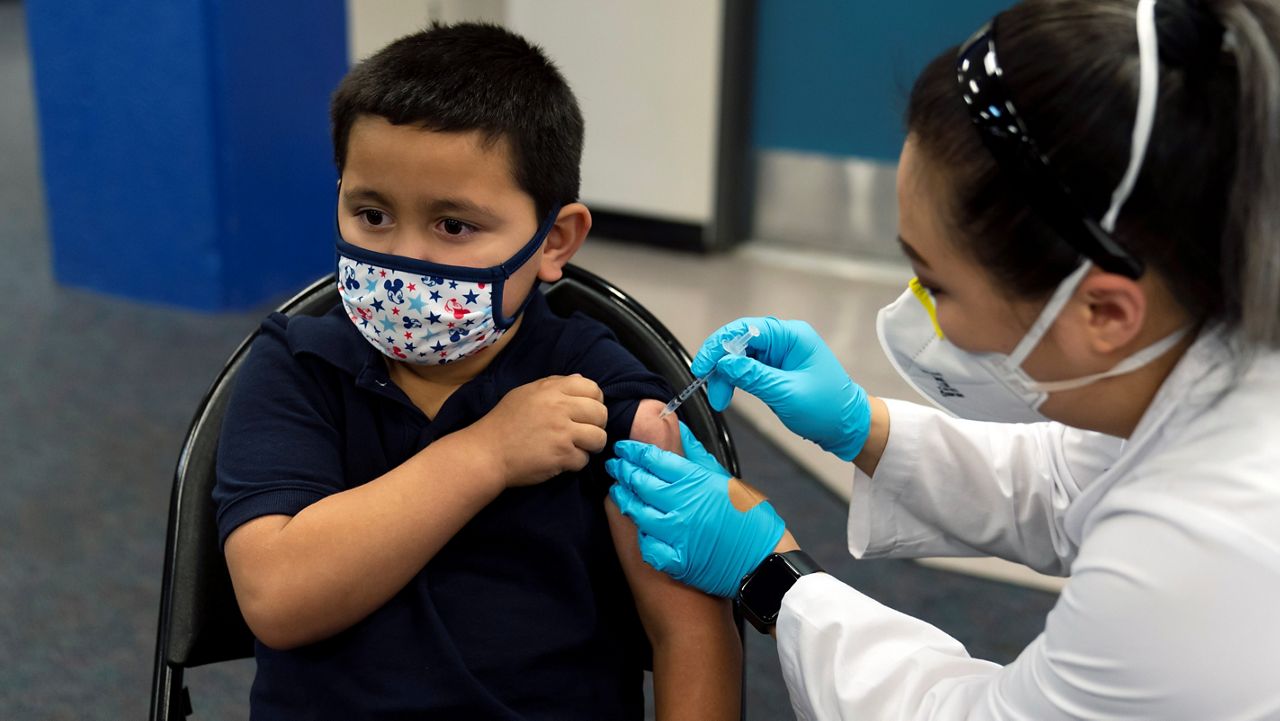
WASHINGTON — The U.S. Centers for Disease Control and Prevention is no longer recommending the COVID-19 vaccine for healthy children and healthy pregnant women, Health and Human Services Secretary Robert F. Kennedy Jr. announced Tuesday.
In a brief video posted on X, where he stood alongside the heads of the Food and Drug Administration and National Institutes of Health, Kennedy said there is no clinical data to support repeated COVID booster shots for children.
NIH Director Jay Bhattacharya said the move was “common sense” and “good science,” while FDA Commissioner Martin Makary said, “There’s no evidence healthy kids need it today.”
Kennedy said the updated recommendation moves the CDC “one step closer to realizing President Donald Trump’s promise to make America healthy again.”
In February, Trump signed an executive order calling for Kennedy to chair a new Make America Healthy Again Commission, which includes the chairs of multiple federal agencies, including the CDC and FDA. The order directed the commission to address what it called a “childhood chronic disease crisis.”
Even before becoming U.S. health secretary, Kennedy has long questioned the safety of vaccines.
His announcement Tuesday comes eight days after the FDA said annual COVID-19 shots for healthy younger adults and children will no longer be routinely approved. The FDA said COVID shots will still be available to adults 65 and older as well as children and younger adults with at least one health problem that puts them at higher risk. But a new FDA framework urges companies to conduct large, lengthy studies before tweaked vaccines can be approved for healthier people.
Earlier this month, the FDA granted Novavax full approval of its COVID-19 vaccine with major restrictions for who can receive it. Moderna and Pfizer also make COVID-19 vaccines that are updated annually similar to flu shots.
"With the COVID-19 pandemic behind us, it is time to move forward," Emily Hilliard, press secretary for the Department of Health and Human Services, said in a statement to Spectrum News. "HHS and the CDC remain committed to gold standard science and to ensuring the health and well-being of all Americans—especially our nation’s children—using common sense."
The CDC did not directly respond to questions seeking more details about the change in guidance for COVID vaccines boosters.
Just like with flu vaccines, the FDA has until now approved updated COVID shots when manufacturers provide evidence that they spark just as much immune protection as the previous year's version. The FDA's new guidance appears to be the end of that approach under Kennedy, who has filled the FDA and other health agencies with outspoken critics of the government’s handling of COVID shots, particularly their recommendation for young, healthy adults and children.
Experts say there are legitimate questions about how much everyone still benefits from yearly COVID vaccination or whether they should be recommended for people at increased risk.
But Jodie Guest, an epidemiology professor at Emory University called the move “a surprising recommendation, especially because it is going against our normal policies for recommendations like this.”
The CDC’s Vaccine Advisory Committee, which is set to meet next month, is typically involved in such decisions. But a person with knowledge of the committee’s deliberations told Spectrum News it was not consulted.
The move by Kennedy could have major implications for people trying to access the vaccine.
“You could still have access to it, but you may have to pay out of pocket,” Guest said. “And we’re talking perhaps a couple hundred dollars for a vaccine, and you may have fewer places where you can find it.”
If insurance companies don’t cover the shot, millions of healthy adults and children may struggle to get it.
“For health people who are under 65, double digit percent of those people, I bet … would like a vaccine every year,” said Dr. David Wohl, a professor of medicine at the University of North Carolina at Chapel Hill.
“For an administration and RFK Jr. particularly, who says we should have choices, people should make decisions based on their options, for themselves, for their children,” Wohl said. “Taking this off the table doesn’t seem to really fit with that.”