




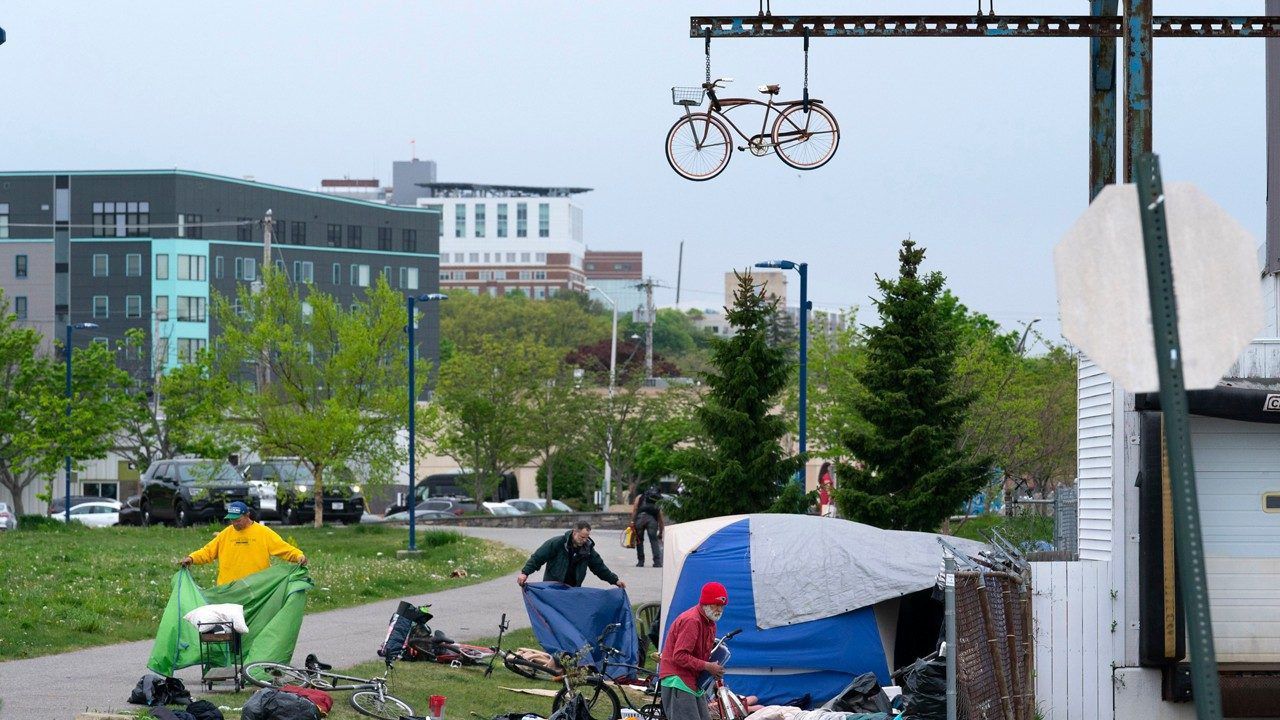
PORTLAND – Advocates for Maine’s homeless are worried about the impacts of recent massive federal cuts to Medicaid.
“This is going to be pretty devastating for populations that rely on health care to be successful,” said Cullen Ryan, executive director of Community Housing of Maine, a nonprofit that helps develop affordable housing and support services for the unhoused.
President Donald Trump signed the federal spending cuts bill, also known as the "big beautiful bill,” on July 4. The legislation cuts as much as $1 trillion in Medicaid funding over the next 10 years.
Ryan said it’s tough to say exactly how much of that money was earmarked for Maine. Early estimates suggests Maine could lose up to $6 billion in Medicaid funding over the next 10 years.
“I think that they’re still figuring it out,” he said. “What we know is that it’s going to be an enormous impact.”
Danielle Smaha, a spokesperson for Preble Street, Portland’s largest emergency overnight shelter, said the cuts could contribute to the number of homeless people over time.
“The most immediate effect of cuts to Medicaid (and SNAP) will be that Mainers will need to choose which basic items to pay for: food, medications, healthcare, or heating or cooling for their homes,” she said. “As more people struggle to meet these needs, inevitably, these cuts will lead to more housing instability and homelessness.”
Less Medicaid funding means less access to treatment for mental illness and substance use disorder, Smaha said. Those conditions consistently contribute to chronic homelessness, and Smaha said maintaining those services helps to keep people housed.
“Without these supports, more people could end up on the streets or in shelters, which are already stretched thin in communities across Maine,” she said.
The new law also requires anyone enrolled in Medicaid aged 19-64 to prove they are working at least 80 hours per month, which Smaha said is concerning.

“Adding work requirements will only create administrative barriers, causing eligible individuals and families to lose coverage from missed paperwork deadlines or long delays from overworked agency staff,” she said.
The new law has compounded federal issues related to homelessness. In March, as part of a purging of federal staff, roughly half of the positions at the U.S. Department of Housing and Urban Development were on the chopping block, including virtually all staff members who are knowledgeable about homeless services.
At the time, HUD Secretary Scott Turner said in a statement, “Thanks to President Trump’s leadership, we are no longer in a business-as-usual posture and the DOGE task force will play a critical role in helping to identify and eliminate waste, fraud and abuse and ultimately better serve the American people.”
But those federal employees, Ryan said, were vital in helping Community Housing of Maine and other organizations navigate the federal system to identify funding or other assistance they might be eligible for.
“We’ve lost a lot of expertise, people who have been there for decades, who really understood how programs work, and they’re no longer there,” he said.
The cuts are scheduled to take effect in late 2026 and probably won’t be felt in Maine until early 2027.
And those cuts may not save as much as conservative voices in Washington think, according to Ryan.
“When you don’t serve people and provide for their health, people get more unhealthy and it gets more expensive, so we’re not saving money by (not) providing preventive care or avoiding serving people who need it,” he said. “We’re actually compounding their issues and making a more expensive emergency crisis down the road.”