




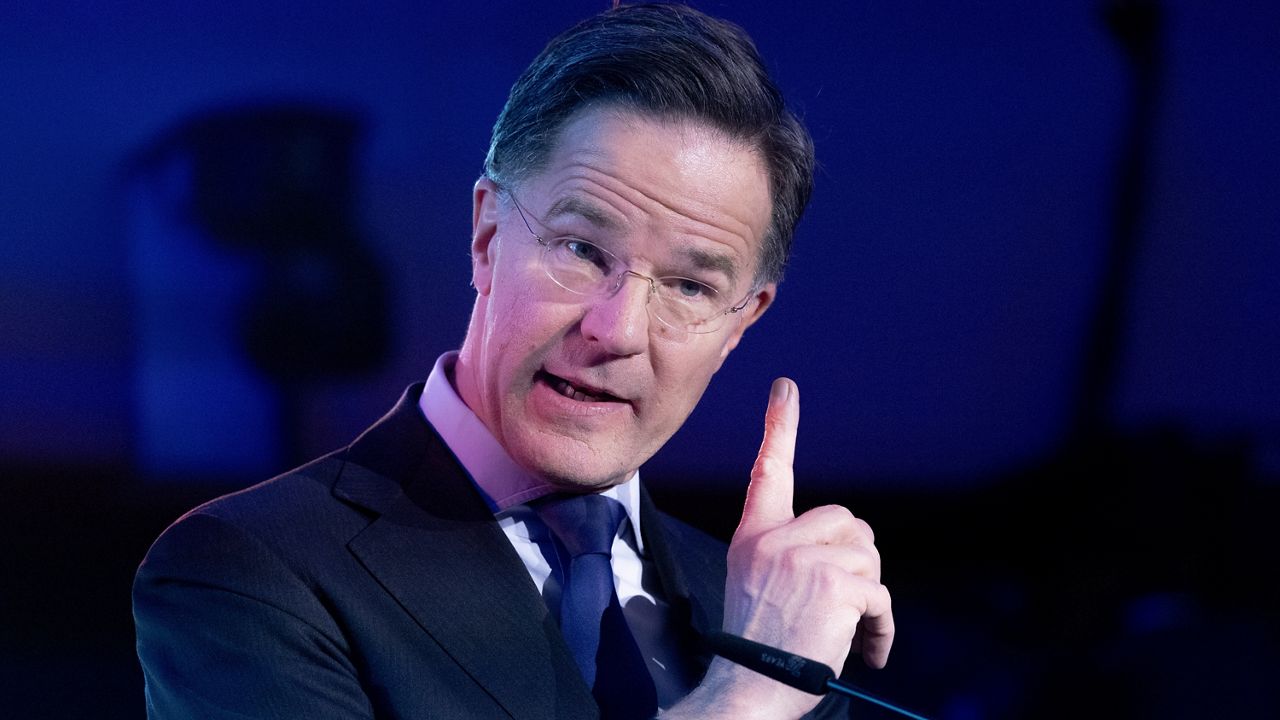
President Donald Trump is set to host NATO Secretary-General Mark Rutte at the White House on Wednesday — a visit that comes amid Trump’s persistent criticism of member nations’ response to the war in Iran and his strongest threats to date of pulling the U.S. from the transatlantic alliance.
Asked during an interview with The Telegraph last week if he would reconsider the U.S.’s NATO membership, Trump said: “Oh yes, I would say (it’s) beyond reconsideration. I was never swayed by NATO.”
Rutte, who has been called a “Trump whisperer,” will also meet Secretary of State Marco Rubio and Defense Secretary Pete Hegseth, according to NATO.
Trump has expressed anger at NATO allies for what he sees as lack of support for the U.S. military operations against Iran and rejection of his call to help reopen the Strait of Hormuz, a key waterway through which about a fifth of the world’s oil is transported.
Ship traffic has fallen dramatically since Tehran closed the strait in retaliation for the war launched by the U.S. and Israel, causing global fuel prices to surge.
During a national address Wednesday evening, the U.S. president encouraged countries that rely on oil transported through the waterway to "build some delayed courage" and go "take it."
Days later –– during a press briefing at the White House on Monday –– Trump said he was "very disappointed in NATO."
“I think it’s a mark on NATO that will never disappear, never disappear in my mind. You know they’re coming to see me on Wednesday. ‘Oh, we’ll do this. We’ll do that.’ Now they want to send things, you know, but they said it loud and clear at the beginning,” he continued.
He called the coalition a “paper tiger” four separate times while taking questions from reporters Monday.
“Look, we went to NATO. I didn’t ask them very strongly, I just said, ‘Hey, if you want to help, great,’” Trump recounted, before seeming to adopt a vaguely European accent to convey the response from U.S. allies in the military alliance. “‘No, no, we will not help.’”
“That’s all right. You don’t want to help because I’ve always said NATO is a paper tiger,” the U.S. president continued.
Last week, Trump told The Telegraph that he thought support in the Middle East from other NATO members should be “automatic,” citing U.S. assistance to Ukraine after it was invaded by Russia more than four years ago. Ukraine is not a member of NATO, but some 35 countries — mostly in Europe — have formed a “coalition of the willing” to support Kyiv.
Trump has also in the past fueled confusion over whether the U.S. would defend NATO members that don’t contribute enough to the military alliance. Article 5 of NATO states that “an armed attack against one NATO member shall be considered an attack against them all,” and was invoked only once — in defense of the U.S. after the terror attacks on Sept. 11, 2001.
Questions about the future of the alliance bubbled to the surface earlier this year as Trump threatened to take over Greenland — an autonomous territory of the Kingdom of Denmark, a member of NATO. Ultimately, Rutte seemed to have been successful in ending the standoff and convincing the U.S. president to scrap plans to tariff allies who did not support U.S. control of the island.
In a comment provided to Spectrum News, a NATO official called Rutte’s trip to Washington this week “a long-planned visit.”
The secretary-general plans to “build on the success of the NATO Summit in The Hague, unlock further cooperation among defence industry on both sides of the Atlantic, and discuss current security dynamics including in the context of Iran as well as Russia’s ongoing war against Ukraine,” the NATO official said.
Since Trump returned to office last January, the secretary-general has seemed to avoid criticism and instead deploy flattery, including when he referred to Trump as “Daddy” last summer.
During a news conference late last month, Rutte fielded several questions from reporters about his strategy toward the U.S. and his response to Trump’s comments condemning NATO members as "cowards," but the NATO chief deflected each one, praising Trump’s push for increased military spending among alliance members and describing the coalition as “stronger today than it has ever been.”
He said that countries needed time “to get organized” in response to Trump’s request for aid after the U.S. and Israel launched large-scale strikes on Feb. 28 –– without alerting allies.
Rutte’s stance toward Trump has seemed to stand in contrast with that of some NATO member states. French President Emmanuel Macron and German Defense Minister Boris Pistorius both emphasized that their countries had not been informed nor involved in the war’s commencement.
“Of course, NATO is the cornerstone of our security,” the Polish Ministry of Foreign Affairs said on X last week. “Of course, we want to be a good, loyal ally of the United States, but we cannot pretend that the U.S. President isn’t saying what he is saying.”
Trump would need congressional approval to withdraw the U.S. from NATO, which marked the 77th anniversary of its founding Saturday.
Meanwhile, Rutte is expected to remain in Washington through Sunday. On Thursday, he is slated to give a speech at the Ronald Reagan Presidential Foundation Institute, and Rutte is expected to attend the Bilderberg Meeting –– an annual, private conference between North American and European political, financial, academic and media leaders — for the rest of his trip.