




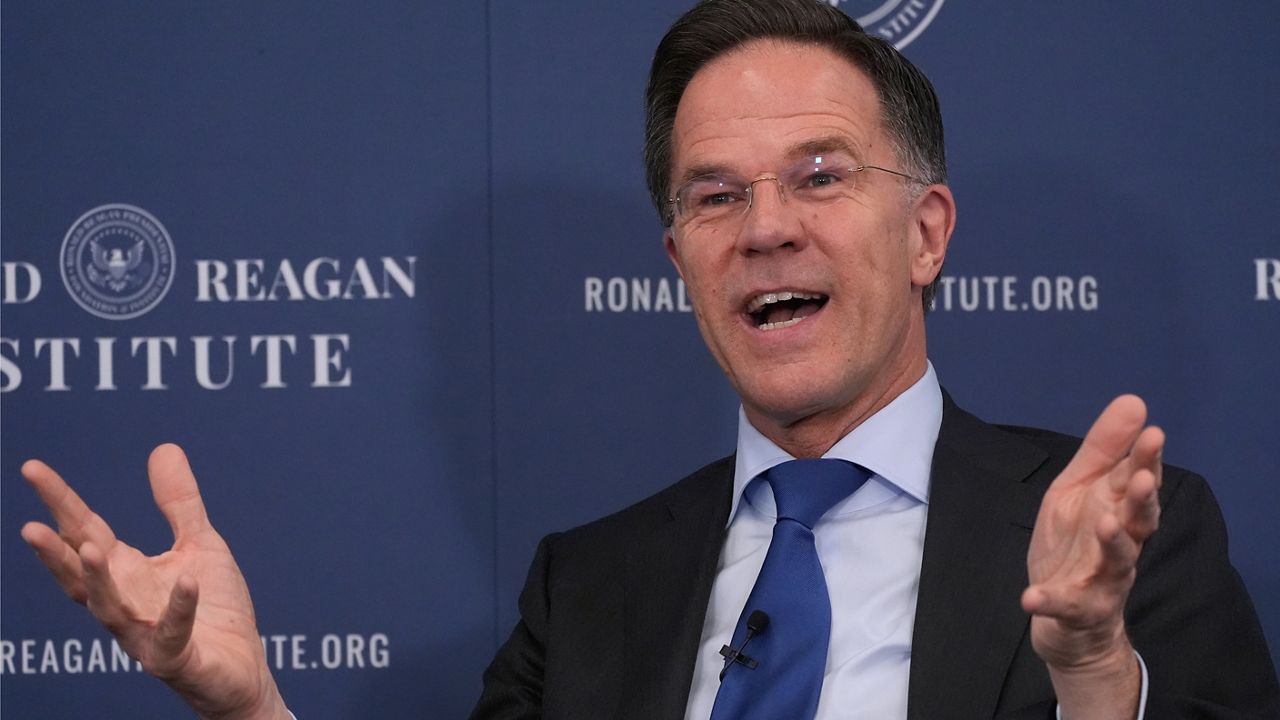
WASHINGTON — Hours after President Donald Trump referred to NATO as “very disappointing," the coalition’s secretary-general, Mark Rutte, touted on Thursday a “period of profound change” that would strengthen the trans-Atlantic alliance while speaking at the Reagan Institute in Washington.
“Why when we turn on our televisions or scroll on our phones, do we see eager, early drafts of NATO's obituary?” Rutte asked attendees. “Let me be clear: This alliance is not whistling past the graveyard as you would say in the United States.”
The secretary general applauded Trump for his “bold leadership and vision” in pushing the other 31 members toward contributing “a greater and fairer share of the task of providing for its conventional defense,” and said NATO was shifting away from “unhealthy co-dependence” between Europe and the U.S.
Rutte also acknowledged that “some allies were a bit slow” in responding to Trump’s request for support, including assistance in trying to secure the reopening of the Strait of Hormuz in the Middle East, a key shipping lane through which one-fifth of the world’s oil is transported.
Iran's chokehold on the waterway has sent fuel prices more than 30% higher since the U.S. and Israel launched large-scale strikes on Iran on Feb. 28. On Wednesday, Iran said the strait was closed again, citing attacks by Israel on Lebanon as violating terms of the fragile, two-week ceasefire agreed to on Tuesday.
Rutte met with Trump at the White House on Wednesday, and shortly afterward, the U.S. president took to Truth Social to criticize the military alliance, saying member countries were not “THERE WHEN WE NEEDED THEM, AND THEY WON’T BE THERE IF WE NEED THEM AGAIN.”
He chided the coalition again in a post Tuesday morning, saying, “None of these people, including our own, very disappointing, NATO, understood anything unless they have pressure placed upon them!!!”
Rutte noted how the U.S. did not share its plans with allies ahead of Feb. 28, which the secretary-general called “understandable.” NATO members “had to scramble to understand what was happening and then to step up,” he said.
“I sensed his disappointment about the fact that he felt that too many allies were not with him,” Rutte said of his meeting with Trump. “I said, ‘Hey, Mr. President, clearly, the overwhelming majority of Europeans have done what the U.S. asked … and what was previously agreed in these circumstances.’”
In his post Wednesday evening, Trump also raised another issue where he had been rebuffed by NATO members earlier this year, writing, “REMEMBER GREENLAND, THAT BIG, POORLY RUN, PIECE OF ICE!”
Trump had threatened to impose tariffs on allies that did not support a U.S. takeover of Greenland, a semiautonomous territory of Denmark, which like the U.S. is a member of NATO. Rutte seemed to successfully turn down the temperature on the U.S. president’s demands for American control of the world’s largest island earlier this year.
“I share (Trump’s) view that there is a big risk that the Russians and the Chinese will become even more involved in the Arctic,” Rutte said when asked about Greenland on Thursday, adding, “We have to defend ourselves.”
Rutte said that during the World Economic Forum in Davos, Switzerland, in January, NATO had agreed to launch a security initiative, called Arctic Sentry, and conversations would continue about how to block Russia and China from gaining access to Greenland’s economy.
Separately, the secretary-general noted talks between the U.S., Denmark and Greenland about “what happens if Greenland would in the future –– maybe yes, no –– change its constitutional position within the kingdom of Denmark.”
Rutte, a former Dutch prime minister who has been referred to as a “Trump whisperer,” has consistently eschewed criticism of Trump for flattery, at one point referring to the U.S. president as “Daddy” last year — a comment that Rutte was asked about Thursday.
“On the ‘Daddy’ thing, this is a language problem,” Rutte said, explaining that he had meant to compare Trump’s anger at Iran and Israel for violating a previous ceasefire last summer with that of a stern father.
“This was so funny, and this is why I like him so much,” he added. “But, hey, you make mistakes, and this is when you are not a native speaker.”
A day earlier, Rutte had been asked during an interview with CNN if Trump’s threat that Iran’s “whole civilization will die tonight” bothered him as a diplomat.
“What I always say when it comes to what leaders are saying, I'm not commenting on everything,” Rutte responded. ”What I want you to know is that I support the president, and I know large parts of Europe do when it comes to taking out the capacity of Iran to export chaos to the region, to Europe, to the whole world.”
Trump has previously threatened to leave the military coalition –– telling The Telegraph earlier this month that he “was never swayed by NATO.”
But federal lawmakers have made the process to do so more challenging. A provision in the National Defense Authorization Act prevents any president from pulling the U.S. from the trans-Atlantic alliance without congressional approval.
“The President shall not suspend, terminate, denounce, or withdraw the United States from the North Atlantic Treaty” without support of two-thirds of the Senate or an act of Congress, the law stipulates.
Asked during an interview with CNN about Wall Street Journal reporting that the U.S. president was weighing whether to move U.S. troops out of NATO countries that were not “helpful” in the Iran war effort, Rutte said Wednesday, “it was a very open discussion. He clearly told me what he thought of what happened over the last couple of weeks.”
Meanwhile, a majority of Americans said that the U.S. benefits from NATO membership, according to a recent Pew Research Center survey, but that view has been dropping among Republicans.