




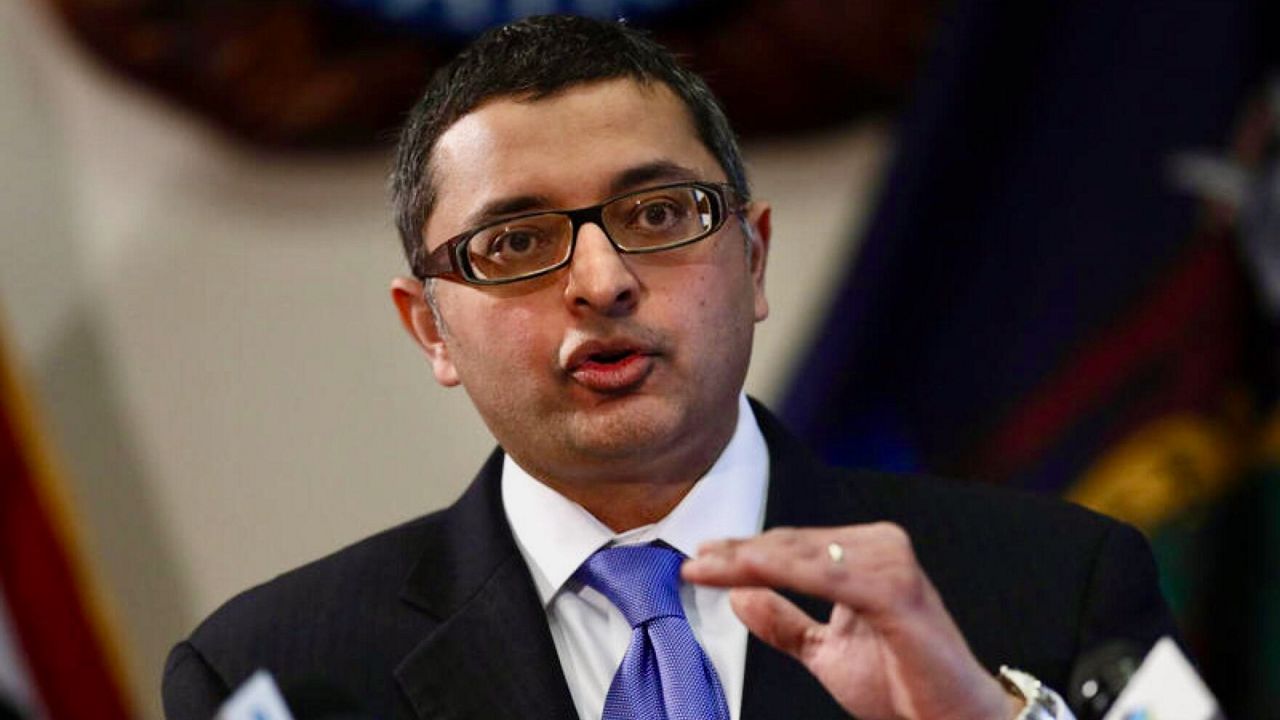
The state’s top doctor on Thursday answered questions from lawmakers about the effectiveness of COVID-19 vaccines, the state’s efforts to provide testing sites and whether Maine will seek to impose restrictions on people who are not vaccinated.
Dr. Nirav Shah, director of the Maine Center for Disease Control and Prevention, spent 90 minutes in front of the Legislature’s Health and Human Services Committee on a day when the state set a new record for COVID-19 hospitalizations.
He said the 436 people hospitalized with COVID represents “a sad and grim high mark” for the pandemic, with surging numbers driven by the omicron variant.
Rep. Michael Lemelin (R-Chelsea) pressed Shah on data that shows that about 30% of people who are hospitalized with COVID have been vaccinated. He said he objects to a decision by Gov. Janet Mills last year to require health care workers to be vaccinated.
“The key is not whether or not unvaccinated people are hospitalized or not, the key to Maine is vaccinated people are hospitalized,” Lemelin said. “If 30.5% percent of vaccinated people are in hospitals and 20% of people on ventilators are vaccinated, why are we forcing vaccinations on people?”
Shah said no one is being forced to take a vaccine, but that it is required for those who work in health care settings, just as other vaccines are a condition of employment. He then cited statistics that show people who are unvaccinated are five times more likely to get the virus, eight times more likely to be hospitalized and 14 times more likely to die of the disease.
“The vaccines are not 100% effective,” Shah said. “What they are is extremely effective at reducing the relative risk of hospitalization.”
Lemelin said more than 600 people have died after getting vaccinated, something Shah said is “not factually correct.”
“There is no evidence whatsoever that vaccines played a causative role in the deaths of any individuals,” Shah said. “The three vaccines that are available in the United States have undergone significant testing through randomized trials. Indeed, when these vaccines were studied and the data were reviewed, there was no risk of death in the vaccine group relative to the placebo group.”
Rep. Jonathan Connor (R-Lewiston) asked whether the state is planning to implement policies “to restrict the movements of unvaccinated” people.”
“The answer is a clear and unequivocal no,” Shah said.
Rep. Kathy Javner (R-Chester) asked Shah about what she described as “conflicting articles” about whether hospitals in the state are allowing staff to come back to work even while they have COVID.
Shah said the federal CDC released guidelines in late December that allows hospitals to make their own decisions regarding staffing. Hospitals are not required to notify the Maine CDC of those decisions, he said.
“In recent days we’ve become aware at least one health care facility has deemed itself to be in a crisis mode such they have opted to bring back, on a limited basis, positive health care workers,” he said.
Earlier this week, St. Mary’s Hospital in Lewiston announced it is allowing COVID-positive workers to return to duty. Shah said the preference is for those staffers to work only with COVID patients.
Javner also asked about natural immunity versus the type of immunity conferred by the vaccine.
Shah said he recommends even those who have had COVID get a vaccine, which gives the person “hybrid immunity.”
“The vaccine plus the virus is really the best you can get,” he said.
With regard to students in school, Rep. Michele Meyer (D-Eliot) said school nurses are telling her that students are coming back to school with symptoms after being home for the required five days. She asked whether it would be prudent for students to be tested before they return to school.
Shah said he agrees with the federal CDC that it’s not necessary to require a test for those coming out of isolation. That’s because a test doesn’t reveal much to those still experiencing symptoms – they should stay home – and for those without symptoms, it’s OK to come back.
“What we know about COVID is that after day five, the likelihood of infection doesn’t go to zero, but it does go down to a level that we have to make a balance,” he said.
When it comes to testing, Shah said his department is working with federal partners to see if there is a way to open additional testing centers.
“We know we have more work to do there,” he said. “We’re hoping to be able to launch additional locations, if we can, in coming days. We recognize that testing access remains a challenge.”
In closing, Meyer asked Shah what keeps him up at night.
“Hospitals and our health care system,” he said. “Trying to keep the center from falling out of our health care system. Second is keeping kids in school.”
In addition, he said, he worries about “the looming mental health and substance use crisis.”