




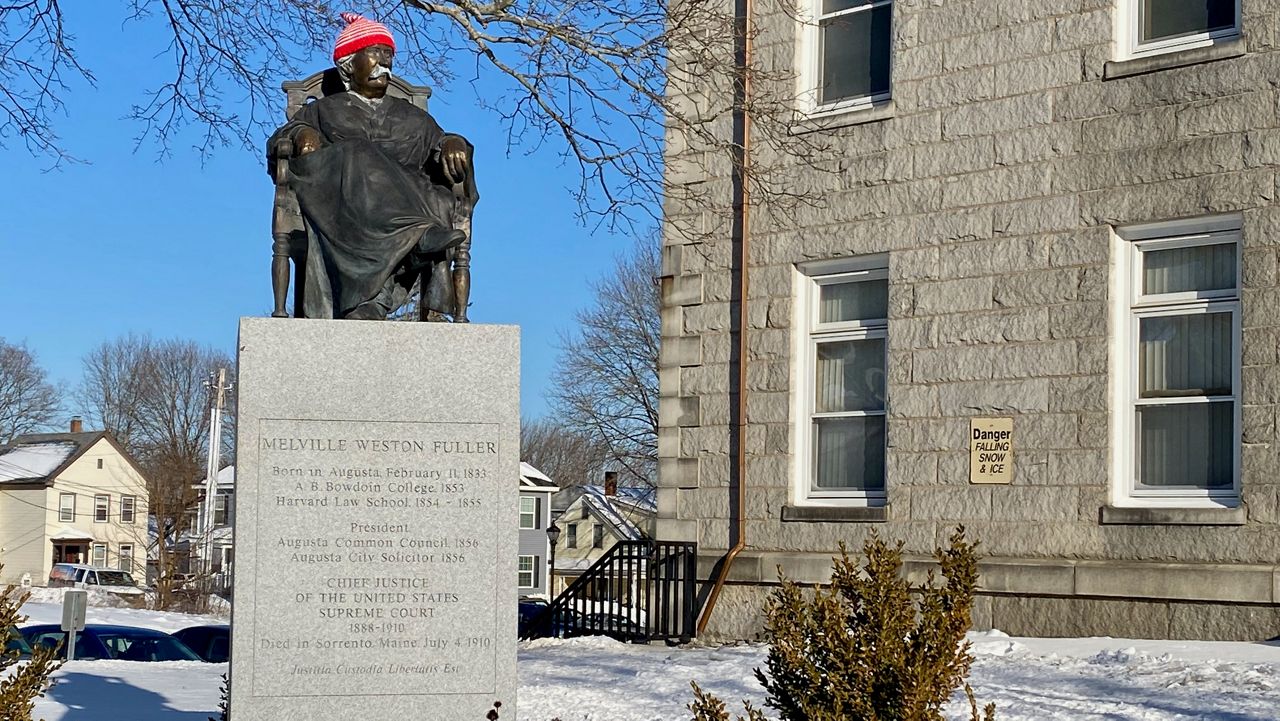
The Augusta Planning Board on Tuesday tabled a proposal to move a controversial statue from the Kennebec County Courthouse grounds to a vacant lot across the street following a 90-minute discussion.
Robert Fuller, a descendant of former U.S. Supreme Court Chief Justice Melville Weston Fuller, wants to move a statue honoring his relative to a lot that was the former home of the YMCA on State Street. Although Melville Fuller served 22 years as chief justice from 1888-1910, he is controversial because he voted with the majority in Plessey v. Ferguson, which established the “separate vs. equal” doctrine. That decision institutionalized racial segregation for decades.
“It breaks my heart if Augusta becomes known as a place where there is a monument to what is really institutional racism and American apartheid in my neighborhood,” said City Councilor Linda Conti, one of several people who testified in opposition to Fuller’s plan.
Fuller must find a new home for the statue following a decision last year by the county commission that it did not belong on courthouse grounds.
On Tuesday, after Conti and others objected to Fuller’s proposal because of the Plessey decision, an engineer who has worked on the plan asked for the board to table the matter.
“In light of some of the testimony, we’d like to have the project tabled,” said Jim Coffin of Coffin Engineering.
At the start of the meeting, Planning Board Chairwoman Alison Nichols reminded the board that it is not their job to judge the content of what Fuller is calling the Maine Judicial Heritage Society Memorial Museum. Rather, it is their job to determine whether what Fuller is proposing meets city standards, she said.
“Please keep in mind that this museum will be located on private property and on the corner near other civic buildings which themselves may have been targets of demonstrations in the past and may be in the future,” she said.
The city received more than 30 letters in opposition to the project, some of which urged the board to reject it because of fears that it would draw violent protests. About 10 people who attended the meeting said they too were opposed.
Some of the discussion focused on the city’s definition of a museum and whether what Fuller is proposing to do fits the definition. His application is to move the statue, add eight parking spaces and a maintenance shed, and fence in the area.
Coffin said Fuller is considering the purchase of a nearby building to house a museum, but that it won’t be on the same property as the statue. Planning Board member Catherine Cobb pressed Coffin on that point, saying most people’s definition of a museum includes a building with displays, not a monument.
In 2013, Fuller donated the statue to the county to honor Melville Fuller, an Augusta native who is one of only 17 chief justices of the Supreme Court and the only one from Maine.
Following racial justice protests across the country in 2020, former Acting Maine Supreme Judicial Court Justice Andrew Mead encouraged the removal of the statue from courthouse grounds.
On Tuesday, Adam Turner of Augusta, who owns property nearby, said he doesn’t think the museum will beautify the area and that he believes it will have a detrimental effect on other properties.
“Who wants to live by a racist monument?” he said. “I don’t.”