




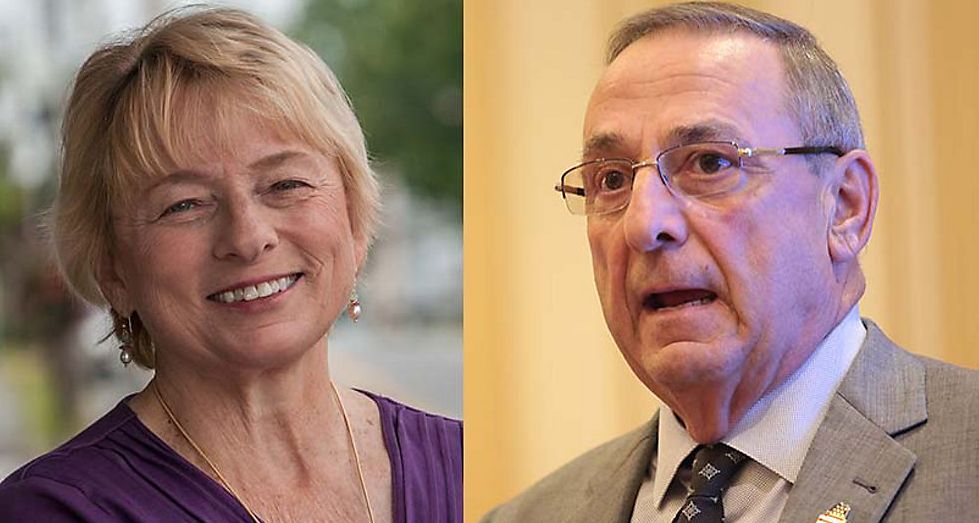
Gov. Janet Mills defeated her Republican challenger, former Gov. Paul LePage, in her bid for re-election Tuesday, setting the course for the state for the next four years during a time of economic uncertainty and divisive national politics.
With a little over 80% of the vote counted Wednesday morning, Mills was comfortably ahead of LePage, 55.7%-42.5%. Independent Sam Hunkler trailed with about 2% of the vote.
“Tonight, you sent a clear message – a message that says we will continue to move forward, and we will not go back. We will continue to fight problems, and not one another,” Mills told the election-night crowd in downtown Portland, according to the Associated Press.
The AP reported that LePage didn’t concede but acknowledged the math wasn’t adding up. He took an angry jab at the sitting governor during emotional remarks to his supporters in Lewiston, questioning her honesty and calling her an “elitist.”
Mills, a Democrat and the first woman governor of Maine, emphasized her accomplishments during her first term, which was dominated by the COVID-19 pandemic. She made frequent reference to issuing $850 inflation relief checks to most Mainers over the summer, balanced budgets and a record high $896 million rainy day fund.
LePage, a Republican, who served from 2011-2019, said he felt compelled to come out of retirement to seek a third term following decisions made by Mills during the pandemic.
The former Waterville mayor and Marden’s executive stressed his business background and criticized Mills for spending “Uncle Joe’s money”, a reference to billions in federal pandemic relief funds that flowed into Maine.
The race shattered records for spending on a gubernatorial election, with outside groups pumping more than $20 million into the race, the vast majority of which paid for negative television ads. That total does not include money raised by the candidates themselves, with Mills raking in $5.6 million, LePage $2.6 million and independent Sam Hunkler reporting $4,237.
The election comes at a time when 71% of Mainers say they are concerned about the cost of living, with 42% specifically identifying inflation as a key issue, according to Pan Atlantic Research.
An average of five polls conducted in recent weeks put Mills at 50%, with LePage at 43%, according to FiveThirtyEight, an opinion poll analysis website owned by ABC News.
Mills and LePage, both 74, participated in four televised debates where they explained their positions on abortion, education, the economy and a host of other topics.
Democrats sought to make abortion a central part of campaigns in Maine and nationally following the June Supreme Court decision to overturn Roe v. Wade. In Maine, the decision has little immediate impact because of a 1993 law that enshrines a woman’s right to an abortion in Maine.
Mills said she will veto any attempt to limit a woman’s access to abortion care, while LePage said he would veto a bill seeking to limit abortions after 15 weeks.
LePage worked to blame Mills for high inflation, attempting to tie her to high gas, heating oil and grocery prices. Mills said if reelected, she plans to convene the Legislature in December to see if more money is available for struggling Mainers.
Similarly, LePage said he would “make sure we have some monies available” in January to help people with high heating oil prices.
LePage also frequently described Mills as having a “woke” education agenda following Republican ads that highlighted a video explaining what it means to be transgender to young school children.
The video was immediately removed from the state Department of Education website and during a debate Mills said it “didn’t seem to be an appropriate message at all, especially for kindergartners.”
Beals physician Hunkler participated in the first debate, but after a poor performance in early October — and a failure to get more than 5% support in public polls — was not on stage for the other discussions.
The winner of the governor’s race will be tasked with working with a new Legislature that will be sworn-in in Dec. 7. A major part of the agenda will be crafting a new two-year state budget amid stubbornly high inflation and federal interest rate hikes that are slowing the housing market but have yet to bring down prices.
The new governor will be inaugurated Jan. 4.