




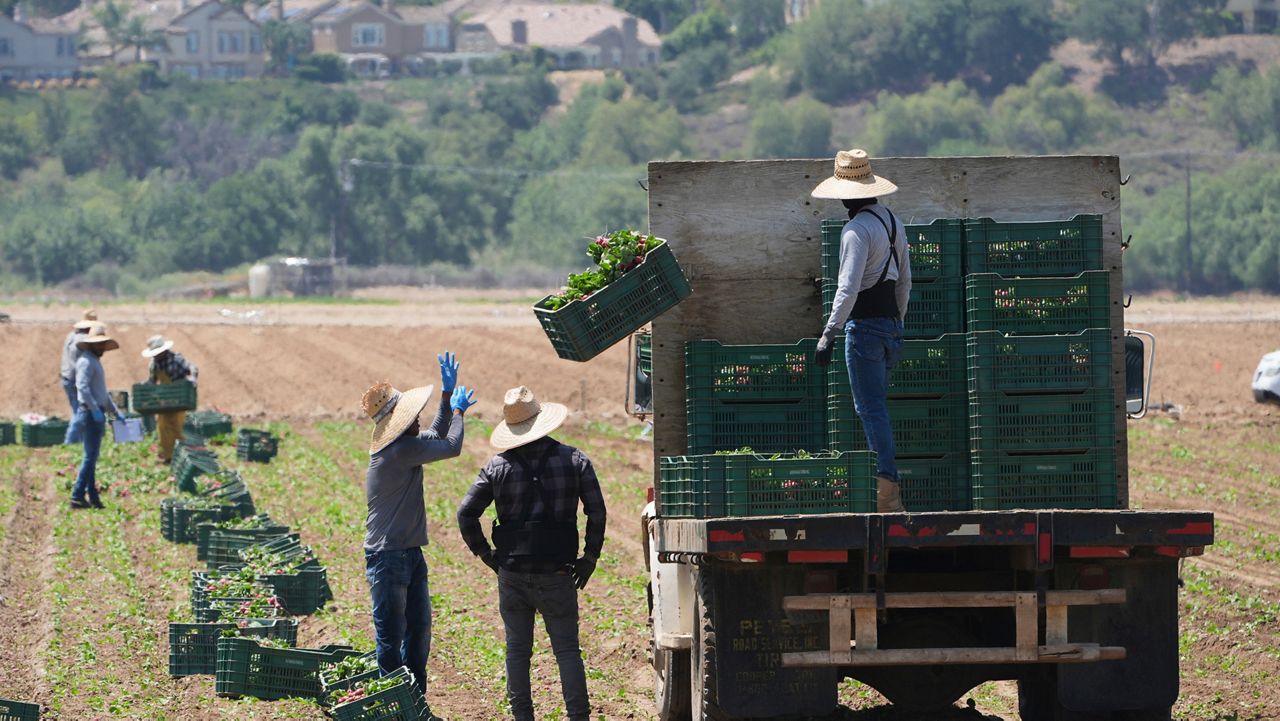
WASHINGTON — President Donald Trump said his administration is working on a “temporary pass” in his mass deportation efforts for migrants who may have entered the U.S. illegally and now work on farms or at hotels
The comment, which came in an interview with Fox News that aired over the weekend, marked perhaps the most concrete signal that the president does plan to offer some relief to those in the agriculture and hospitality industries after weeks of confusion around the administration’s approach.
“We’re working on it right now," Trump told Fox News’ Maria Bartiromo in an interview taped last week but released Sunday. "We’re going to work it so that some kind of a temporary pass — where people pay taxes, where the farmer can have a little control as opposed to you walk in and take everybody away."
The president stressed the difficulty of the work in agriculture, noting some don’t want to go into the industry because of it and that taking away longtime workers can “end up destroying a farmer.” He called it a “problem” and specifically said it applies to hotels as well.
Trump indicated his plan would involve a degree of trust in farmers knowing who to hire for themselves.
“And when we go into a farm and we take away people that have been working there for 15 and 20 years, who were good, who possibly came in incorrectly — and what we’re going to do is we’re going to do something for farmers where we can let the farmer sort of be in charge,” Trump said. “The farmer knows he’s not going to hire a murderer.”
Asked about the temporary pass, White House press secretary Karoline Leavitt told reporters Monday she did not have more details to provide on the potential new plan. She stressed the White House is "working closely" with the departments of Agriculture and Homeland Security on worksite enforcement.
"The president's focus and the focus of this administration is, of course, to remove public safety threats from the streets and to deport as many of the illegal criminals," Leavitt said.
The idea of a temporary pass for those in such industries comes as the Trump administration has looked to ramp up a central part of its immigration and border agenda — mass deportations, including at workplaces around the country. Recent immigration enforcement actions at places of work in Los Angeles led to wide-scale protests and a high-profile battle between Trump and the area’s Democratic state and local leaders.
Amid the public showdown, Trump administration officials doubled down on its immigration enforcement intentions, saying they would continue in full-force in California and elsewhere. White House border czar Tom Homan told Semafor in the wake of the Los Angeles protests that immigration enforcement actions at workplaces in particular were set to “massively expand.”
But Trump began to signal a concern for the potential impact on those in agriculture and hospitality, acknowledging in a Truth Social post that farmers and people in the hotel and leisure business have expressed that the administration's “very aggressive policy on immigration is taking very good, long time workers away from them.” The president then went on to declare that “Changes are coming!” but did not offer any details.
Confusion around the administration’s approach continued after that, particularly as the Department of Homeland Security said in a statement days later that there would be “no safe spaces for industries who harbor violent criminals or purposely try to undermine ICE’s efforts.”
“Worksite enforcement remains a cornerstone of our efforts to safeguard public safety, national security and economic stability,” the statement continued.
Some in the GOP have pushed back on the idea of certain industries being treated differently in the administration’s mass deportation efforts, with Sen. Tom Cotton of Arkansas telling CBS News earlier this month that “worksite enforcement in all industries needs to be able to move forward.” On the other hand, others have pushed for such a move with a group of six House Republicans writing to Immigration and Customs Enforcement calling on it to focus its deportation efforts on those in the country illegally with criminal records rather than dedicating resources to immigrants not charged with crimes.
In an interview with Spectrum News on Friday, Agriculture Secretary Brooke Rollins said the administration is committed to moving toward a “100% legal workforce.” At the same time, she said it wants to ensure farmers and ranchers have the workforce they need and the administration is focused on “getting the worst of the worst out first.”
Asked about what changes Trump was referring to as it pertains to immigration and farmers in his Truth Social post, Rollins mentioned reforming the H-2A visa program, which can facilitate some foreign nationals being brought into the country to fill temporary agriculture jobs.
Spectrum News' Charlotte Scott contributed to this report.