




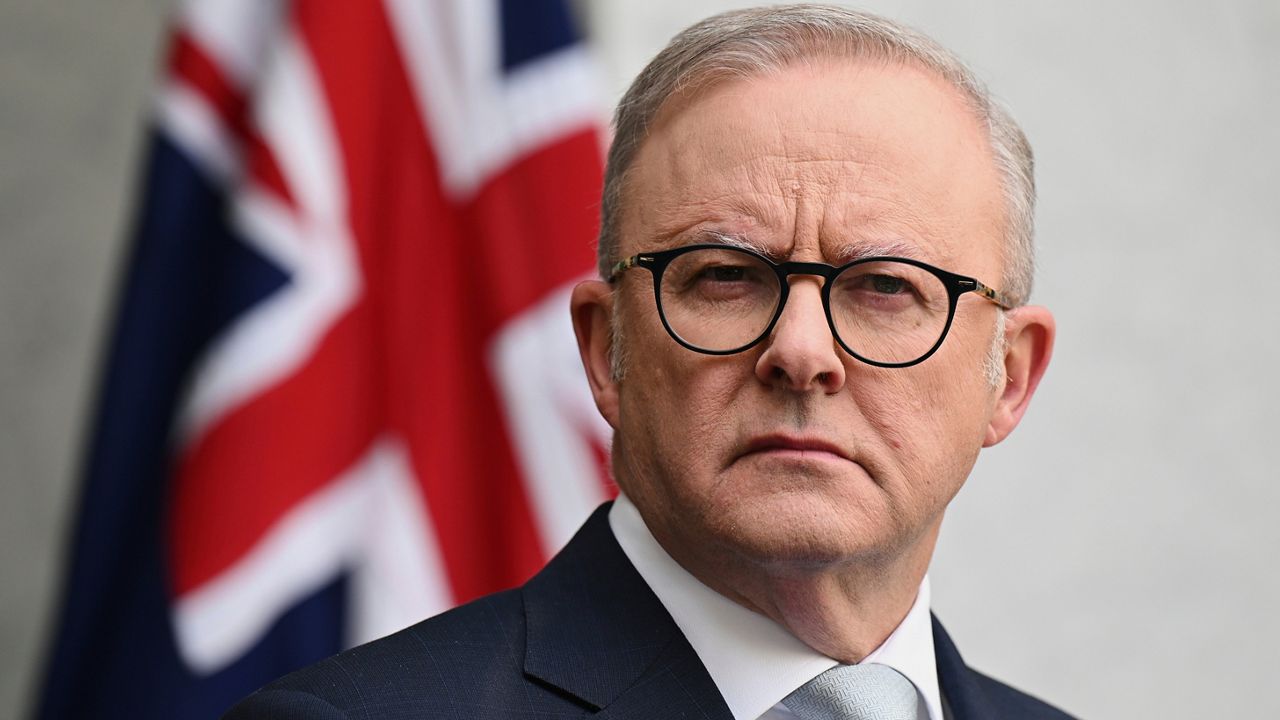
WASHINGTON — President Donald Trump welcomed Australian Prime Minister Anthony Albanese to the White House to sign a new critical minerals deal as the U.S. looks to counter China’s influence in the rare earth space amid a reignited trade and tariff war.
The two Indo-Pacific leaders signed the new agreement Monday sitting side by side in the White House Cabinet Room before holding up the freshly inked documents for the cameras to see. Albanese described the agreement as including a $8.5 billion pipeline that both leaders said is “ready to go.” A fact sheet from the White House following the meeting said that the U.S. and Australian governments are agreeing to jointly invest more than $3 billion in critical mineral projects in the next six months. It also noted the U.S. will invest in the construction of an advanced gallium refinery in Australia.
”We're just getting started,” the Australian leader added after talking about the pipeline.
The Trump administration’s effort to ramp up cooperation with Australia — a nation fertile with rare earth resources — on an issue in which China has an overwhelming presence comes after the very topic of critical minerals sparked a fresh round of trade tensions between Washington and Beijing.
China’s move earlier this month to place new export controls and restrictions on access to its rare earths led Trump to vow to increase the tariffs he’s placed on the country by 100% if a deal isn’t worked out by Nov. 1, inflaming the trade war between the world’s two largest economies that had cooled since its peak this spring.
China processes nearly 90% of the world’s rare earths, according to the Center for Strategic and International Studies. Those are critical for manufacturing and technology moving forward, and both countries have been angling for leverage in trade talks.
Just ahead of the meeting Monday, Trump’s director of the White House’s National Economic Council, Kevin Hassett, praised Australia’s supply of minerals, its mining economy and the skill of its refiners, making the case that the country will be key in countering “the kind of rare earth extortion that we’re seeing from the Chinese.”
Nevertheless, Trump, seated next to Albanese, dismissed any tensions with China, insisting Beijing was “respectful” of the U.S. including by paying “tremendous amounts of money” in the form of tariffs. He was adamant in his belief that a “very fair deal” would be arranged between the two nations and said he still planned to meet with Chinese leader Xi Jinping in South Korea in a couple of weeks despite previously questioning whether the planned face-to-face would still take place.
Trump also rejected the notion of China pulling in front of America in essentially any way, insisting the U.S. is “way ahead” of the country in artificial intelligence — another key area of competition between the two — and militarily, with the exception of ship building, which he pledged the U.S. will be “catching them” on.
The U.S. president also praised Australia as doing a “fantastic job in weaponry,” as both leaders noted that security was a major topic they planned to discuss in their talks at the White House.
Trump confirmed he was "moving very, very quickly,” on supplying nuclear-powered submarines to Australia as part of the AUKUS security pact that was worked out between the two nations as well as the United Kingdom when Democratic former President Joe Biden was in office. Australia is expected to spend billions on the submarines as part of the agreement that was set up to counter China’s military presence in the region.
In the meeting, Navy Secretary John Phelan described the current U.S. approach to the pact, which had an uncertain future amid the switch from Biden to Trump, as looking to take the original framework and “improve it,” including clarifying ambiguity.
During what marked their first face-to-face at the White House since Trump returned to office in January, the pair repeatedly referred to one another's country as a "friend" and noted the two nations' history of standing "side by side," particularly on battlefields.
Albanese thanked Trump for showing him around the “improved” Oval Office — something the U.S. leader takes much pride in — and congratulating him for the ceasefire deal in the Middle East.
Also on the agenda was trade as Trump has hit Australia with a 10% tariff, the baseline rate he used for all countries that didn’t receive a higher one as part of his effort to balance trade relationships in America's favor. Asked about why he placed a tariff on the country despite the trade imbalance between the U.S. and Australia benefiting the U.S., Trump noted it pays “among the lowest tariffs.”