




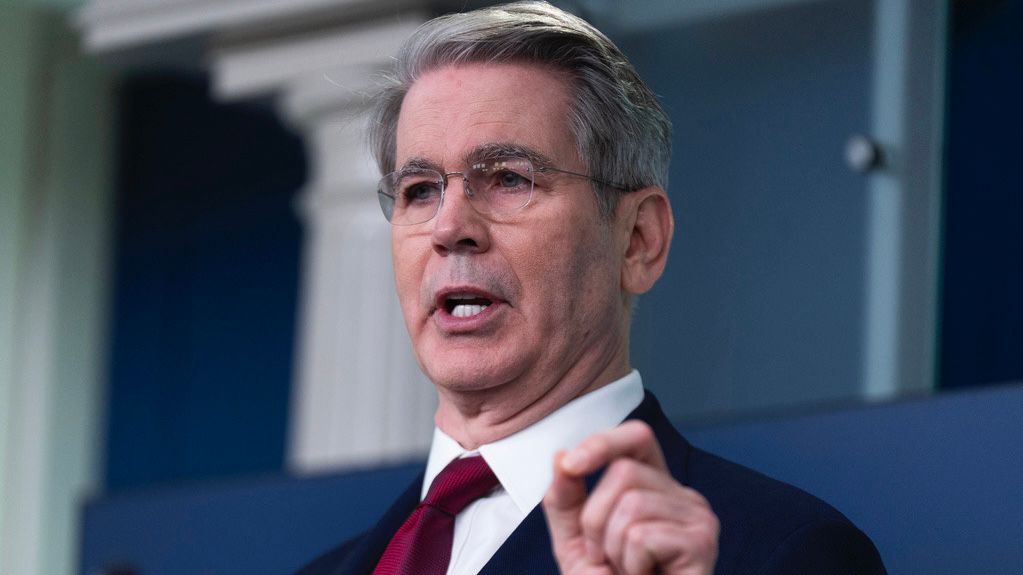
MALIBU, Calif. — As the global economy reacts to an ever-changing landscape of tariffs imposed by President Donald Trump, Treasury Secretary Scott Bessent said Monday they are part of a three-pronged strategy to make the United States more appealing to investors.
Speaking at the annual Milken Institute Global Conference in Malibu, California, Bessent said getting better terms of trade is not always a straight line or a pleasant process but that Trump’s tariffs are laying the foundation to level the playing field with U.S. trade partners so companies that invest in the United States can take advantage of upcoming tax cuts and fewer regulations.
The treasury secretary said Trump’s first 100 days prepared "the soil” for a "golden-age economy."
“We have uprooted government waste,” he said, referencing efforts by the U.S. DOGE Service to radically reduce the federal workforce while eliminating what administration officials view as financial waste, fraud and abuse.
“We have planted the seeds of private investment,” he said, referring to the many billions of dollars in U.S. investment announcements since Trump took office in January.
“And we have fertilized the ground with fresh tax legislation,” he said, referencing the congressional budget bill currently being negotiated to not only extend the tax cuts Trump enacted in his first term but expand them.
“Next, we harvest, and we want you to harvest with us,” Bessent said at the conference attended by major financial and tech company executives, where this year’s theme was “toward a flourishing future.”
Bessent said the president’s tax plan includes making the small-business deduction permanent. Set to expire at the end of 2025, the deduction allows small-business owners to deduct up to 20% of their net business income. The plan also calls for enabling businesses to receive tax credits and deductions for research and innovation to stimulate investment in high-tech industries, such as artificial intelligence and quantum computing, and to expense 100% of their equipment, including new factory construction.
In addition to trade and tax cuts, Bessent said deregulation is the last interlocking part of the Trump economic plan to drive long-term U.S. investment.
Shortly after taking office, Trump made good on a campaign promise by signing an executive order to eliminate 10 regulations for each new regulation that is issued. On Monday, Bessent praised the president for signing subsequent executive orders that have sped up the federal approval process for new energy and construction projects — moves he said will drive down business costs.
Calling energy “the base layer of all economic activity,” Bessent said Trump’s actions to develop more oil, gas and coal production in the U.S. will lower business costs.
“Trade, tax cuts and deregulation may be three distinct policies, but each policy is mutually reinforcing," Bessent said. “The president’s economic plan will be more jobs, more homes, more growth, more factories, more critical manufacturing plants, more semiconductors, more energy, more opportunity, more defense, more economic security, more innovation. In short, more of the all the things we need the most.”