




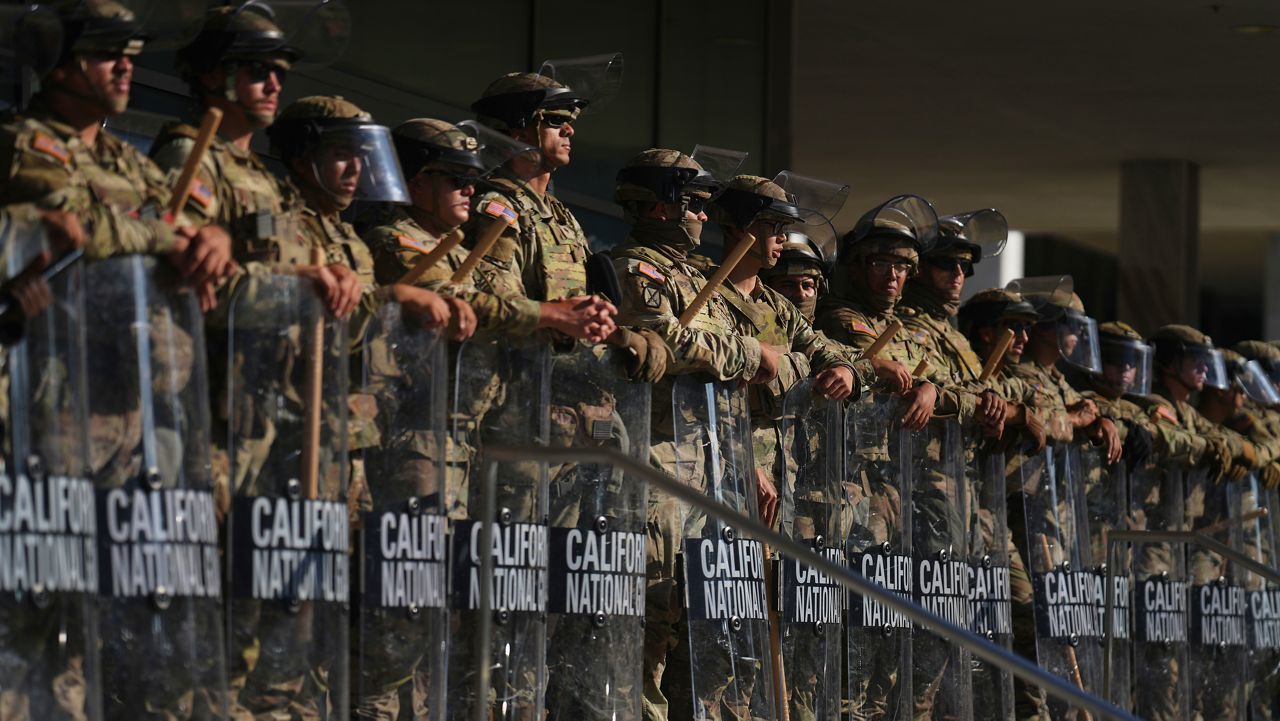
Amid Immigration and Custom Enforcement’s hiring blitz aimed at bringing in an estimated 10,000 new agents, federal officials are also looking to GOP-led states to pitch in National Guard personnel to assist with President Donald Trump’s mass deportation agenda.
Republican governors from some 20 states have been authorized to send their guardspeople to do “case management, transportation and logistical support, and clerical support” through Nov. 15, allowing ICE officers to focus on field work.
A defense official said the planned activation included up to 1,700 National Guard members in total, and their duties may involve collecting DNA, photographs and fingerprints of detainees in ICE facilities. The authorization given by Defense Secretary Pete Hegseth is through Nov. 15 but could be extended, the official said.
Several states have already signed on and pledged their soldiers’ help in recent days. Meanwhile, one state with a Republican governor –– Vermont –– declined to take part in the plan.
Most recently, Iowa Gov. Kim Reynolds on Tuesday directed members of her state’s National Guard to begin helping ICE next month. Twenty Iowa National Guard soldiers are set to assist ICE with administrative and logistical support starting Sept. 8, the governor said.
Iowa’s decision is the latest in a series of announcements, including one made by Idaho Gov. Brad Little on Friday. The Idaho governor said up to 14 Idaho National Guard members would begin performing “administrative and clerical support functions, enabling ICE to dedicate more agents to law enforcement activities” within 30 days.
South Dakota Gov. Larry Rhoden said in a Facebook post he was deploying six South Dakota National Guard soldiers to support ICE –– three in Sioux Falls and three in Rapid City –– as part of an initiative he called “Operation: Prairie Thunder.”
A. A. “Cotton” Puryear, the public affairs chief for the Virginia National Guard, said it is finalizing its plans to mobilize approximately “60 Soldiers and Airmen with a mission to provide administrative and logistics support.” The personnel are scheduled to conduct training at the end of August and are expected to be “on duty” by early September, Puryear said.
Tennessee Gov. Bill Lee was mobilizing guardspeople in his state, the Tennessee Lookout reported, and Nevada Gov. Joe Lombardo was authorizing his state’s National Guard members to “temporarily” assist ICE, according to the Nevada Independent. Louisiana plans to provide 70 service members to the efforts, the Christian Science Monitor reported.
And 25 of an estimated 200 Florida National Guard members being activated to help ICE have already been mobilized, Air Force Capt. Brittianie Funderburk, a spokesperson for the Guard said. The guardspeople will work out of nine ICE facilities across the state, with their tasks likely including “administrative/clerical tasks, fingerprinting, DNA swabbing, photography and transportation support,” Funderbunk said.
Vermont Gov. Phil Scott, a Republican, opted not to mobilize the 12 National Guard members requested by federal officials to assist ICE with administrative tasks, Vermont Public reported, with his chief of staff telling the outlet that the ask for help with immigration enforcement was “obviously more sensitive because of the politics.”
South Carolina National Guard confirmed that 40 of its members had been requested to assist ICE, and those guardspeople may be placed under Title 32 duty status by the end of the month.
With this designation, service members remain under the command and control of their respective governor, but the federal government provides pay and benefits.
Activation of troops in each state hinges on the respective governors’ approval, and when under Title 32 duty, National Guard members are exempt from the Posse Comitatus Act, which restricts federal soldiers from taking part in civilian law enforcement except when authorized by law.
In a statement issued last month, Sean Parnell, the Pentagon’s chief spokesperson, noted the distinction and said that any of the total 1,700 service members who had been previously activated under Title 10 duty status –– for which soldiers are federally controlled and federally funded –– would be transitioned to Title 32.
“Through active planning and collaboration with our ICE partners, the Department determined that specific operational needs may require direct interaction with individuals in ICE custody,” Parnell said.
In states where GOP governors have signaled support of the plan, some Democratic lawmakers and immigration advocates have criticized mobilizing state troops to help with immigration enforcement.
“The Nevada National Guard’s mission is to protect us, not sow more fear in our communities by doing Trump’s dirty work,” Democratic Rep. Dina Titus wrote on X.
And in Virginia, Eduardo Zelaya, organizing director for advocacy group CASA Virginia, called the mobilization of state troops who will report directly to ICE leadership "a dangerous misuse of state resources and a direct attack on immigrant communities."
The other states that have been authorized by Hegseth to participate –– Alabama, Arkansas, Georgia, Indiana, Missouri, Nebraska, Ohio, Texas, Utah and Wyoming –– have not officially announced if they would supply their National Guard members. Spokespeople for the Texas and Utah National Guards each referred inquiries to the Department of Defense, and the Missouri National Guard public affairs office said that Gov. Mike Kehoe and the adjutant general of the Missouri National Guard are assessing the request.
Col. Will Cox, director of public affairs for the Georgia Department of Defense said his state was in "the early stages of staffing the request" and that no timeline nor number of National Guard members who may be involved was currently available.
This story has been updated to include responses from the Missouri National Guard and the Georgia Department of Defense.