




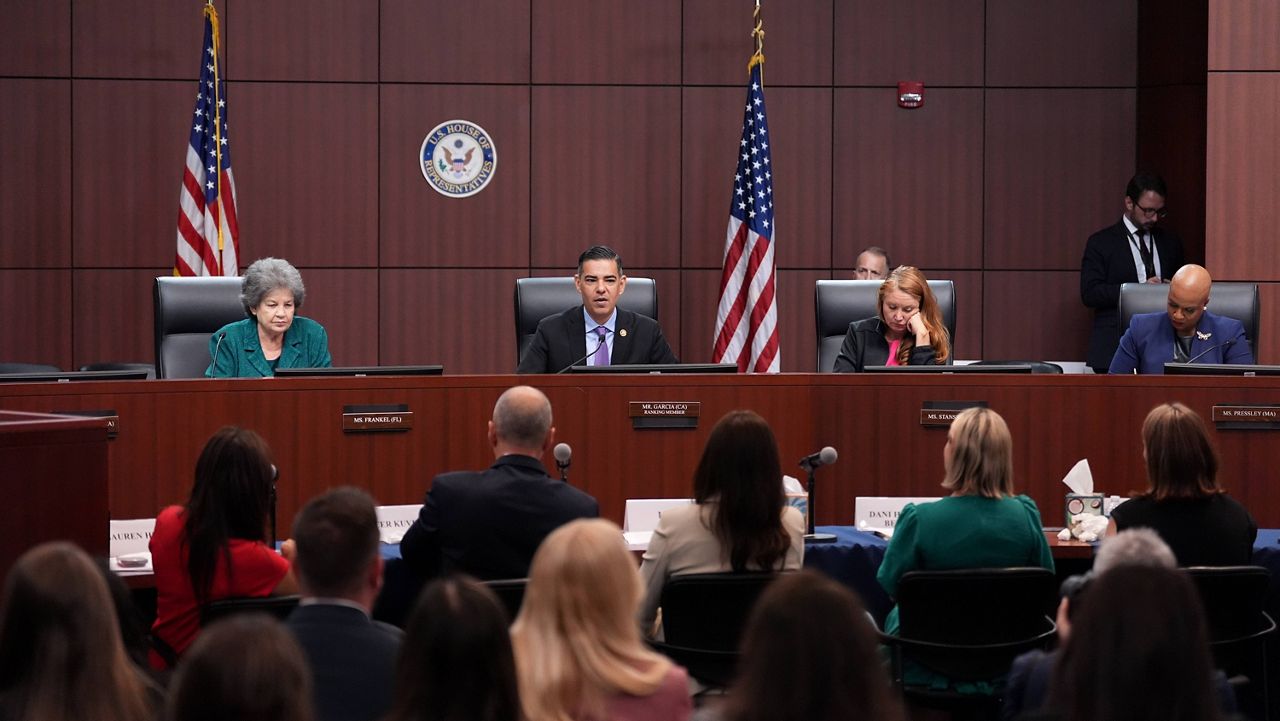
Women who say they were abused by the late convicted sex offender Jeffrey Epstein provided their personal and sometimes emotional testimony Tuesday during an unofficial congressional hearing held by Democrats on the House Oversight Committee in Palm Beach, Florida.
Palm Beach County is where many of the allegations against the disgraced financier first came to light, including that of Maria Farmer, who is believed to have been the first person to report Epstein to authorities in 1996.
“For three decades, I carried a weight that no survivor should ever have to bear,” she said in a video played Tuesday. “I reported what I believed were heinous crimes against children, and these individuals responsible were involved in an international pedophile ring. I reported their crimes in real time, and the government continues to ignore me to this day.”
An FBI complaint form describing the information that Farmer shared with agents was among the massive trove of records the Justice Department recently released under the Epstein Files Transparency Act.
Farmer and other accusers also raised the 2007 agreement that prosecutors reached with Epstein allowing him to plead guilty to state charges of soliciting a minor for prostitution and avoid federal charges. The deal also shielded others, including unnamed “potential co-conspirators,” from future federal prosecution.
“Why did Jeffrey Epstein get the deal that he got, and why would the survivors get so mistreated in the grand jury room?” Rep. Lois Frankel, D-Fla., asked at one point Thursday. The field hearing, which was led by ranking member Rep. Robert Garcia, D-Calif., was held in Frankel’s district.
Garcia told attendees that lawmakers were "launching a new phase of the Epstein investigation,” which included the release of a new report that contended that Epstein's plea deal allowed him to “continue and expand his trafficking operation.”
Authorities believe Epstein, who died by suicide in a New York City jail cell while awaiting trial on sex-trafficking charges, ultimately victimized more than 1,000 young women and girls over several decades.
“He abused so many girls after 2009 at the same exact time that I was asking the government why he got the deal and why they violated my rights,” said Courtney Wild during Thursday’s field hearing. “That is the real injustice here.”
Wild, who was 14 years old when she says she was first recruited by a friend to go to Epstein's Palm Beach mansion, later sued over the agreement, saying that federal prosecutors failed to notify alleged victims in violation of the Crime Victims Rights Act.
In 2020, a federal appeals court affirmed a lower court's ruling that threw out her lawsuit but expressed sympathy for Wild and others “who suffered unspeakable horror at Epstein’s hands, only to be left in the dark—and, so it seems, affirmatively misled—by government lawyers” in the 2-1 opinion. The Supreme Court later declined to hear the case.
“There was no remedy. I just want to say it again: The court found that the court violated the law and nothing happened," Wild said Thursday. “That means that the law does not matter.”
Accusers also took issue during Thursday’s proceeding with the Justice Department’s release of some 3 million records, saying that identifying information of accusers was not properly redacted in many files.
A request for comment made by Spectrum News to the Justice Department about the criticism was not immediately returned.
Danielle Bensky, who says she was sexually abused by Epstein when she was a 17-year-old aspiring ballet dancer, described searching her own name in the Justice Department’s disclosure website as “like a bullet to the chest” when she saw the records retrieved.
“I am public," she told lawmakers. "That's a choice that I made, but never in my life did I expect for anybody to read intimate details of the abuse. To me, it's always been about protecting others. And unfortunately, I have friends in this story, and to see somebody's name out there who has worked so hard to move past this in life … sends a shockwave through your body.”
Jena-Lisa Jones, who says she was first abused by Epstein at the age of 14, spoke about the ripple effects of the disclosures.
“We have put ourselves on the front line and spoke out and put our face to the public when we should have never had to, and that comes with a huge toll,” Jones said. “Now every job that we apply for, they Google us. They know our most personal information of things that happened to us as children That is forever, forever going to follow us.”
Another woman, identified only by her first name, Roza, told attendees at Thursday’s field hearing about being recruited in Uzbekistan, being brought to the U.S. with promises of a career, meeting Epstein in 2009 and subsequent being abuse over several years.
“You need to figure it out, and I hope you do,” she told lawmakers. “I hope this never happens again to anybody. Keep it in the history books. Don't stop fighting. Don't let it go away.”
Other speakers Thursday included Lauren Hersh, national director of World Without Exploitation and a former sex-trafficking prosecutor; relatives of the late Epstein accuser Virginia Roberts Giuffre; and Spencer Kuvin, a Florida-based attorney who represented some of the first young women and girls who reported being victimized by Epstein.
Thursday’s field hearing comes just over two weeks ahead of former Attorney General Pam Bondi’s transcribed interview with the House Oversight Committee, scheduled for May 29.