




Voters in six states will head to the polls Tuesday in primaries that will shape some of most closely watched races this year.
In Georgia, crowded and competitive contests for governor and U.S. Senate will help set the stage for key showdowns in November with implications for control of the narrowly divided Senate and the future political direction of a key swing state.
Across Alabama, Kentucky, Pennsylvania, Oregon and Idaho, meanwhile, primaries will test President Donald Trump’s influence, preview the fight for the U.S. House majority and help define the midterm political landscape.
Voting concludes in the swing state of Georgia in competitive primaries for governor and a U.S. Senate seat that could decide control of the closely divided chamber.
The nomination contests will set the stage for two of November’s marquee races that could have long-lasting political implications far beyond the state’s borders.
Georgia voters will also pick nominees for U.S. House, the state Legislature and a long list of statewide offices. Also on the ballot are nonpartisan judicial races, including two competitive contests for state Supreme Court.
Eight Republicans are vying for the nomination to succeed term-limited GOP Gov. Brian Kemp, including state Attorney General Chris Carr, healthcare executive Rick Jackson, Lt. Gov. Burt Jones and Georgia Secretary of State Brad Raffensperger.
Jones has Trump’s endorsement, but Jackson is testing the value of the president’s backing by pouring more than $83 million into the race from his personal fortune.
The Democratic field includes former Atlanta Mayor Keisha Lance Bottoms, former Republican Lt. Gov. Geoff Duncan, former state Sen. Jason Esteves, state Rep. Derrick Jackson, and former state labor commissioner and former DeKalb County CEO Mike Thurmond.
If no candidate receives a majority of the primary vote, the top two vote-getters will advance to a June 16 runoff.
Whoever succeeds Kemp will be in office in 2028 and could emerge as a key figure in the next presidential election if Georgia remains as competitive as it was in 2020 and 2024. Trump blamed Kemp for refusing to help overturn his 2020 loss in Georgia to Democrat Joe Biden, but the two reached a détente in 2024 ahead of Trump’s reelection victory.
In the U.S. Senate race, five Republicans are running to take on first-term Democratic U.S. Sen. Jon Ossoff, who is unopposed for renomination. The field includes U.S. Reps. Buddy Carter and Mike Collins, as well as former University of Tennessee football coach Derek Dooley, who has Kemp's endorsement.
Carter has outraised and outspent the rest of the GOP field, but he, Collins and Dooley began the month on roughly equal financial footing with campaign war chests of about $1.7 million each.
An Ossoff reelection victory in November is critical to Democratic hopes of retaking the chamber.
Only three of Alabama’s seven congressional districts will hold binding primaries in the wake of a U.S. Supreme Court decision that prompted Republicans in a handful of southern states to throw out their congressional maps.
Elections in the four remaining Alabama districts were postponed to an Aug. 11 special primary while state officials restore a previous set of Republican-drawn district boundaries that eliminates one of the state’s two majority-Black U.S. House seats currently held by Democrats.
The Court-inspired actions in Alabama, Louisiana and Tennessee, as well as earlier legislative actions in other states to redraw their boundaries through mid-decade redistricting, are part of a nationwide Republican effort championed by Trump to maximize the party’s chances of keeping its U.S. House majority in the 2026 midterm elections.
Only the primaries in the 1st, 2nd, 6th and 7th Congressional Districts were moved to August. Alabama voters will choose nominees Tuesday as planned for the 3rd, 4th and 5th Congressional Districts, as well as for U.S. Senate and a full slate of state and local offices.
In the race for governor, U.S. Sen. Tommy Tuberville and two others seek the GOP nomination to replace term-limited Republican incumbent Gov. Kay Ivey. Among the candidates for the Democratic nomination is former U.S. Sen. Doug Jones.
U.S. Rep. Barry Moore is running for the GOP nomination to replace Tuberville in the U.S. Senate. He faces six other candidates, while four candidates compete for the Democratic nomination.
Moore represents the 1st Congressional District, which will hold its primaries in August. Former GOP U.S. Rep. Jerry Carl is among the contenders for that seat.
Trump has endorsed Tuberville for governor, Moore for U.S. Senate and Carl for the 1st Congressional District.
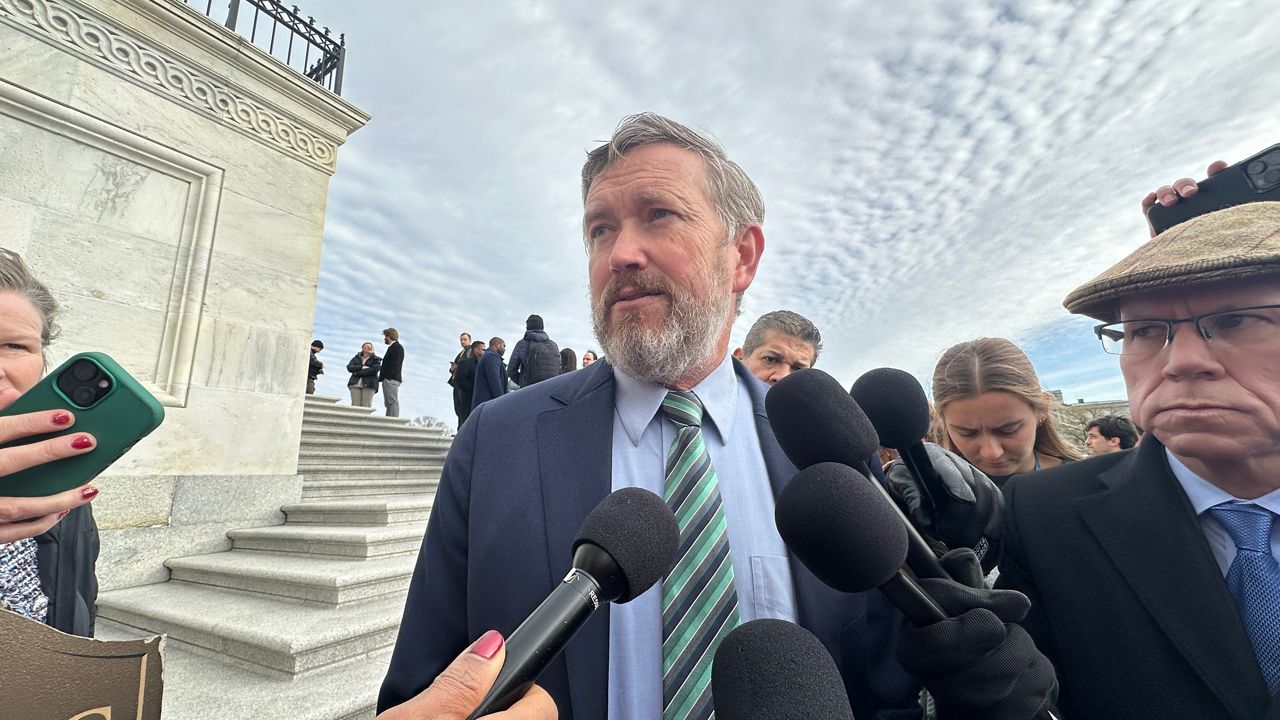
U.S. Rep. Thomas Massie, one of Trump’s most vocal critics within the Republican Party, faces a tough primary challenge in Kentucky’s state primary. It’s the latest example this primary season of the president trying to purge the party of Republicans he perceives as disloyal.
Kentucky voters will also pick nominees for U.S. Senate, five other U.S. House seats and the state General Assembly. Voters in Louisville will winnow down a crowded field for mayor.
The commonwealth’s marquee race is in the 4th Congressional District, where Massie seeks the GOP nomination for an eighth full term. His opponent is Ed Gallrein, a farmer and former Navy SEAL who entered the race at Trump’s urging.
Massie is the rare Republican in Washington who has clashed with Trump on his key domestic and foreign policy initiatives, opposing both his signature tax package and the war with Iran. He has also been a leader in Congress of the effort to release the files of convicted sex offender Jeffrey Epstein.
Massie has a fundraising advantage, but Gallrein has remained competitive. The incumbent more than doubled his opponent’s spending over the course of the campaign, but the two began the month on comparable footing in terms of funds in the bank.
The 4th Congressional District in northern Kentucky stretches along the Ohio River and shares a border with Indiana and Ohio. Trump received about 67% of the district vote in the 2024 general election. Massie ran unopposed in 2024 and received 65% of the vote in his 2022 reelection bid.
In the U.S. Senate primaries, nearly 20 candidates are competing to succeed longtime GOP Senate Majority Leader Mitch McConnell, who is retiring after seven terms. Among the 11 candidates for the Republican nomination are U.S. Rep. Andy Barr, who has Trump’s endorsement, and former state Attorney General Daniel Cameron, a former McConnell aide who has criticized his ex-boss on the campaign trail.
Seven candidates seek the Democratic nomination, including former state Rep. Charles Booker, military veteran and 2020 U.S. Senate nominee Amy McGrath and state House Minority Leader Pamela Stevenson.
Democratic voters in Pennsylvania primary will pick their nominees to flip four seats seen as critical for the party to retake the U.S. House in November.
Republicans hold a slim House majority, and just a handful of seats could determine whether they continue to control the chamber next year. Democrats see four competitive Republican-held districts in Pennsylvania as among their top pick-up opportunities.
U.S. Reps. Brian Fitzpatrick in the 1st Congressional District, Ryan Mackenzie in the 7th Congressional District, Rob Bresnahan in the 8th Congressional District and Scott Perry in the 10th Congressional District are all unopposed in their Republican primaries.
Voters across the commonwealth will also decide primaries for lieutenant governor and for both chambers of the General Assembly.
Half of Pennsylvania’s 50 state Senate seats and all 203 state House seats are up for election in November. Democrats hold a slim majority in the state House, while Republicans have an edge in the state Senate.
Democratic Gov. Josh Shapiro will also appear on the ballot but has no primary opponents in his bid for a second term. He has spent his time on the campaign trail boosting his preferred candidates for Congress.
Oregon’s Democratic Gov. Tina Kotek and the nearly two dozen challengers hoping to defeat her are among the candidates who will seek their parties’ nominations for state and federal offices Tuesday. Voters will also decide a statewide ballot measure that would raise gas taxes to pay for improvements to the state’s roads and bridges.
National politics cast a long shadow over the primary, as is often the case in a midterm election year, when voters historically have punished the incumbent president’s party at the ballot box. Kotek has made Trump a top foil in her campaign, while the vote on Measure 120 to raise vehicle fees and gas taxes for transportation infrastructure projects takes place against the backdrop of gas prices that have steadily climbed since the start of the Iran war.
Kotek faces nine Democratic primary challengers in her bid for a second term. The Republican primary field features 14 candidates, including Marion County Commissioner Danielle Bethell, state Rep. Ed Diehl, state Sen. Christine Drazan and financial planner and former NBA player Chris Dudley. Dudley last ran for governor in 2010, when he received about 48% of the vote in the general election.
Incumbents are also running for reelection for U.S. Senate and all six U.S. House seats, with only one member of Congress facing no opposition for renomination.
Idaho voters will nominate candidates for federal, state and local offices.
Republican U.S. Sen. Jim Risch faces three primary challengers in his bid for a fourth term. The incumbent eclipsed challengers Joe Evans, Denny LaVe and Josh Roy in fundraising heading into the final weeks of the primary campaign.
The candidates for the Democratic nomination are David Roth, Nickolas “007” Bonds and Brad Moore. Only Roth has reported raising any money for his campaign, about $7,500, but his campaign was out of funds as of March 31, according to federal campaign finance records. Roth was the Democratic nominee in the 2nd Congressional District in 2024 and for U.S. Senate in 2022.
Republican Gov. Brad Little faces a much larger primary field in his run for a third term, but he also enjoys a huge financial advantage over his seven competitors. By mid-May, Little’s campaign had raised about $1.9 million and had about $1.2 million in the bank. His nearest competitor was bar owner and former police officer Mark Fitzpatrick, who raised about $185,000 and had about $35,000 in the bank. The rest of the field trailed far behind.
Attorney Terri Pickens leads the Democratic field for governor in fundraising. She was unopposed for the party nomination when she ran for lieutenant governor in 2022 and faces three other candidates in 2026.
Primaries for lieutenant governor, secretary of state, state controller, state treasurer, state attorney general and state schools superintendent are also on the ballot, but the Democratic and Republican candidates for those offices are running unopposed.