




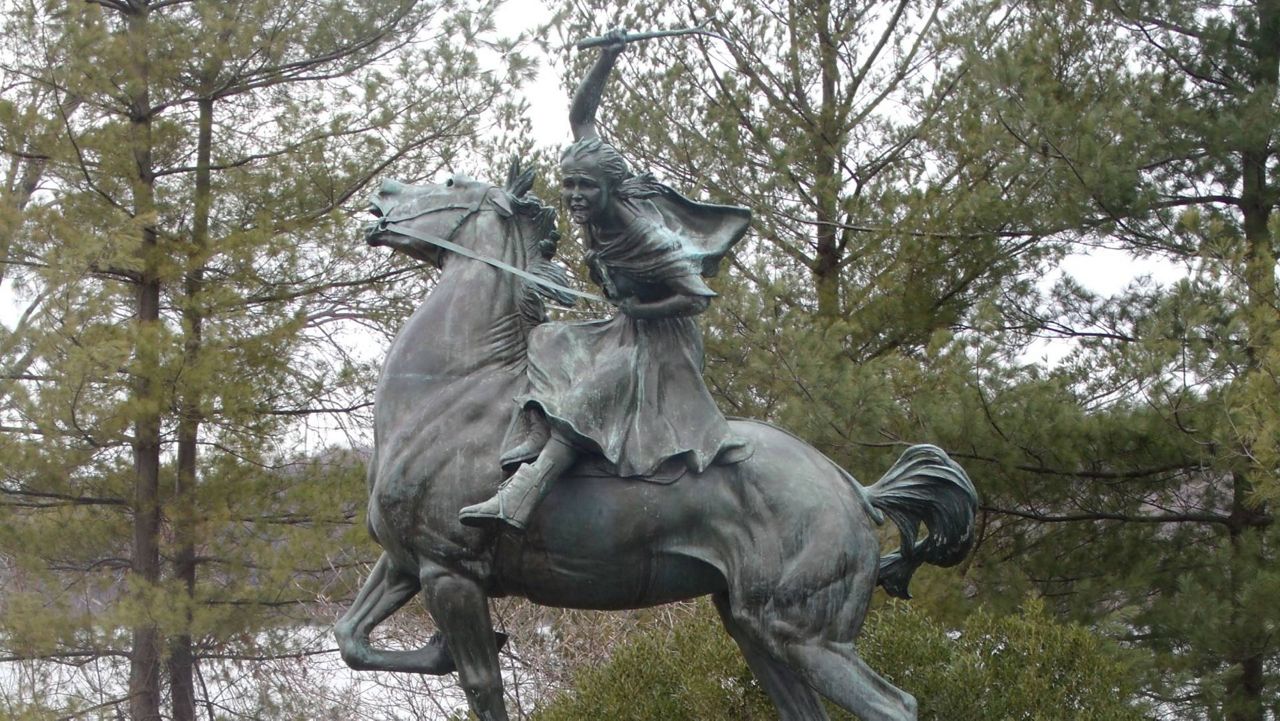
The story goes something like this: On the night of April 26, 1777, a messenger arrived at the Putnam County, New York, home of Col. Henry Ludington, a militia leader aligned with the patriot cause, to warn that the British were raiding and burning an American military depot in nearby Danbury, Connecticut. Ludington’s 16-year-old daughter, Sybil, then mounted a horse and made a 40-mile trek through rain and darkness to rally 400 soldiers from her father’s regiment, who fought in the Battle of Ridgefield soon after.
Or did she?
Nearly 250 years later, the story of the ride taken by Sybil Ludington, who has become known as the “female Paul Revere,” remains a topic of debate.
Many historians have cast doubt upon the tale, citing a lack of proof from that time, including official militia records or diary entries. They note that word of her journey didn’t come to light publicly until more than a century later — in 1880, when historian Martha Lamb wrote about it in “History of the Origins of New York City.” Those historians also pointed out that Lamb did not name her source for the information.
The next notable telling of Sybil Ludington’s ride was in 1907, when author and historian Willis Fletcher Johnson wrote about the alleged heroine in a biography about her father. But the book was commissioned by Henry Ludington’s descendants and therefore did not sway skeptical historians.
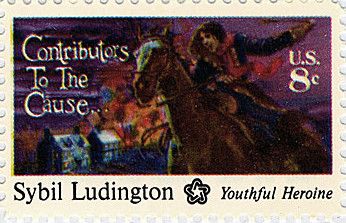
Nevertheless, Sybil Ludington’s story gained momentum over the course of the 20th century. In the 1930s, a chapter of the Daughters of the American Revolution placed markers along the route she supposedly had traveled. In 1940, she was the subject of a Berton Braley poem published in This Week magazine, a nationally syndicated Sunday newspaper supplement. Before long, there were statues, a postage stamp and children’s books celebrating Sybil Ludington.
“There are inconsistencies in the accounts until we get to the early 20th century, when suddenly everything is cemented and the story, as it has been passed down now, becomes solidified,” said J.L. Bell, an author on the Revolutionary War in New England who runs the blog Boston 1775.
Such stories, Bell said, are usually verified by looking “back as far as you can into documentation, and yes, contemporaneous documentation is the best thing. And often that is created at the time for the purpose of the time, and not for presenting somebody or a family in good light.”
Vincent Dacquino, who has written four books about Sybil Ludington, including 2019’s “Patriot Hero of the Hudson Valley,” is arguably her biggest present-day defender.
Through his research, Dacquino uncovered that the earliest evidence of her ride actually came in 1854, when Charles Ludington — Henry’s grandson and Sybil’s nephew — argued in a letter to a group of Masons planning a statue for Gen. David Wooster, who was killed in the Battle of Ridgefield, that Henry and Sybil Ludington should also be included in their tribute.
Dacquino also found an 1894 letter in the New York State Historical Library in which Charles Ludington’s sister, Laura, recounted hearing the story about Sybil Ludington’s ride from her grandmother — Sybil’s mother — at a family reunion when she was 10 years old.
“Sybil’s information came to us through the family,” said Dacquino, who also discovered that Charles Ludington was Lamb’s source. “We're talking 1777. There were no cameras in the driveways. There were no phones. There were no reporters looking for stories everywhere. It was a totally different time.”
And Dacquino argues there’s good reason there is no documentation from the time of Sybil Ludington boasting about her heroics.
“Her father had enemies all over the territory,” he said. “There were Tories, loyalists, British people who wanted to kill him. He had a bounty on his head. His daughter that night rode 40 miles, as we know, to gather his men, his troops. If his enemies knew this, they would have killed her, or it certainly would have put her in danger.”
Bell has a theory, which he calls “grandmother’s tales,” for how stories like Sybil Ludington’s, or even Betsy Ross’, come to be. Much like with Sybil Ludington, the account that Ross sewed the first American flag lacks evidence, did not surface until nearly a century later and was pushed by her relatives.
“Women, sometimes men, involved in raising children would tell stories of the family's involvement in historical events, presenting those stories simply as educational, as inspirational, as entertaining, not expecting them to be put into the public realm,” Bell said. “ … But the children who are hearing those stories grow up — and because these are the earliest stories they've heard, because they have to do with their family, because they hear them maybe many times — they really stick with them. And so as they become older, they want these stories, which they believe to be gospel truth, out for everyone to hear.”
In a 2015 essay in The New England Quarterly, Paula Hunt, then a doctoral candidate, wrote that the tale of Sybil Ludington seemed to shift over the years to reflect public sentiment of the times. For example, Lamb’s and Johnson’s tellings were published as the Colonial Revival movement “was reminding America of its Revolutionary past and Americans were endeavoring to find their links to it,” Hunt wrote.
While Bell concedes it’s possible that Sybil Ludington’s ride could have occurred, he says there are exaggerations surrounding the story that help fuel the skepticism, including about the impact her ride had. While some accounts argue Henry Ludington’s militia played a role in repelling the British from Ridgefield, the troops arrived too late to stop the raid on Danbury and the Battle of Ridgefield was a clear defeat for the Americans, Bell notes.
Dacquino, meanwhile, insists Sybil Ludington’s place in history is warranted, saying she “stands for American freedom.”
“Sybil Ludington should be celebrated because on that night she got on a horse and she risked her life for her family and her country, and she represents all of those hidden, unknown heroes who have died for this country without ever being recognized,” he said. “Here we have an opportunity to recognize one of those heroes.”