




WASHINGTON — Long before Kenneth Cohen became the chair of military history at the Smithsonian National Museum of American History, he was an eighth grader transfixed by the gunboat Philadelphia.
“I spent too much time in the gallery, and my school group went off to dinner without me,” he said with a laugh. “They had to send a bus back to get me, because I had been looking at the gunboat.”
Cohen’s obsession is easy to understand. The 54-foot long, 29-ton gunboat is the oldest surviving American fighting vessel — after playing a brief but crucial part in the Revolutionary War.
Built on the banks of Lake Champlain during the summer of 1776 as the colonies were declaring their freedom from England, the flat-bottom boat set sail in the battle of Valcour Island in October 1776 as part of a small American fleet trying to fend off the formidable Royal Navy.
“What these ships are up against are sort of British imperial warships on a scale far beyond what these vessels are,” said Cohen. “The goal isn't to sink that fleet or to win the battle, but to delay, and in that they're successful.”
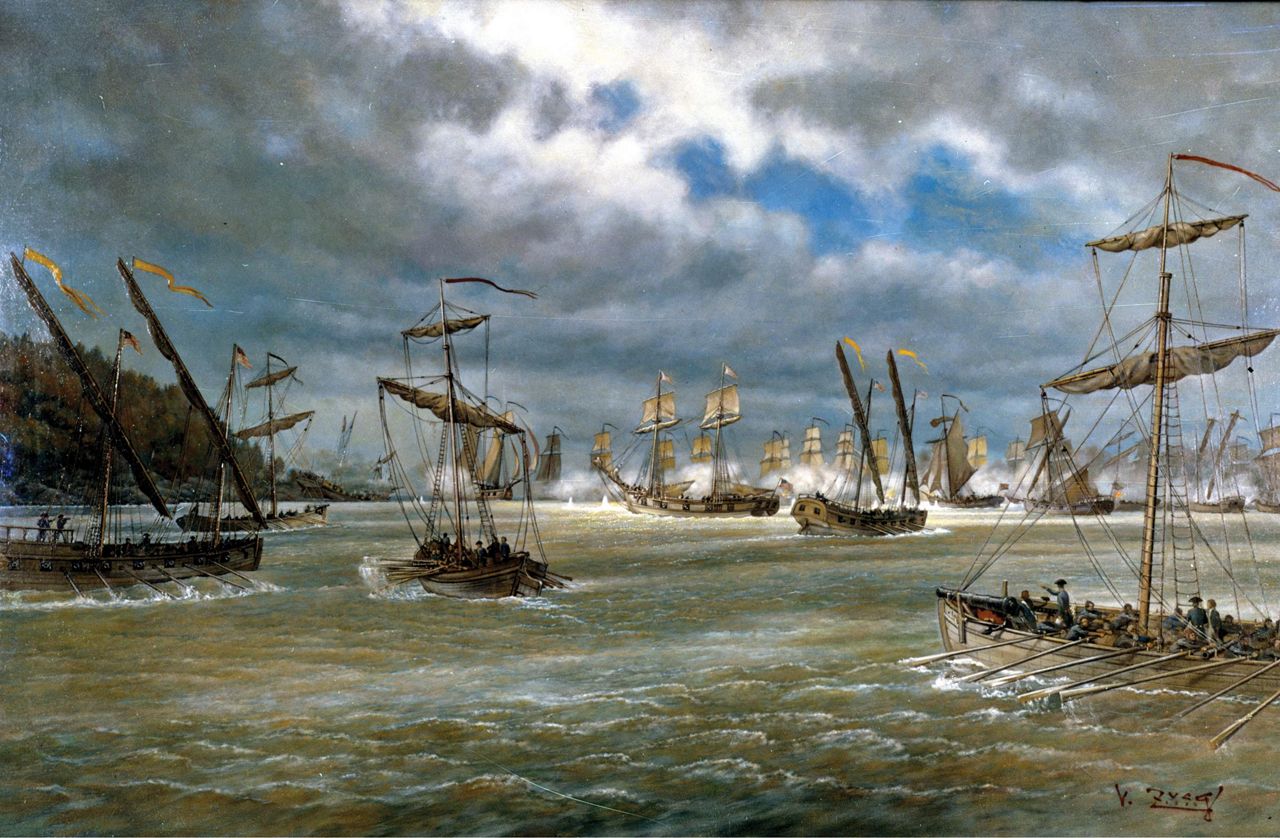
America’s fleet on Lake Champlain, under the command of Benedict Arnold, is credited in helping to prevent the British from cutting off all of New England from the rest of the colonies, which could have been devastating to the American cause.
The Philadelphia, though, did not get to see the success of its mission. Just six hours into battle, it was struck by a 24 pound British cannon ball and sank to the bottom of Lake Champlain. Despite its short lifespan, the Philadelphia — according to Jennifer Jones — played a huge role in the founding of our country.
“It's a role that most people don't think about, because the Northern Theater isn't where George Washington was,” said Jones. “We know Benedict Arnold today as having been a traitor, but what we don't think about is how Arnold was a brilliant commander when it came to 1775, 1776, and 1777. When the Americans were able to regroup and meet the British back in battle in 1777 at Saratoga and win a battle there, and that in fact brought in the French alliance — without the French alliance and America working with its allies — we probably would have not been as well off and been able to fight the British as long as we could.”

The Philadelphia spent over 150 years in the cold waters of Lake Champlain before being raised by underwater engineer and veteran Lorenzo Hagglund in 1935. He attempted to do some conservation work on the boat and took it on a traveling road show through the 1950s. When Hagglund died, the Smithsonian acquired the vessel, and eventually put it on display. Now, the Smithsonian is undertaking a new effort to preserve it.
“It was seen as the largest and one of the most important objects of the revolution that is fully intact and really tells a moment in time of 1776 and the American ingenuity and the audacity of our new nation,” said Jones, who is overseeing the preservation work.
The gunboat lays in a cradle on the museum’s third floor, while a team of four Texas A&M restoration experts meticulously pick debris from the ship’s timbers and remove lacquer from the ship’s cannons and anchor. Big glass windows give tourists a glimpse of the conservation work.
“It's the only way that it's going to make it through to other generations,” said Peter Fix, an associate research scientist with the Texas university. “Here in the museum we're working on trying to find the best environment for her, but we are very, very fine-tuned to that environment.”
Fix has been attached to the multi-decade preservation process since 2004, when the museum hired Texas A&M to do an assessment of the boat.
He now knows the ship like the back of his hand.
“Wherever you see an orange oval, those are the original fasteners and the original fastening positions of the boat,” he explained during a visit to the gunboat’s conservation room.
The gunboat is beginning to show its age as the wood continues to shrink as a result of its decades submerged in Lake Champlain.
“We actually now only have half 60% of the original thickness of those timbers,” said Fix, pointing out where some of the iron fasteners remain in the ship’s boards which give off the appearance of little ant hill mounds. “That is actually the original surface of and height of the thickness of the plank.”
While Fix’s team can’t reverse the damage done, the Smithsonian is learning how to better preserve it, such as reducing humidity labels in the air around it. Jones says the Smithsonian has worked with the Texas A&M team to create a protocol to help control that so further shrinking is minimized.
“Our charge from the Smithsonian is to make sure this boat gets to the next major anniversary, so another 250 years,” said Fix of the work his team has been doing. “Others will stand on our shoulders as we have stood on previous conservators' shoulders, and they're going to be about 11 generations of people charged to get it there. We're just the foundation.”
Cohen said the Philadelphia and the battle of Valcour Island are the perfect embodiment of the American dream on the 250th anniversary of the country. Throughout conservation of the boat, strong connections between the boat and either the Caribbean or even South Asia to create the oakum to seal the ship have been discovered. The guns that armed the Philadelphia were actually Swedish cannons, and the labor to build the Philadelphia and the rest of the fleet was likely provided not just by American colonists, but French Canadians, freed and enslaved Africans, and Indigenous people.
“This is a truly global story. The Americans are scouring the entire Atlantic rim, at least, in order to pull together what they need to arm and build this vessel,” reflects Cohen of the Philadelphia’s origin story — one that many Americans probably aren’t familiar with.
That’s what Cohen says he hopes visitors take away from the gunboat during their visit.
“There's still more to learn," he said. "The revolution, like most of history, is not something that's signed, sealed, and delivered already. There's more questions to ask."