




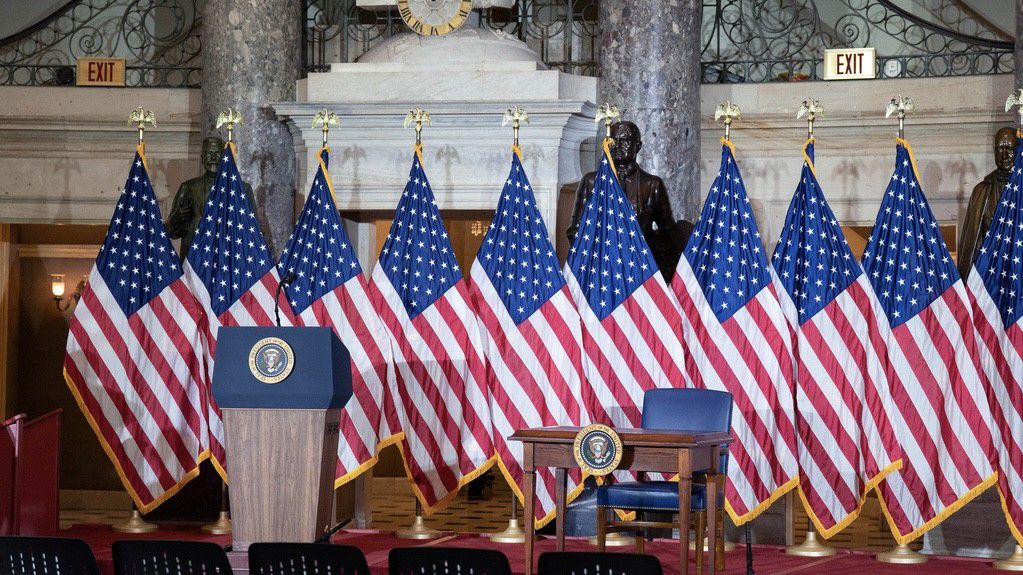
The fate of the bipartisan housing bill passed by Congress last month is uncertain as it approaches the end of a 10-day window that allows it to automatically become law if not vetoed or signed by President Donald Trump before then.
After abruptly canceling a signing ceremony for the bill in June and demanding that lawmakers prioritize the voter-ID legislation known as the SAVE America Act instead, the president has been vague about his plans.
“I’ll make a decision,” he told a reporter during a press gaggle Wednesday when asked if he will let it become law without his signature by the Friday night deadline. “Not that I dislike it. I dislike the fact that people aren’t voting for voter ID with a picture. How can you not vote for voter ID?”
Trump abruptly canceled a signing ceremony for the housing bill June 24, demanding that Congress pass the SAVE America that would require proof of citizenship to register to vote and an ID to cast a ballot. At the time, he described the SAVE America Act’s passage as “a national emergency.”
Last month, Trump said that "compared to the SAVE America Act, just about everything is a big yawn," a statement Democrats have seized upon in a midterm election year to suggest the president is not committed to improving affordability for Americans.
The voting legislation has passed three times in the House but has repeatedly failed in the Senate, where it needs 60 votes to pass in a chamber where Republicans control 53 seats.
In a pair of reposts on Truth Social on Wednesday, Trump seemed to endorse an end to the filibuster, which would allow for the SAVE America Act to pass with a simple majority vote. He has previously called for the filibuster to be eliminated.
“Through whatever means — nuking the Zombie Filibuster, enforcing the Talking Filibuster, a creative use of budget reconciliation, or otherwise — the Senate MUST pass the SAVE AMERICA Act,” one of the reposts said. “We’ve crossed the point of no return. Failure is not an option.”
The Senate is holding nonlegislative sessions Thursday but is otherwise on recess and will not return for full legislative sessions until Monday, according to the Senate Democratic schedule — days after the Friday deadline for Trump’s possible veto of the housing bill.
Trump’s prioritization of the voter-ID bill, which Democrats uniformly oppose, has left the status of the housing bill in limbo.
The housing bill does not require the president’s signature to become law because of a Constitutional provision that states a bill can automatically become law if a president neither signs nor vetoes a bill within 10 days while Congress is in session.
Congress could override a Trump veto if two-thirds of each the Senate and House approve. The Senate passed the bill 89-10, and the House voted for it 358-32.
The 21st Century ROAD to Housing Act would reduce federal regulations, streamline environmental reviews, speed up the construction process and curb the influence of corporate landlords by limiting their ability to purchase single-family homes. It represents one of the most sweeping efforts in decades to increase the supply of housing and bring down prices, as voter frustration runs high about the cost of living.
The legislation would expand financing, encourage the development of “innovative housing” like modular homes, require new renter protections and enhance programs that aim to end homelessness.
It would also offer funding to local governments that build more housing, including Community Development Block Grant money to places exceeding the median rate of homebuilding. It would provide new dollars for communities to turn abandoned infrastructure into housing, and it offers a framework for communities that want to reform outdated zoning regulations, which often limit larger housing developments.
Following the housing bill’s passage in the House last month, House Financial Services Chairman French Hill, an Arkansas Republican who worked on the bill, said it is the first time in years that Congress has come together to make “measurable, accountable changes” to the nation’s housing laws.
“Donald Trump could have signed the bill into law, but he just decided not to,” Sen. Elizabeth Warren, D-Mass.,” said in a video post on X on Wednesday.
“It is time for Donald Trump to sign the damn bill,” she said. “It’s been two weeks.”