




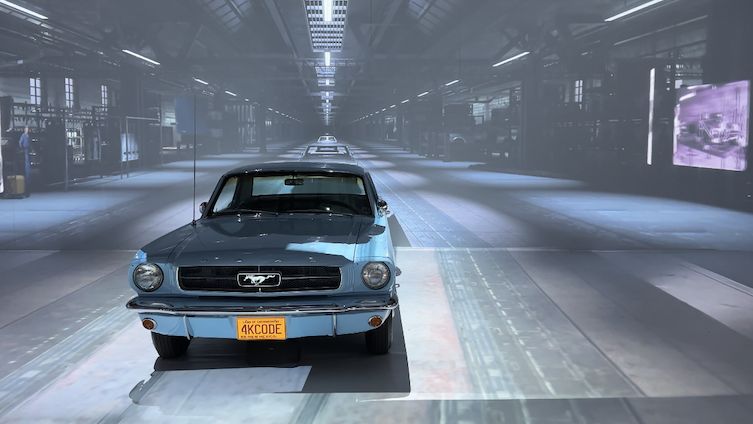
LOS ANGELES — Walk into Ford’s Mustang Immersive Experience in a forgotten corner of downtown Los Angeles and it’s an explosion of sight, sound — even aromas — all of it centered around the iconic sports coupe.
A baby blue version of the original 1964 pony car sits idle and unassuming in the middle of a giant warehouse before the walls and floor envelop visitors in 3D, surrounding them in a stereophonic, videographic storytelling experience. Enter another room, and the visitors are part of an immersive thrill ride, complete with jostling seats, whiffs of motor oil and the shriek of squealing tires.
Welcome to automotive marketing in 2025, where cars aren’t just functional hunks of metal. They are experiences waiting to happen.
“If you look at Mustang and its cultural impact, it’s more than a car,” Ford North America Product Communications Director Michael Levine told Spectrum News. “When it comes to something that’s more than a car, that’s actually part of culture, how do you experience it?”
As consumer time becomes more valuable and difficult to claim amid the swirl of social media influencers and traditional advertising, car companies are increasingly embracing experience to break through.
“Driving a car, that’s your environment," iSeeCars Executive Analyst Karl Brauer told Spectrum News. "It’s what you’re broadcasting to the outside world. It’s what you’re experiencing in the cabin. It’s what you might be experiencing for hours and hours.
“A car is such an experiential part of human existence that it makes sense you need a more aggressive, more encompassing experiential atmosphere to be convinced to buy it and really appreciate what it has to offer.”
At the Los Angeles Auto Show, which opened Friday and runs through Nov. 30, car companies are no longer content to just park a car on the carpet. Volvo brought its mobile museum — a bus outfitted with photos, videos and props that has been touring the company stopping at events such as the New York City Marathon.
Subaru set up its pet adoption clinic so visitors to the dog-friendly automaker’s booth could bring home a husky while they ponder putting out for a brand-new Forester or Crosstrek. And Hyundai, official mobility partner for the 2026 World Cup, brought games, including a soccer-themed contest that allowed people to kick an actual ball toward a giant screen, along with a bank of racing simulators to virtually flog its sports cars.
Last week, the Swedish automaker launched its $135,000 luxury electric performance sedan, the Polestar 5, in the video game "Gran Turismo 7" rather than in real life. The game lets players virtually experience the flagship vehicle with a 3.1-second 0- to 60-mph acceleration time in the hopes it may inspire a younger audience to give the real car a try once it's actually available.
The Polestar joins a growing list of performance vehicles that launch through the gaming world to let virtual drivers indulge their need for speed from the cozy confines of their bedrooms, hoping a small fraction might eventually buy in. Others to go that route include the Ferrari Testarossa and Ford Mustang GT.
“They’re looking for that younger audience," Josh Bulrice, spokesperson for the Los Angeles Auto Show, told Spectrum News. "Millennials and below, they come up from the video game era.
“What you’re seeing a lot of the manufacturers look at is: How do they get undivided attention?” Bulrice said. “At the LA Auto Show, it’s about getting a consumer behind the wheel to feel the vehicle.”
This year’s auto show has 50 different makes of car available for people to drive — the most in the show’s history — including many models that are available for the public to drive for the first time, such as the new Nissan Leaf EV and Polestar 4.
Beyond test drives, more manufacturers host track days and operate entire driving schools to let her rip behind the wheel. Porsche, BMW, Range Rover, Ford — they all have professional driving schools and frequently throw in a free day of driver training for new buyers.
“At Ford, it’s more than selling cars. Our customers use their vehicles for experiences, and we make passion products,” Levine said, citing the Bronco SUV, F-150 Raptor truck and Mustang, which start at $40,000, $79,000 and $32,000, respectively.
With the current average transaction price for a new vehicle now $50,080, according to Kelley Blue Book, Brauer said, “it’s that much more important that automakers get more targeted and effective in how they market it for people."