




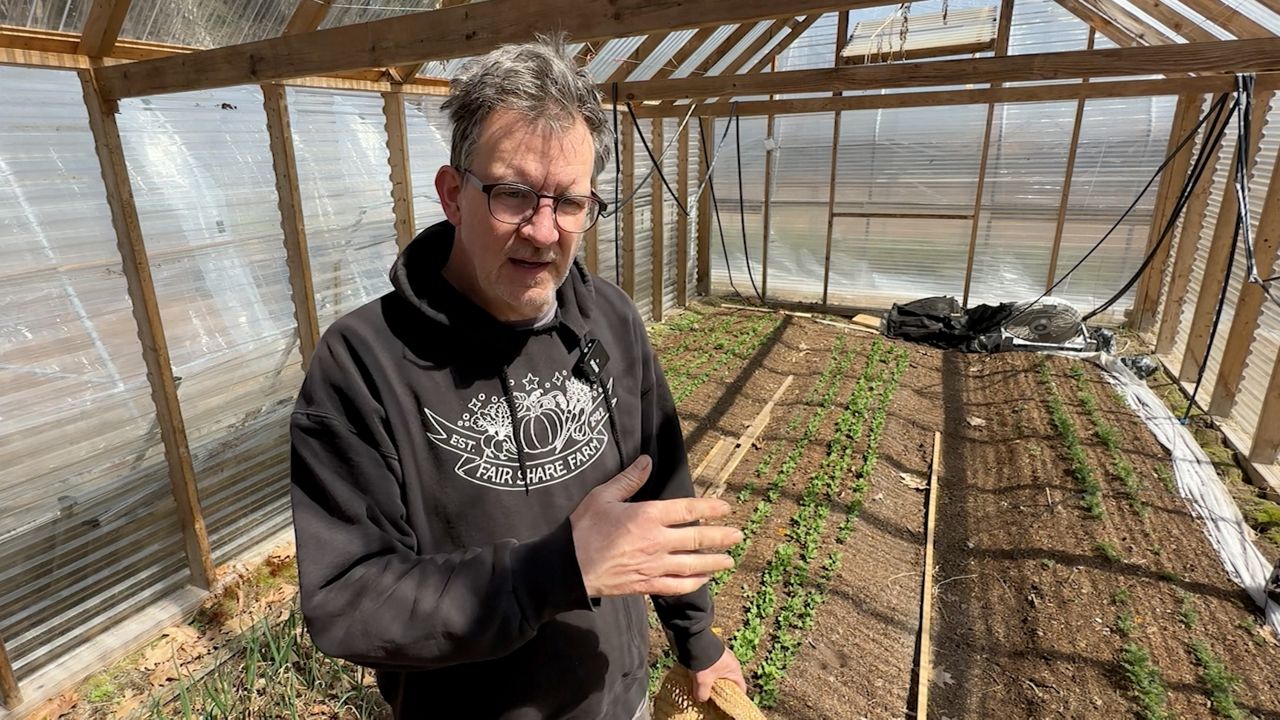
WAYNE – It’s springtime, and in the hills of Wayne, Todd Chretien is getting ready for early planting. His farm, Fair Share Farm, produces around 25 different crops, including potatoes, tomatoes and cucumbers.
“We do a pretty wide variety of organic vegetables here,” he said.
But recent cuts to federal funding by the Trump administration and Elon Musk’s Department of Government Efficiency are cutting small farmers like Chretien off from equipment upgrades and even customers.
Farmers took to Augusta this week to protest the canceling of key programs. The Maine Organic Farmers and Growers Association’s website shows at least seven programs that have been confirmed canceled by USDA and the Trump Administration, including Local Foods for Schools, an initiative that allows school districts to buy local fresh produce.
USDA Secretary Brooke Rollins, in an April 14 statement, described some of the programs as “overburdened by red tape,” and called encouraging organic farming in particular a “scam.”
“The Partnerships for Climate-Smart Commodities initiative was largely built to advance the green new scam at the benefit of NGOs, not American farmers,” Rollins said. “The concerns of farmers took a backseat during the Biden Administration.”
Chretien said the cuts are hurting farms like his, which struggle as small businesses even in a good year. Now, he said, they’ll have to find ways to compensate for the cuts.
“A lot of small farmers are in this position of, you’re right on the edge,” he said. “If you have a bad year or you have a president who pulls out the rug from underneath farmers, then you’re forced to go off-farm and work, or one of the family members has to go get a job.”
For example, Chretien was counting on a federal grant to help finance an expansion of his greenhouse space. It allows seedlings to grow in shelter, despite harsh conditions, and the bigger space would give him room to expand his offerings.
But without the grant, that expansion Chretien was counting on will cost him up to $10,000 out of his own pocket.
“It’s been a big loss, and we’re going to basically have to figure out a way to pay for that,” he said. “We’ll survive, but it’s a big blow to a small farm like us.”
As for the school lunch program funding, the Trump Administration has said that such funding was established as a relief system during the pandemic, and is no longer necessary, hence the cuts.
The loss is forcing school districts throughout Maine to take a hard look at what they can afford to spend on their lunch programs. Whitney Thornton, food nutrition director for the York School Department, said her district normally contracts with as many as 25 local farms and related businesses to provide local fresh produce. As much as 75% of the vegetables in the district’s salads, she said, are locally sourced.
The Trump Administration has not just cut off the lunch grant – an ongoing public battle between Trump and Gov. Janet Mills over transgender school athletes has led to even more federal education funding cut off from Maine overall. That, Thornton said, could make balancing the district’s food budget even more difficult.
“We are definitely hoping very much that that trickle-down effect doesn’t happen to us, but if cuts are done federally, then that affects our free meals for all here in Maine,” she said.
Thornton said the district still has state-level funding to tap into, but that may not be enough. Worst case, she said, starting this fall the district could be forced to buy from a national distributor. That means food served at the schools will be less fresh, and ultimately not as healthy.
“I’m so afraid that if the federal money is cut, then we will lose participation and therefore it will be such a trickle-down effect that then we will have to start using more processed items, and no one wants to go back to that,” she said.
Chretien said the cuts won’t kill his business, and he doesn’t know of any other small farms that are closing due to the losses, but he said everyone is feeling the pinch, including school districts that rely on farms like his for healthier options.
“Farmers are, generally speaking, pretty resourceful and tough people, so I have faith that most people will make it through and find a way, but it just makes it harder for people to get access to good quality local food,” he said.