




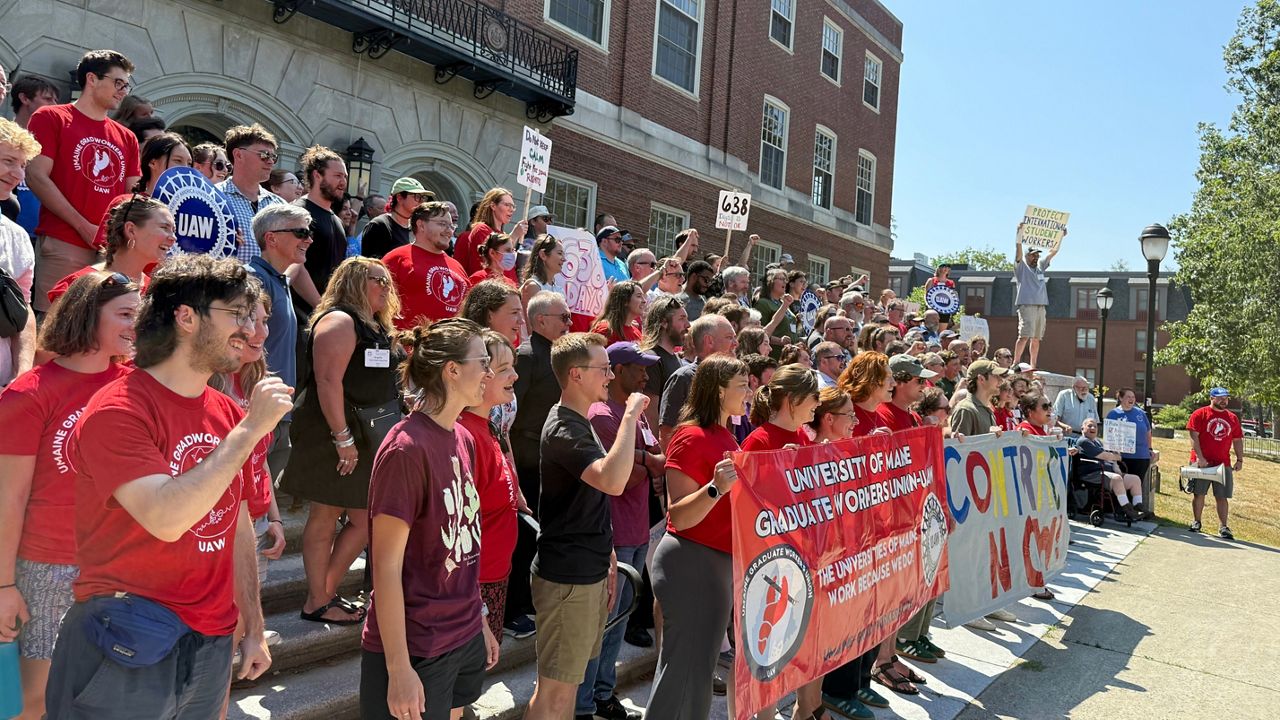
ORONO — Graduate workers and union members gathered at the University of Maine Wednesday to demand that the administration reaches what workers say would be a fair contract agreement.
Workers say they have been bargaining for more than 630 days, and the sticking point is their demand for higher pay.
“We also have a hard time affording food,” said Tricia Collins, UMaine PHD student and graduate worker. “Our stipends are so low. We’ve got folks taking advantage of food pantries on campus. That’s just not an acceptable way to live. We’re looking to reduce the sacrifice that is this career path.”
Graduate workers also rallied in April.
Workers say they’re asking the University of Maine System to address what they say is a “wide gap in pay” between graduate workers in the University of Maine System and graduate workers in institutions like the University of Rhode Island and the University of New Hampshire.
“We’re looking at our peer institutions, and looking at the system to come up to that level,” Collins said. “We’re vital to this institution.”
The standard minimum stipend for master's students is $17,000 for a nine-month appointment — based on 2023-2024 figures, According to the benefits explanation on the UMaine website. This amount is $20,000 for doctoral students.
The website notes that “amounts will vary widely depending on the funding source supporting your position.”
In a statement, the system said it values its graduate workers and will continue to bargain in good faith, but the administration’s ability to make improvements is limited by the amount of state and federal support it receives.
“As a public university system, our ability to improve work opportunities and conditions without shifting costs to our students and their families in the form of unreasonable tuition increases largely depends on our State appropriation and our federal grants and contracts,” the statement reads. “Tens of millions of dollars of which have been impacted in recent months.”
Millions in federal funding to the system has been paused or cut in recent months, though some awards have since been restored.
In May, UMaine announced $250,000 in philanthropic funding to support graduate workers affected by the loss of federal research funding.
The system’s statement also noted that the university is “committed to achieving an agreement that is responsive to the requests of these respected student workers and the operational needs and increasingly constrained resources of our public institutions.”
“It’s time for the University System to come together with graduate workers and sign a fair contract that strengthens the University of Maine and our whole state,” state Sen. Mike Tipping, D-Penobscot said at the rally. “Six-hundred-and-thirty-eight days is way too long to be waiting for a first contract.”
Members of unions in other industries including paper, iron and nursing also spoke in support of graduate workers.
“These graduate workers are training the future nurses of Maine,” said Erin Oberson, a labor and delivery nurse at Northern Light Eastern Maine Medical Center and a member of the Maine State Nurses Association. “Shouldn’t we want to attract the best and brightest graduate workers to teach our states future nursing workforce? Yes we should.”