




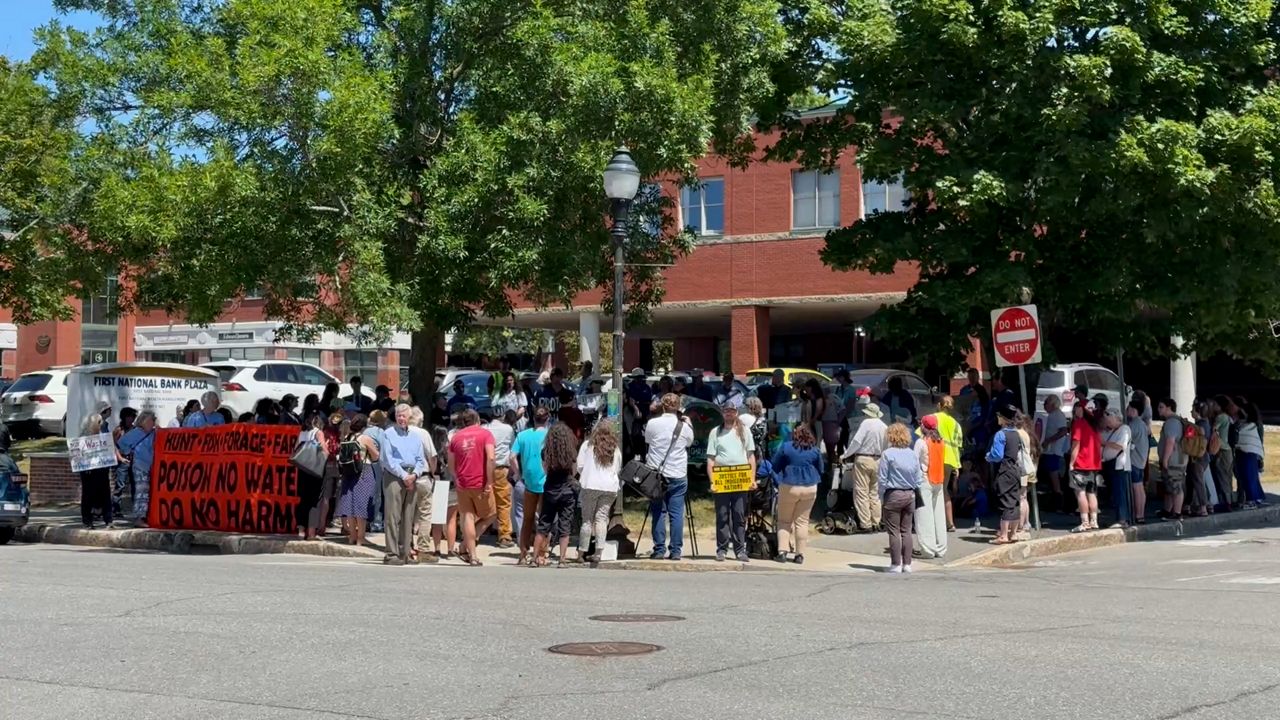
BANGOR — Members of the Penobscot Nation and environmental advocates rallied outside of the Penobscot County Court in Bangor Friday in opposition to the expansion of Maine’s largest landfill — prior to a hearing on the subject.
“The Conservation Law Foundation, Penobscot Nation and a bunch of friends throughout the state are challenging the expansion of the Juniper Ridge landfill under the Casella contract,” said Maulian Bryant, executive director of the Wabanaki Alliance. “We have a lot of concerns about environmental justice factors, certain conditions that we live under being right next to the landfill, the implications on our tribal lands and waters, and we’re really happy that so many other people care about the same things.”
Late last year, the Maine Department of Environmental Protection approved the expansion of the Juniper Ridge Landfill in Old Town and Alton by nearly 12 million cubic yards.
That was followed by an appeal from the Penobscot Nation and the Conservation Law Foundation to block the expansion — noting concerns about PFAS chemicals, air contaminants and the landfill’s proximity to tribal lands.
“If ever there were a case that shouldn’t go forward because of environmental justice concerns, this is it,” said Alexandra Enriquez St. Pierre with the Conservation Law Foundation.
Representation for the plaintiffs Nora Bosworth noted in her arguments that landfilling waste is meant to be the last option under Maine's so-called “waste management hierarchy.”
“DEP acted erroneously and arbitrarily, because their decision defies the solid waste management hierarchy in violation of the PBD statute,” said Nora Bosworth, representation for the plaintiffs. “Under this decision, watery sludge and the vast amounts of waste used to bulk that sludge will continue to devour a needless amount of space in the one active state-owned landfill in Maine.”
However, representation for the Maine DEP, Jack Dafoe, said in his arguments that the expansion proposal is consistent with the state waste plan.
Brian Rayback, who represented NEWSME Landfill Operations, a subsidiary of Casella Waste Systems – which operates the landfill, mentioned in court Friday that the landfill has a number of features to protect the environment.
“It is a secure disposal facility. It is a very sophisticated facility,” said Rayback. “There’s a liner and a leachate system to collect leachate and protect groundwater. There’s a stormwater management system to protect groundwater and surface water, there’s a gas extraction and treatment system.”
Both Rayback and Dafoe stated in court Friday that Juniper Ridge is in critical need of an expansion due to capacity issues.
“The state waste plan discusses the absolute critical need for this expansion,” said Dafoe. “It also discusses, of course, this is a waste facility. It talks about how an expansion will take in more waste and there are capacity issues which is why an expansion is necessary.”
Dafoe also noted that the DEP took environmental concerns into consideration in its Public Benefit Determination and have required landfill operators to create a system to treat the waste liquid known as “leachate.”
“I think the major issue we’ve been discussing is the discharge of the leachate into the Penobscot River and that is definitely a major issue they’ve discussed as having an impact on the Penobscot Nation in particular,” said Dafoe. “And if you look at the PBD that is why there is a condition requiring Casella NEWSME to create a leachate treatment system that will address that concern.”
However, St. Pierre criticized the DEP’s Public Benefit Determination and said she has several concerns about the potential for environmental risks if the landfill expansion moves forward.
“There's a greater risk of fire, greater risk of air contaminants, greater risk of PFAS and dioxins and furans and PCBs in the Penobscot River,” said St. Pierre. “That will affect the fish and animals that eat the fish and ultimately the people that live there.”
In a statement, Vice President of Commuinications for Casella Waste Systems Jeff Weld said failure to expand could lead to waste disposal issues.
“Maine residents should feel confident that this is an outstanding facility with sufficient room for expansion to meet their needs for an additional 10-15 years,” Weld said, in part. “Failure to expand would create significant disposal capacity issues as many in Eastern Maine are already struggling with a shortage of waste disposal options.
There is currently no timeline for when Justice Bruce Mallonee will rule on the appeal.