




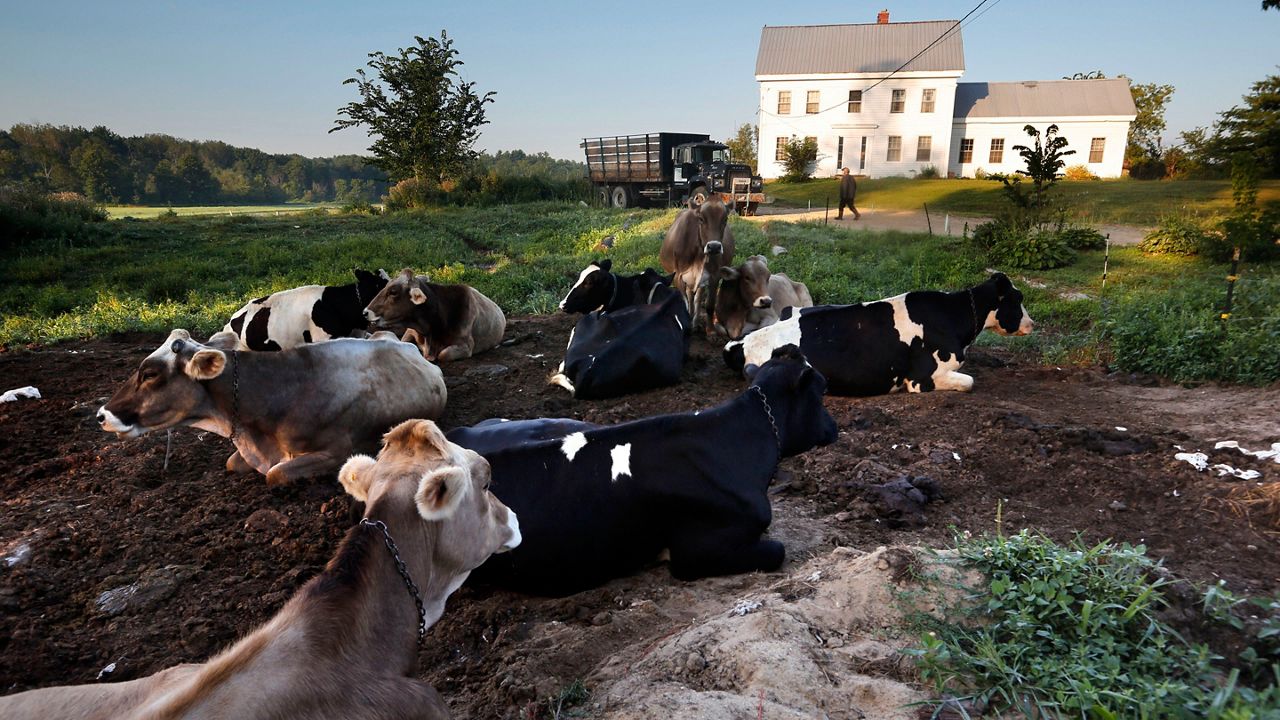

Maine has awarded another $3 million for research into perfluoroalkyl and polyfluoroalkyl substances, otherwise known as PFAS, aimed at supporting farmers affected by contamination from the so-called “forever chemicals.”
The Maine Department of Agriculture, Conservation and Forestry on Friday announced the second round of awards from the PFAS Fund to research projects studying the agricultural impacts of the contamination.
“These new grants expand and accelerate agricultural PFAS research,” said Commissioner Amanda Beal in a statement. “The results will help impacted farmers in Maine and across the country make informed decisions so they can continue to operate and thrive.”
PFAS are a group of man-made chemicals used in a variety of consumer products because they are oil and water resistant. They have been linked to numerous health issues, and don’t break down in the body or the environment.
Contamination in Maine has largely been linked to the spread of sludge, a wastewater treatment byproduct, on fields. Maine DACF said although the majority of farms are not impacted, it is currently working with 127 sites to support farmers and property owners.
The PFAS Fund was created in 2022 to support farmers and fund research into how PFAS move through the environment, where the chemicals accumulate, and how to manage the contamination.
The fund received 31 applications for this round of grants, requesting more than $11 million. The department awarded a total of nearly $3 million to six major projects, focused on a broad set of research priorities, to be conducted over two years.
Two projects focus on mitigating PFAS contamination of crops grown in tainted soil. Although the state has implemented water filtration systems in many areas, removing the chemicals from the soil is a different challenge, and a key concern when research has found that some plants absorb the PFAS.
For one project, researchers with Purdue University will test the use of carbon-based biosorbents and whether they can reduce the amount of PFAS taken in by plants.
The other project, at the University of Maryland Eastern Shore, will look at the use of biochar, a charcoal-like substance produced by burning organic mass, which has shown promise in reducing how much PFAS moves from the soil into crops. The project aims to provide practical, scientific guidelines to farmers about when and how biochar is likely to work.
Several other projects will investigate the impacts of PFAS contamination on other plants and animals.
A Dartmouth University professor will research the impact of PFAS on maple trees growing in contaminated soil, and explore whether the chemicals spread to the sap. The research would help determine if the sap can be used in maple syrup production, and if maple sugaring is an effective way to utilize contaminated land — an ongoing question.
Philip Fanning, an assistant professor at the University of Maine, will investigate the impact on the health and productivity of bees, when taking pollen from flowers grown in contaminated soil.
Jessica Lemos Motta, another assistant professor at the University of Maine, will research sheep reproduction, looking at how PFAS disrupt fertility and embryo development in livestock. PFAS can pass to a fetus in utero, and the project will monitor hormone levels, ovarian function and the number and quality of embryos produced, assessing the impacts at a molecular level.
The final major project, led by Jean MacRae, an environmental microbiologist and environmental engineering faculty member at the University of Maine, focuses on the conditions needed to fully destroy PFAS in contaminated plants, and strategies for preventing PFAS in soil from leaching into water.
The department also awarded roughly $250,000 to three projects focused on targeted research questions that will be completed over a shorter time period.
Christoph Aeppli, with the Bigelow Laboratory for Ocean Sciences, will investigate PFAS soil extraction methods, and identify the best method for estimating how much PFAS a plant can access during a growing season. The information will improve how soil tests are interpreted and offer better guidelines for farmers.
Thomas Simones, assistant state toxicologist at the Maine Center for Disease Control and Prevention, was awarded grants for two projects.
One will improve the model used to predict the daily build-up of PFAS in cattle from feed and water, focusing on perfluorodecanoic acid, or PFDA.
And the second project will research how PFAS move through soil into chickens and eggs — to identify how hens are exposed, and how to limit contamination.