




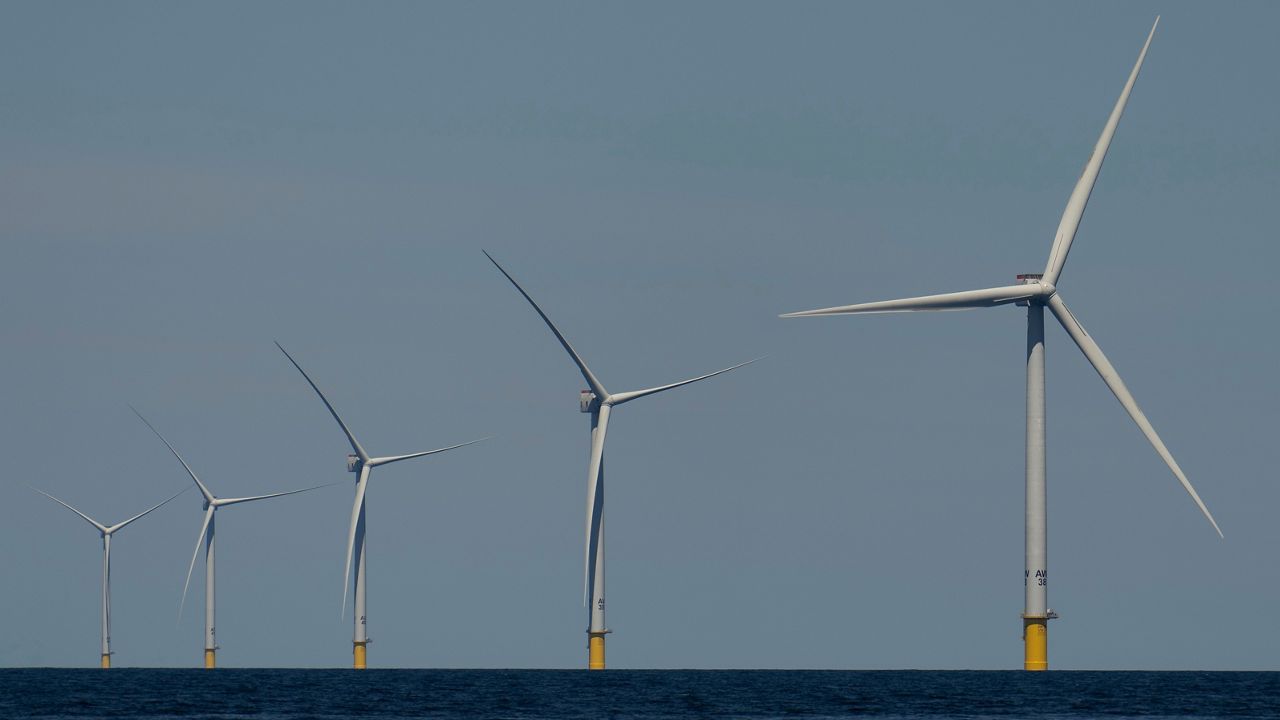

The termination of two federal leases in the Gulf of Maine present the latest layer of uncertainty for offshore wind projects, once thought to be key to Maine’s energy secure, low-carbon future.
Last month, the U.S. Department of the Interior announced a settlement agreement with Chicago-based Invenergy, which included the termination of offshore wind leases in Maine, California and New York.
“It’s a bad deal for Mainers, at a time when energy is getting more and more expensive, we are spending public dollars to not build energy resources and to not bring electricity prices down,” said Nick Janzen with Maine Conservation Voters.
As part of the agreement, the federal government will reimburse Invenergy up to $765 million, which the company will then reinvest in natural gas-fired power plants and geothermal power generation projects.
The administration of President Donald Trump has cited “national security concerns” about the development of offshore wind as the reason for terminating leases, and stopping work on other projects.
“Rather than waiting years for the projects to materialize, the Trump administration is prioritizing investments in existing infrastructure and functioning supply chains that can create jobs now and deliver economic benefits faster,” an Interior spokesperson said in a statement last week.
In a statement, Gov. Janet Mills said the termination undermines years of work and planning to protect Maine’s fisheries, diversify energy resources and create economic investment.
“The Trump administration’s legally questionable plan to spend hundreds of millions to cancel offshore wind leases in the Gulf of Maine and elsewhere is an egregious waste of taxpayer money and a shortsighted decision that will hurt our ability to reduce our reliance on expensive fossil fuels,” Mills said.
It’s far from the only avenue the Trump administration has used to slow or stop offshore wind, Janzen said, but the leases are a foundational part of any project.
“I mean, without a lease, you can’t build a project, so this scheme from the Trump administration is particularly frustrating, because it’s really sort of cutting projects off at the knees,” he said.
Kate Sinding Daly with the Conservation Law Foundation said the redirecting of funds to other projects makes the deal even worse for the state.
“They’re really particularly cynical because they don’t just purport to buy back these leases,” she said, “but they go even further and require that the companies, as part of the so-called settlement, invest that money instead in large measure, new fossil fuel projects.”
Janzen added that those projects are also all located outside of New England.
“While maybe you could talk about benefits of those projects in other communities, it’s not going to benefit Maine, so Maine is still losing out,” Janzen said.
Altogether, Sinding Daly said the Trump administration’s actions may have a chilling effect on future investment in wind energy.
“We’re losing critical time that we just don’t have to address the climate crisis and the energy affordability crisis,” she said.
The Invenergy agreement is the third of four offshore lease terminations. The latest, with North Carolina-based Duke Energy, was announced last Monday and brings the total amount spent on lease buybacks to more than $2.7 billion.
The first agreement was announced in March and terminated one lease in New York and a second in North Carolina, both held by the French developer TotalEnergies.
Under the agreement, TotalEnergies was paid up to $928 million to be reinvested in oil, natural gas and LNG production. The company also pledged to not develop any new offshore wind projects in the U.S.
“These investments will contribute to supplying Europe with much-needed LNG from the U.S. and provide gas for U.S. data center development,” Patrick Pouyanné, CEO of TotalEnergies, said in a statement in March. “We believe this is a more efficient use of capital in the United States.”
But in June, New York filed a lawsuit in federal court opposing the termination of the New York lease. Maine and other New England states joined the suit, arguing that the region would benefit from the energy produced by the project in New York.
The Sierra Club applauded the filing, and called the terminations illegal and politically motivated.
“These states recognize what this administration refuses to accept: Offshore wind lowers energy costs and strengthens our grid,” Sierra Club Senior Advisor Nancy Pyne said in a statement. “Trump’s backroom buy-outs are a bad deal for families already struggling to pay their bills.”
That case is still pending in court, leaving the status of the leases unresolved. It may also mean the Gulf of Maine leases will also be the subject of lawsuits.
Janzen said it’s hard to say what the long-term implications are.
“On the one hand, there’s still room and time to kind of restart these projects and get them built relatively close to the same point in time when they would have had their initial completion date, but part of that depends on how long court proceedings go on,” he said.
If the federal government under a future administration had to restart the leasing process, Janzen said he hopes some of the initial work will help speed the process.
“We don’t need to completely start over from square one,” he said, “hopefully we can just go back to the leasing stage and hold an auction.”
And while the courts are a good tool for stopping the administration, Sinding Daly said it’s harder to force the White House to support wind.
“Ultimately, we need a political solution,” Sinding Daly said. “We need a new administration that is rational about the reality of climate change, about what really represents affordable energy for Americans, and that will continue the transition away from fossil fuels.”
But despite the latest roadblocks, Sinding Daly said she sees the huge potential of offshore wind.
“Although all of this nonsense that the administration is throwing at the wind industry is certainly problematic and is certainly causing delays, we really believe that at the end of the day, the science and the economics are so clear that this will happen,” she said. “It’s just a matter of when.”