




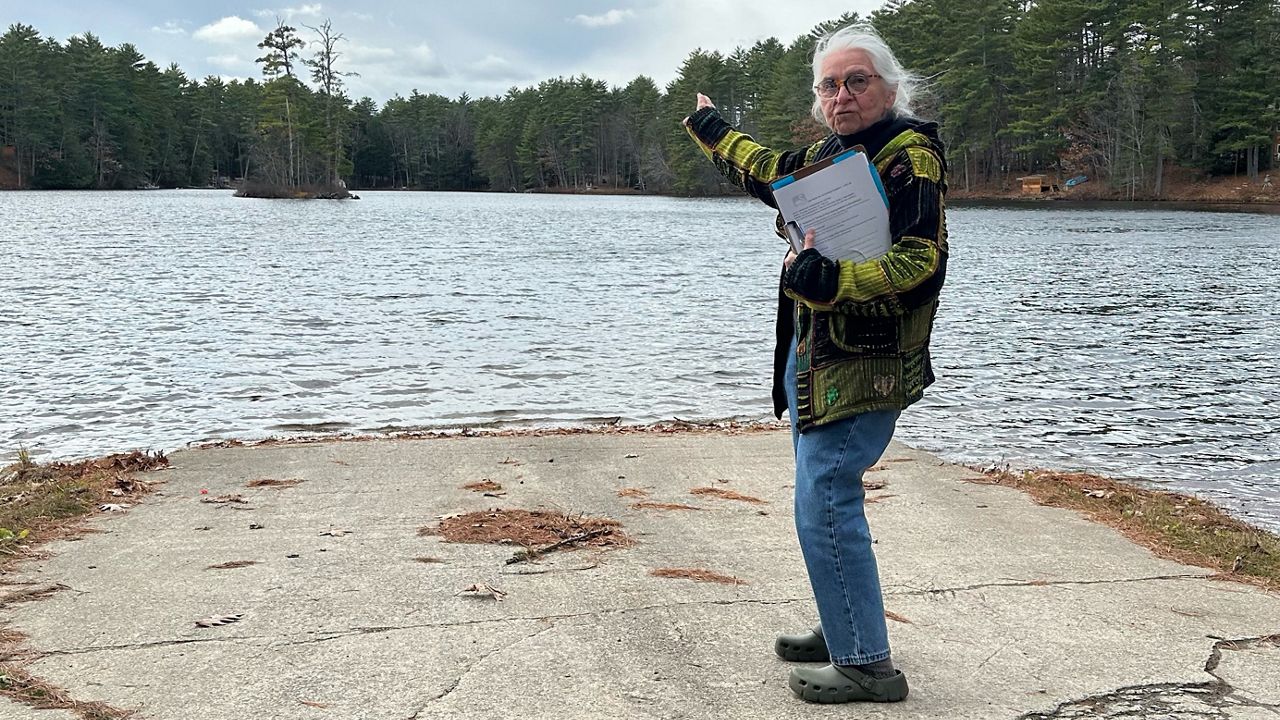
WATERBORO –– Residents in a neighborhood area that straddles the line between Limerick and North Waterboro in rural York County are worried that some recently-documented toxic polluting of groundwater in Limerick dating back decades may spread as far as Lake Arrowhead.
The news, disclosed over the summer to Limerick town officials, has at least one resident near the lake in Waterboro calling for answers from state officials and other regulators.
“This is a community of families,” said Jackie Elliott, 83, who lives on Crescent Drive, nearly within sight of the lake in North Waterboro. “We live here because we like it. It’s peaceful, it’s quiet, it’s beautiful, and the fact that we could be threatened by toxic pollution is just totally unacceptable.”
The disclosure happened during a selectboard meeting on June 30. In it, representatives of the Maine Department of Environmental Protection shared the findings of some water and air quality testing done near an old municipal landfill around Central Avenue.
Among other findings, three out of a total of 10 water samples taken from residential homes found unacceptably high concentrations of chemicals known as tetrachloroethylene (PCE) and trichloroethylene (TCE). Officials said the chemicals came into widespread use in the 1950s, mostly as dry-cleaning chemicals and industrial degreasers. The chemicals were used for roughly the remainder of the 20th century, but have now been linked to numerous health problems, including cancer.
Worse, the chemicals can break down, but Don White, an environmental engineer with DEP, said when that happens the chemicals emit toxic vapors. In the spring of this year, DEP sampling found high levels of the toxic vapors in at least three homes in Limerick, toxic enough to need filtration systems similar to those used to remove Radon from the air in some homes.
Brendan Auth, a hydrologist with DEP, said during the meeting that many of the liquid forms of these chemicals could flow into a valley near the landfill made up of sand and gravel, meaning the chemicals could flow underground.
“Anything that’s spilled in this area or discharged into the environment is most likely going to flow toward Lake Arrowhead,” he said.
That fact did not sit well with Elliott, who said she watched the meeting online that day “and I was very concerned.”
Since then, Elliott, a New Hampshire native who has worked as an environmental activist in the past, hasn’t been able to find out much, and wants to organize with her neighbors to pressure DEP to do more.
So far, Elliott said, no one seems to know just how big an area of pollution exists, how fast it’s moving or if Lake Arrowhead is indeed threatened. Right now, she said, current local water testing has shown no signs of the toxins, but it’s not clear whether that will change.
“We certainly want to keep our water supply safe, which it currently is,” she said. “We have our own community water supply here that is managed and tested regularly and it’s tested fine, and we want to keep it that way.”
Even who is responsible for causing the pollution in the first place is unclear. It’s possible that materials dumped in the landfill contained the toxins, but the landfill itself closed down in the late 1960s, prior to the DEP being established in 1972. Since its closure, the landfill’s property was sold off in pieces.
And it’s not just the landfill. In the same area, according to the DEP presentation, there are the remnants of an old mill building, which was the site of manufacturing for more than one company.
There is even a former Maine Department of Transportation salt shed that used to exist nearby, at 286 Burnham Road. Just who was in charge of all of these properties, when, and how much each property contributed to the problem is still not known for sure.
“That is one of the things that has to be investigated,” Elliott said.
The community around Lake Arrowhead began as a large subdivision in the 1960s and today is difficult to define from a political standpoint – it is recognized by the U.S. Census as a “Census-designated place,” but it’s not a town or village. Elliott said “neighborhood” may be as good a definition as any, but she simply prefers to think of the people there as her neighbors.
This week, Elliott is organizing a meeting at the neighborhood’s clubhouse, at 206 Old Portland Road, on Thursday at 6:30 p.m. Elliott is describing it as a “meeting of neighbors” to discuss what is known, what isn’t known, and how to find answers.
“We can’t not know these things,” she said. “We need to understand what we’re dealing with.”