




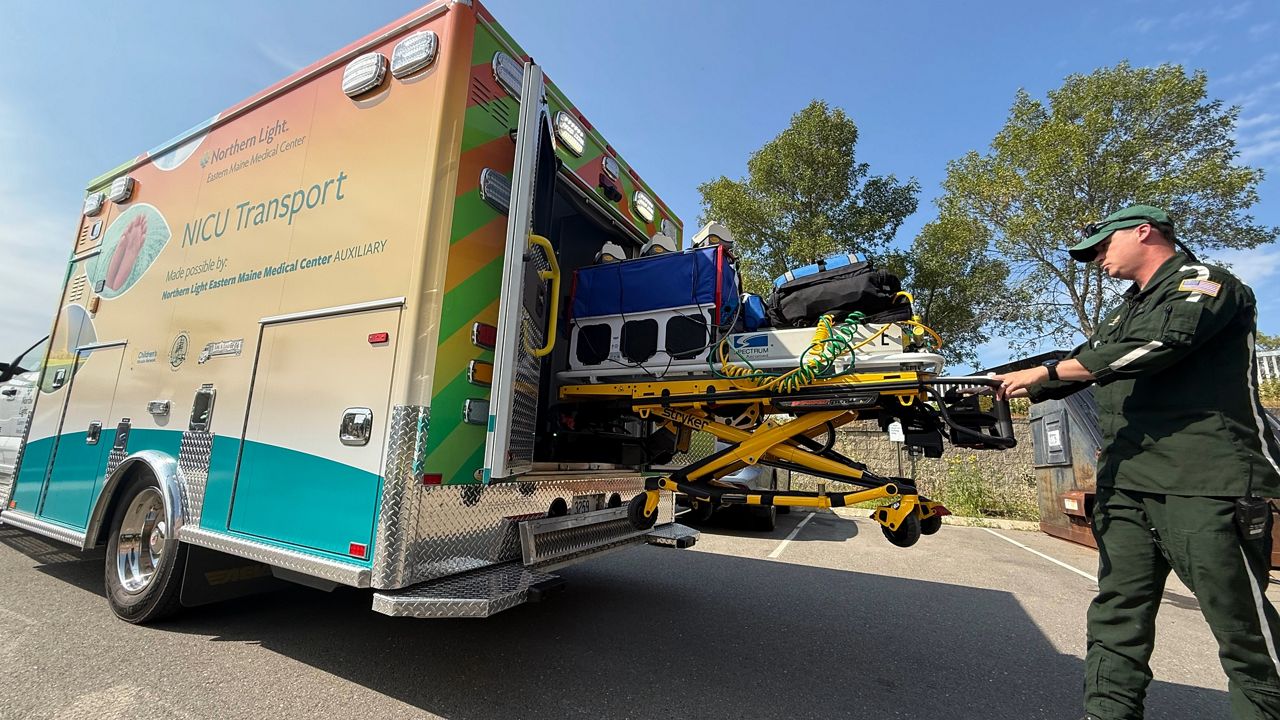
BANGOR — Northern Light Health’s newest addition to its fleet of emergency vehicles is different from the rest -- it’s designed specifically for newborns.
The health provider says its new ambulance acts as a “rolling NICU” for premature and critically ill newborns, which is essential when many patients in the northern part of the state might be hours away from the nearest Neonatal Intensive Care Unit.
“Maine is unique in that it’s very geographically separated,” said Greg Milliken, critical care Flight Paramedic for LifeFlight of Maine. “You have very isolated portions of the state where it takes a long time to move somebody from the northern reaches of the state to higher-level care facilities like Eastern Maine Medical Center, for example.”
The Neonatal Transport Team inside the ambulance is made up of trained nurses who partner with LifeFlight EMTs.
The ambulance, known as the Miracle II, has been in service since May and is an upgraded replacement for the healthcare provider’s previous Miracle I.
“This is the second ambulance we’ve had like this,” said Mikele Neal, associate vice president of patient care services at Northern Light EMMC. “The first one we had for about ten years.”
Milliken said the vehicle is able to provide specialized care that’s not typically available in a standard ambulance.
“The ambulance here has some specialized capabilities that you don’t find on other ambulances,” said Milliken. “We also transport an isolette in this ambulance which is able to keep the baby just the right temperature, and it has some specialized equipment to help breathe for them.”
Milliken said this kind of resource is essential — especially when other modes of transport may not be an option.
“Having secondary assets that can be used when the helicopters and the airplanes aren’t able to fly is massively important,” said Milliken. “We’ve gone a little bit of time now at LifeFlight without having a dedicated ambulance to take care of neonatal patients. And it’s really incredible to have an asset again that’s specialized in doing that job.”
According to Northern Light, the healthcare provider’s Level III NICU in Bangor is the only one north of Portland.
“We serve the northern two-thirds of Maine, primarily,” said Neal. “[But] we will go anywhere. We’ll go anywhere and get any baby and we’ll help any family or hospital in need. But that northern two-thirds of Maine, that large geographic region, is our main service area. So, the large majority of those 150 babies come from that area.”
Neal said the NICU provides care to over 450 newborns each year — with 150 of them being transported from community hospitals.
“A typical gestation for a baby is 40 weeks, or around 9-10 months. Sometimes baby deliver as early as 26 weeks,” said Neal. “So, we’ve had to go as far north as the Canadian border, Fort Kent, Houlton, to get really premature babies, and that is a life and death situation.”
Neal also said the ambulance was completed funded through donors.
“This was 100% donor-funded,” said Neal. “Specific groups donated the money, raised the money — but the community was highly involved in this, very committed. It was really inspiring to be part of those groups that are as committed to this ambulance as we are. Thank you really can’t be said enough.”
Neal said having an ambulance with neonatal capabilities can sometimes mean the difference between life and death.
“It is sometimes life and death. Let’s be honest, this is a critical care ambulance,” said Neal. “We dispatch our critical care isolette. So, this is a mini critical care unit, this is a critical care unit on wheels. We’re sending this to those facilities and we’re providing the same level of care that we do upstairs in our intensive care unit.”
And for families, Neal said that kind of support is everything.
“People live all over the state of Maine, and they live in remote areas, and they deliver babies in remote areas," said Neal. "So to know, and to have that comforting family for a new family that their new baby can get the level of care they need quickly is really quickly. So, all the families tell us how relieved they are when they see our NICU team walk in the room.”