




PORTLAND – A recent study by researchers in four states show infants born with complications face a greater risk of mortality than in other areas.
The study, published in the Journal of Natology, lists doctors at MaineHealth, along with Tufts Medical School in Boston, Eliot Hospital in Manchester, New Hampshire, and the University of Vermont Medical Center among its authors.
The study examined newborn babies born with breathing complications, an occurrence that happens more rarely in rural hospitals, where birth volumes by definition are lower than in urban hospitals.
This means that health care workers in rural hospitals, while skilled, have less experience dealing with respiratory complications than those in urban hospitals.
As a result, the research found, babies born in respiratory distress are four times as likely to die or suffer from severe brain damage when born in rural hospitals than urban hospitals. The study’s abstract called the risk “significantly higher.”
Prompted in part by the study, MaineHealth set to work developing a prototype of a new training simulator that may help to change those odds.
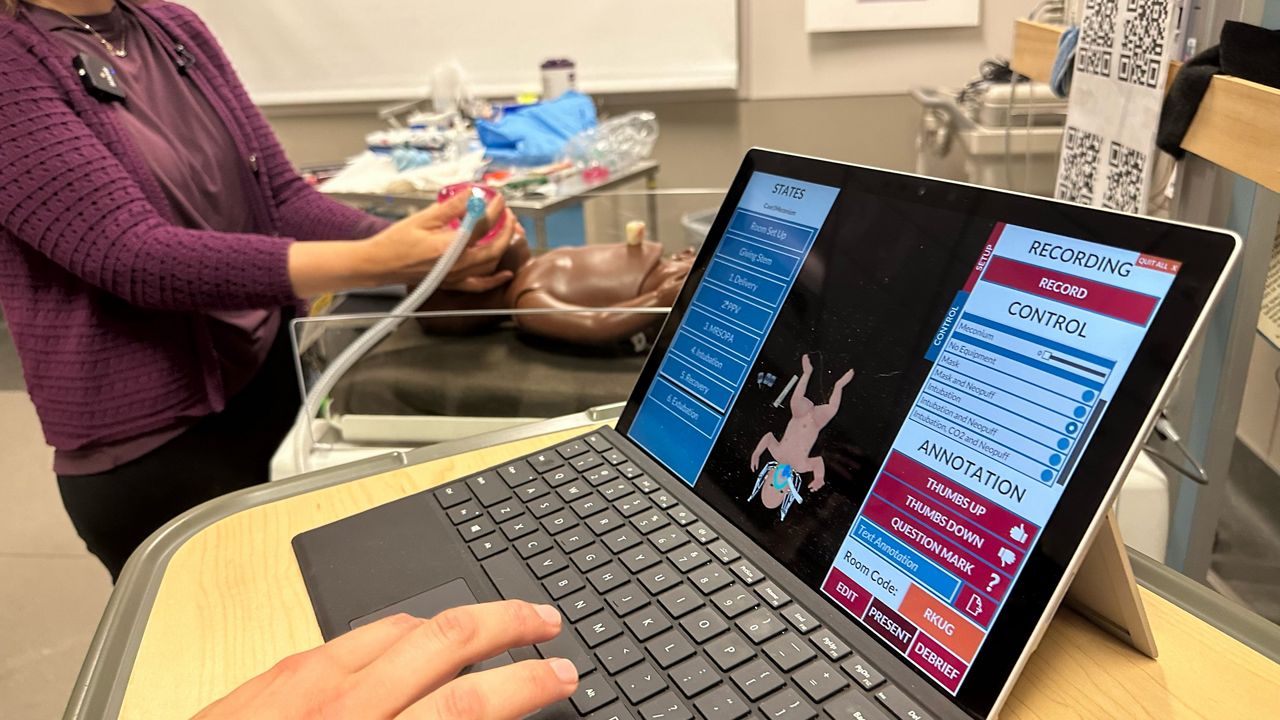
The health care provider calls it HoloBaby, a new form of augmented-reality simulation training, according to Mary Ottolini, chair of pediatrics at MaineHealth Barbara Bush Children’s Hospital.
Ottolini said the hospital received a $2.8 million grant from the National Institute of Health to work with the prototype and make it ready for training sessions throughout the hospital’s network.
Dr. Bill Stephenson has been a pediatrician at MaineHealth Pediatrics in Rockport for 23 years. He said routine training for him and his fellow health care workers is crucial to keep their skills sharp, and simulations can go a long way to augment what they are already doing.
“The more we have the opportunity to do these things, the more comfortable we are with it, the more likely we are to have great outcomes,” he said.
Dr. Allison Zanno, a neonatologist at Barbara Bush Children’s Hospital and one of HoloBaby’s developers, demonstrated the system at the hospital’s lab on Thursday. In a small gurney laid a simple plastic and rubber mannequin of a newborn.
A headset and goggles, however, overlaid what the wearer saw with a computer-generated image of a baby. Technicians link to the goggles with a laptop and change the image based on the simulated baby’s condition, including turning it blue and motionless when in distress.
Between what the goggles show the user and what the user feels when touching the mannequin, Zanno said, trainees can get a realistic simulation of what would happen during a crisis in a real delivery room. Just like with a real baby, the simulated infant responded to the correct treatment and recovered.
“It’s definitely more realistic, so the baby or the simulated baby can respond in real time,” she said.
Medical practitioners, including Stephenson, do refresher training on these skills all the time, but typically the best simulation they have is a mannequin equipped with motors and sensors so it can move and respond.
But that kind of mannequin, Zanno and Ottolini said, can cost up to $60,000 and can’t be moved easily. It needs a group of technicians and a vehicle full of equipment. By contrast, HoloBaby costs a fraction of what the more complex mannequin costs. For transport, the system consists of a laptop computer and four headsets, all of which can fit in a backpack.
Stephenson said the value of ongoing training is not just to reinforce the medical skills needed to treat an infant born with complications. It’s also about the little things, like who needs to stand where. When seconds count, knowing these things in advance makes all the difference, he said.
“The process for a successful newborn resuscitation starts long before the infant is even born,” he said. “So it starts with having these highly-realistic simulations where we have an opportunity to sit with our colleagues – our nursing colleagues, respiratory therapy colleagues, our physician colleagues – and go through these things and figure out ‘OK, what went well, what are some things that we can tweak that we can ensure great outcomes?’”
Ottolini said the hospital is still working out the details of how the technology will be distributed once perfected. Stephenson said his hospital holds refresher training about once a month, and he hopes to see HoloBaby integrated into that training as a new tool.
“I would say any technology that improves the realistic nature of our practice is wonderful,” he said.