




PORTLAND –– The Red Cross has asked for more blood donors due to shortages before, but not like this.
This week, the nonprofit in Maine and nationwide is reporting one of the lowest supplies in its history.
“What we’re facing right now is a blood crisis,” said Jennifer Costa, spokesperson for Red Cross of Northern New England. “This is the most dire situation and only twice now in Red Cross history have we ever declared such a crisis.”
The health care community relies entirely upon donations for its blood supply. Costa said it’s not unusual to run low, especially in the summertime or near the winter holidays, when people are usually too busy to come in to give.
This year, however, the usual summertime dip in donations was worse, fueled in part by heat waves, air quality alerts and foodborne illnesses across the country, leading to even fewer people coming in to donate.
The result is similar to the crisis the Red Cross experienced in January 2022. That year, Costa said, the coronavirus pandemic was keeping people away.
“Donors were physically not feeling healthy and well and that was really impacting donor turnout,” she said.
In June, Costa said, the national blood supply dropped by about 25%. Right now, she said, Type O blood is particularly low, so much so that the Red Cross has had to restrict supplies to some hospitals.
“Doctors in many cases may have to make difficult decisions right now about who receives blood and who must wait,” she said.
In Maine, the Red Cross works with 39 hospitals throughout the state, and has thousands of appointment slots available for donors to come in. For the next two weeks, though, Costa said 48% of those slots are not filled. That percentage, she said, is definitely higher than in other states.
“What I want to stress is that every empty appointment is not just an appointment sitting unfilled,” she said. “That is a patient somewhere waiting for a blood transfusion.”
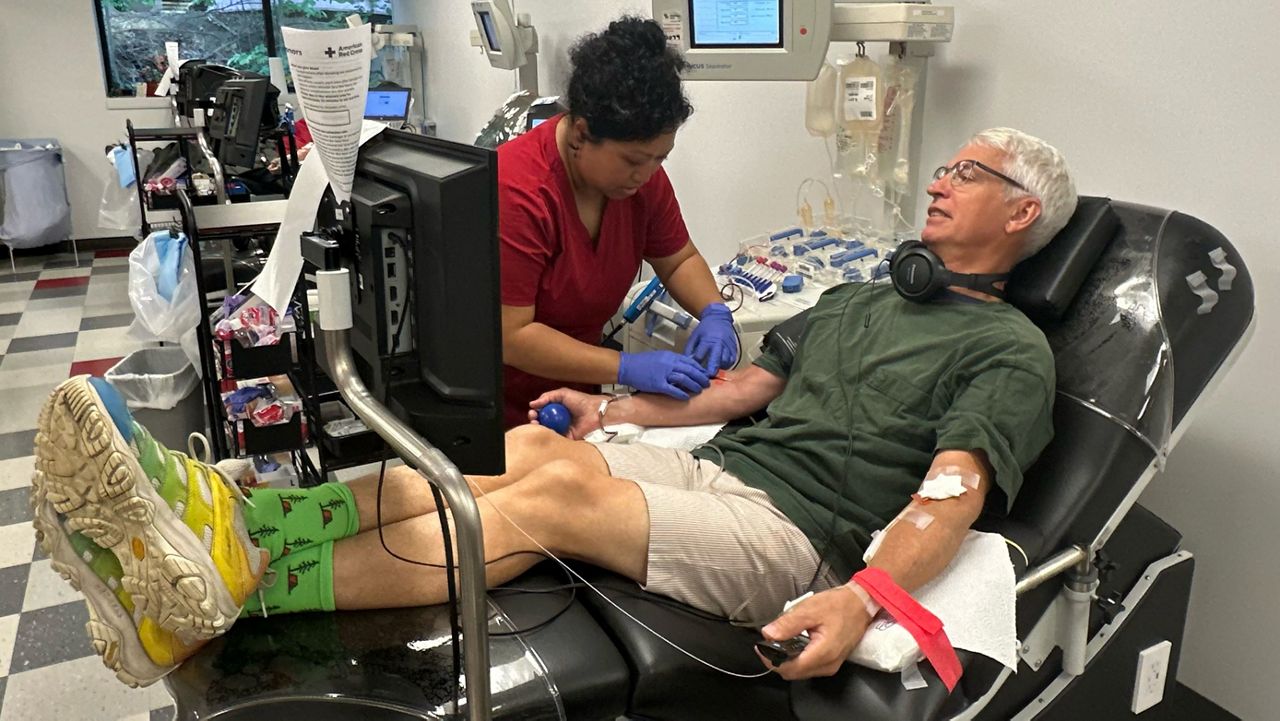
On Thursday morning, at the Red Cross Blood Donation Center on Forest Avenue, donors were coming in to donate platelets. A component of blood that assists with clotting, platelets are also critically low nationwide.
Costa said 50% of donated platelets are given to cancer patients. Without them, she said, the cancer patients can’t receive treatment.
Susan Buckland, 68, of Damariscotta, drove an hour to make her donation appointment.
“I usually come about once a month, but due to the shortage, I’m trying to up my game,” she said.
Buckland said she’s been donating regularly for about 35 years, and has appointments scheduled over the next four weeks.
“It always feels good,” she said.
Dave Letze, 64, of Sanford, is also a longtime donor, for more than 25 years.
“I’ve always been doing it,” he said.
Letze said he donates platelets, which takes longer than the minutes-long procedure for donating whole blood, but he does it for the people he knows who have faced cancer, including his own daughter.
“I just know there’s a need for it, and I know people have needed it,” he said.
Warren Hathaway, 64, a Peaks Island resident, is retired now, and tries to come every other week, or at least once a month.
“I see it as my volunteer work,” he said.
Hathaway urged people who don’t usually donate to consider it.
“It really doesn’t hurt, and for the whole blood, it really doesn’t take very long,” he said. “I think generally, you’re probably going to feel pretty good that you did it.”
Costa said if only three extra people donated whole blood per day, that would be enough to overcome the shortage.
“That blood is only available to save lives if people roll up their sleeve and give,” she said. “Doctors physically can’t get it anywhere else and so patient care is truly at risk right now.”
Anyone interested in booking an appointment can call 1-800-RED-CROSS or visit redcrossblood.org.