




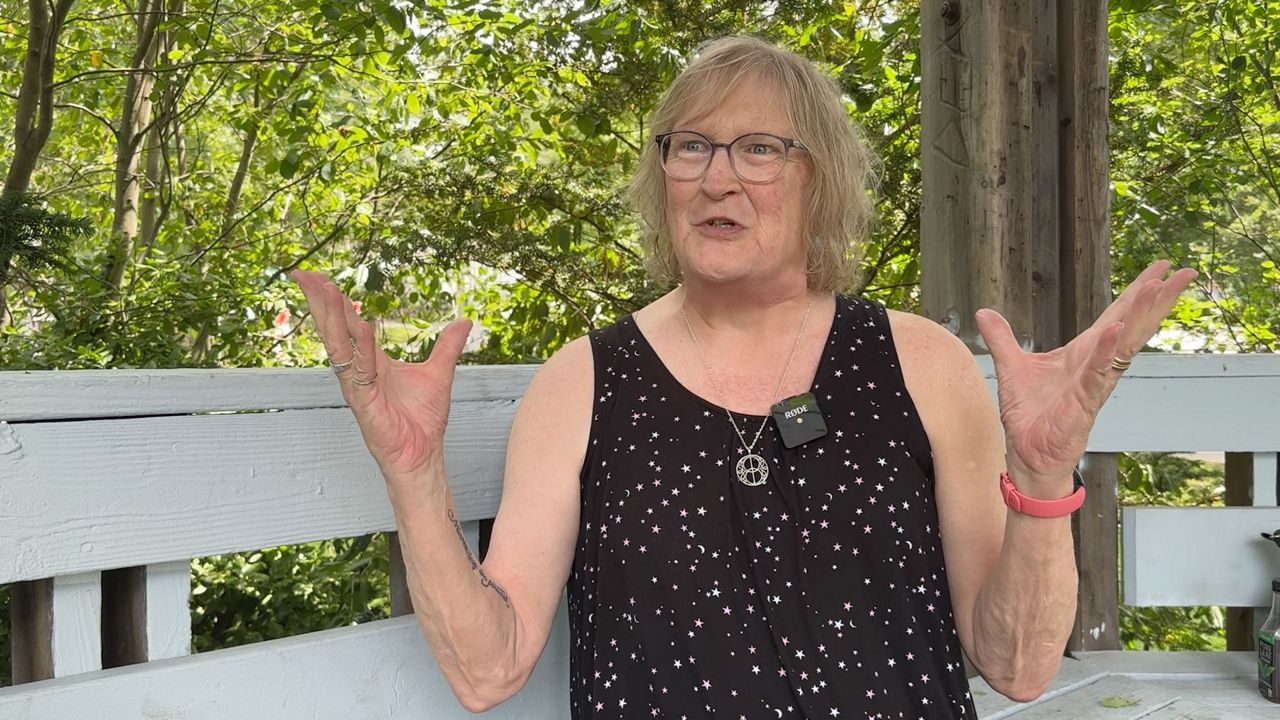
BRUNSWICK – Rev. Gwen Fry will never forget the fallout from coming out as a transgender woman to her friends, family and co-workers in Little Rock, Arkansas.
“I received death threats, I received physical threats, I was afraid to leave my apartment because I feared for my safety. It was difficult,” she said.
That was 11 years ago. Today, she is living in Brunswick and serves as rector at St. Mark’s Episcopal Church in Waterville. She was one of many to testify in Augusta this spring against a series of bills that would have restricted the rights of transgender people.
“If these bills pass, we will be taking giant steps backwards and my small community will experience a return to the same discrimination and oppression I fled moving to Maine,” Fry wrote on May 8.
Fry rejoiced when those bills failed to become law, but she said the current sociopolitical climate is fanning the flames of fear among transgender people, both in Maine and nationwide.
“I see things getting worse before they get better,” she said.
Fry, 65, grew up in northern Kentucky, not far from Cincinnati, Ohio. She had always known she was different, but didn’t know how to explain it until her early teens. One day, she saw Renée Richards, the transgender female tennis player who fought to play in the US Open in the 1970s, playing tennis on television.
“As I paid attention to what was happening on television, it struck me that that’s what I was trying to verbalize,” she said. “That’s who I am, that’s what I was.”
Her family, who was watching with her at the time, was less enthusiastic, calling Richards a “freak” and “monster.”
“The joy that was there one moment disappeared in the next second, and it was difficult,” Fry said.
Years later, while serving as an episcopal priest in Little Rock, Ark., Fry lost her job when she came out as transgender in 2014. When asked if her dismissal was a shock, she said, “A little bit, yes, but it didn’t really surprise me, looking back on it.”
In the years that followed, Fry describes recovering some of her dignity, both with her mother and later with the church, which did finally give her a full-time position as a priest at St. Mark’s nearly three years ago. She has since been named rector.
“I filled that position and got to know the congregation, and the congregation got to know me, and saw my positive points, and they took a chance on me,” she said.
Fry has been living in Maine since 2019, drawn in part by Maine’s laws protecting the rights of transgender people. This is part of what compelled her to speak out against the new bills this spring.
“I have seen what it’s like in a world where discrimination happens on a daily basis, safety concerns are there every single day and I have not felt that here because of the state’s protections,” she said.
Ultimately, the bills in question failed to become law, and Fry was happy to see that result, but when asked if she thinks the issue of intolerance remains, she said, “Intolerance? I would call it ‘hate.’ Let’s call it for what it is.”
Pushes by right wing conservatives, both in Maine and nationwide, are making transgender people fearful, Fry said. She has helped transgender friends move out of dangerous situations in other parts of the country, and at the moment she doesn’t see the fear going away anytime soon.
“It’s just the political climate of the times, and being trans has become a political wedge issue, and folks are going to use that for as long as they can because it’s working,” she said.
Fry said the antidote is through education – for transgender people like her to tell their stories, to show other people there is humanity and dignity in being transgender. She encouraged people who are curious about the transgender phenomenon to ask a transgender person out for coffee, and talk with them like a human being.
“Hear their experiences, hear what’s going on in their lives,” she said. “Give us space to tell our stories.”
Fry also said she herself remains an advocate for transgender people, both in her personal life and in her role as rector.