




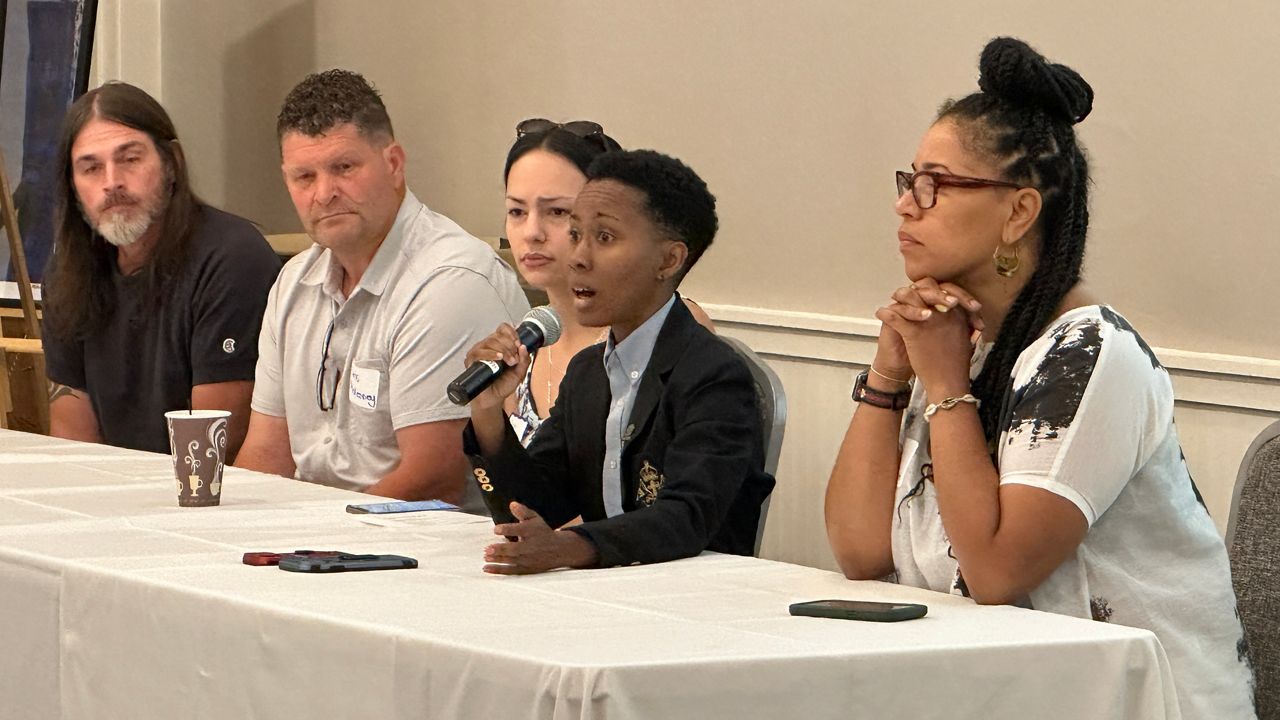
PHIPPSBURG — More than 100 years after their ancestors were forced to leave Malaga Island, descendants gathered Friday to take back their story and forge a path forward as one family.
For Chris McKenney, the discovery of a connection to what’s been called “the shame of Maine” helped fill in blanks about why some family members have continued to struggle generations later.
For Khamani Harrison, a 2012 exhibit at the Maine State Museum inspired her grandmother to open up about their family history. That led Harrison to dive deep into history and helped her find herself.
McKenney, Harrison and about 60 others came together for the second Malaga Island Gathering to share stories and plan for the future. One goal is to create a nonprofit and an archive with accurate information about their families.
“There’s been so many negative stories told about Malaga Island and we have to have a place where people can come to get the facts and the truth,” McKenney said.
In the 1800s, two Black families resettled the island following Wabanaki occupation, according to the Malaga Island Descendants Committee. Several other families — including those who were white and mixed-race — joined them, creating an island fishing and farming community.
But by the early 1900s, false rumors about the islanders and concerns about scaring away wealthy summer visitors led local officials and state government to intervene.
According to the Maine State Museum, the islanders were “victims of the eugenics movement, a popular theory that the poor, immoral, or criminal were born that way due to heredity.”
At the same time, newspapers featured wildly inaccurate stories about the island including headlines referring to “its shiftless population of half-breed blacks and whites.”
Then in 1911, Gov. Frederick Plaisted visited the island and told a reporter that “the best plan would be to burn down the shacks with all their filth.”
Eight of the residents were sent to the Maine School for the Feeble Minded and in July 1912, the remaining families were ordered to leave. The state then dug up the island cemetery and moved the remains to the “feeble minded” school grounds.
“For decades, generations of descendants felt the need to hide their Malaga Island ancestry,” according to the museum. “The term ‘Malagite’ became a racial slur commonly used on Maine’s coast.”
Many of the Black families moved out of state, while most of the white families stayed.
“You just didn’t talk about it,” McKenney said. “It’s our job to get the truth out.”
The group also wants to revive a scholarship fund first put in place during the Gov. Paul LePage administration that has since run out of money.
Harrison received some of that money, which helped her finish college after six and a half years of working toward her degree.
“It was my last year of school at UConn and this scholarship fund was established,” she said. “I already had a hard time funding college. That scholarship fund came through right in time for me to finish my degree. I was able to graduate in my family’s name. Powerful.”
On Friday, those gathered at the Sebasco Harbor Resort heard from historians, an archeologist, a poet and others about their work to create an accurate history of those who lived and worked on Malaga.
Descendant Justin James Marr thinks the current political environment calls for renewed discussions about what happened in Maine in the early 1900s.
“The same hate is rearing its ugly head,” Marr said. “To me the history and lesson of Malaga is we are the same. We’re together. A mixed-race community from the island was razed, exhumed but the spirit is still here.”