




ORONO — While many Mainers may be cheering on the New England Patriots at the big game this Sunday, their Super Bowl LX rivals have a physical connection to the state.
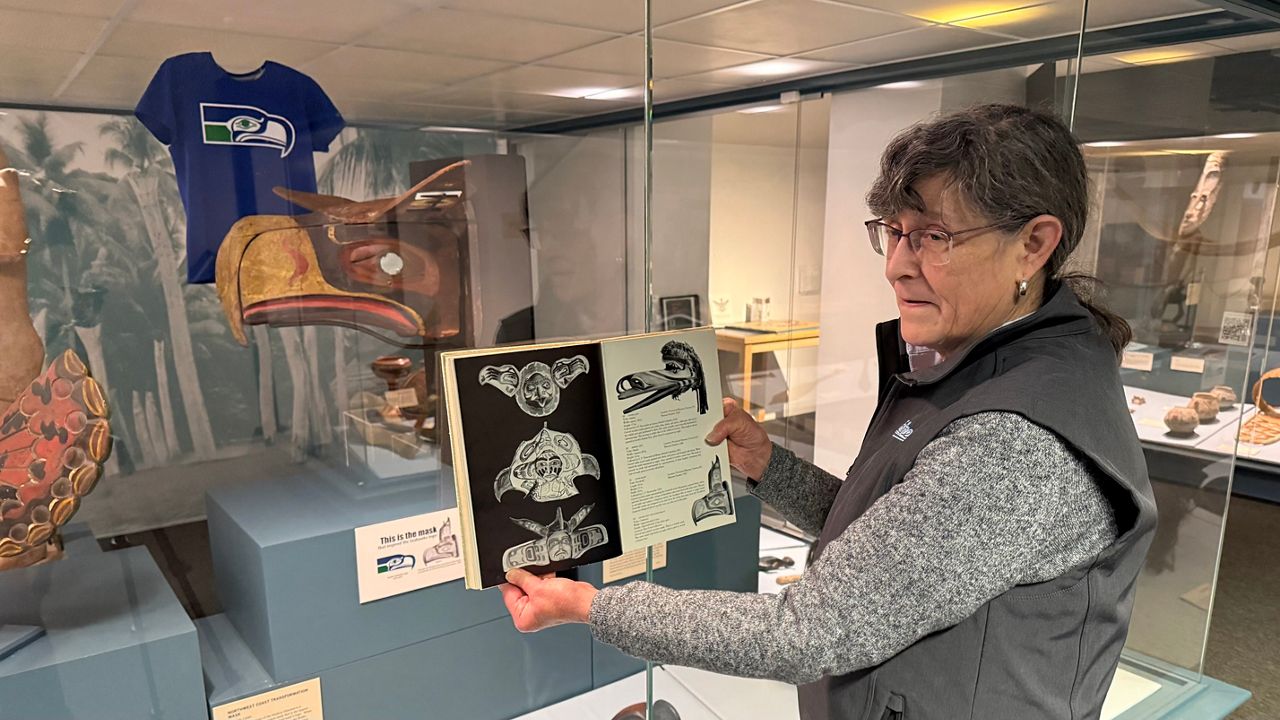
The real-life inspiration for the Seattle Seahawks logo, a carved cedar transformation mask, has a permanent home at the Hudson Museum at the University of Maine in Orono.
The mask was carved by the Kwakwaka’wakw people of British Columbia.
“In the 1970s when the Seahawks team was formed, they selected a name, and then they looked for an image to create a logo from,” said Gretchen Faulkner, the director of the Hudson Museum. “They selected this Kwakwaka’wakw transformation mask from a book image, and they used it as the logo for the Seahawks.”
According to the university, the mask was carved in the late 1800s or the early 1900s. Faulkner said the mask would have been used during winter dances and potlatch ceremonies.
The mask features two forms, a bird of prey on the outside, and a “being” on the inside.
According to the university, it is “designed to express the wearer’s transformation from one form to another: human, mythical being, animal, bird or fish.”
It eventually entered the collection of William Palmer, a UMaine graduate and philanthropist, who later donated it to the university along with thousands of other Native American artifacts.
“The Hudson Museum is a museum of world cultures, and this particular mask is in our world cultures gallery,” said Faulkner. “To have an object that an NFL team’s logo was designed from is really extraordinary.”
According to the university, the connection between the mask and the logo went unnoticed for decades, but researchers at the Burke Museum in Seattle, Washington confirmed it in 2014.
Faulkner said the artifact has been in their collection since 1987 but was temporarily on loan to the Burke Museum in 2014.
“They wondered where it was, and we told them it was in Orono at the University of Maine, and it traveled to Seattle for an exhibition they had,” said Faulkner.
However, it’s now back at the Hudson Museum, where visitors can stop by and see it for themselves.
“Come check it out, and let’s see who wins the Super Bowl,” said Faulkner.