




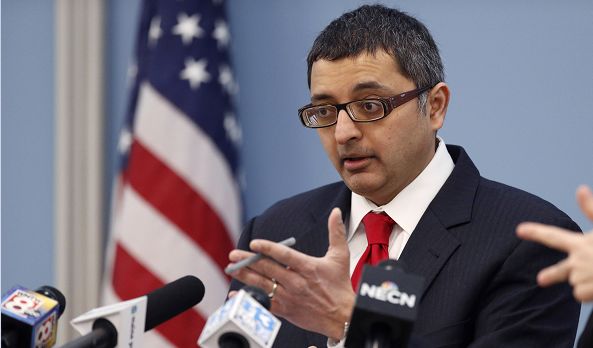
Officials at the Maine Center for Disease Control and Prevention are rolling out a new method of tracking the coronavirus in Maine using wastewater testing in an effort to more accurately track the spread of the disease, Maine CDC Director Dr. Nirav Shah told reporters today.
Shah also said that massive backlogs of test results make daily case totals less indicative of COVID-19 trends in the state.
“They don’t mean what I think folks think they mean,” Shah said in a virtual press conference.
Indeed, data released on Wednesday from Maine CDC indicates 1,545 new cases, but Shah said those are only the number of cases the state has finished processing in the past 24 hours. In reality, Shah estimated that right now the number of positive tests, on average, stands at about 3,172 every day, compared to an average of 957 daily positive tests the week of Dec. 30.
Shah said the volume of omicron-variant cases, which he described as a “tsunami,” has led in part to a backlog of 46,000 lab results awaiting processing.
“The metrics that we are using are showing their limits,” he said.
Now, Shah said Maine CDC is working with about 20 municipalities statewide to begin implementing a system to test samples of municipal wastewater for COVID. Shah said officials believe this testing will allow them to more accurately track the disease. It will also help identify spikes in the disease in specific communities, serving as a warning sign to local hospitals of an incoming surge.
“Wastewater (testing) provides us with a pooled community sample,” he said.
Shah also confirmed that data statewide indicates that the omicron variant is less severe than the delta variant, as has been reported worldwide and in the U.S. Right now, he said, there are 411 people hospitalized with COVID, compared to 382 people just two weeks ago, but only 102 of those are in intensive care, compared to 117 two weeks ago. There are fewer people on ventilators too, he said, with 53 people today compared to 59 people reported on ventilators two weeks ago.
“We’ve seen a decrease in the relative severity of individuals with COVID,” he said.
Shah warned, however, that the disease is still dangerous, and reiterated previous pleas for the public to get vaccinated, wear masks and take other precautions against the disease.
“Even something that’s milder than delta is still a significant illness,” he said.