




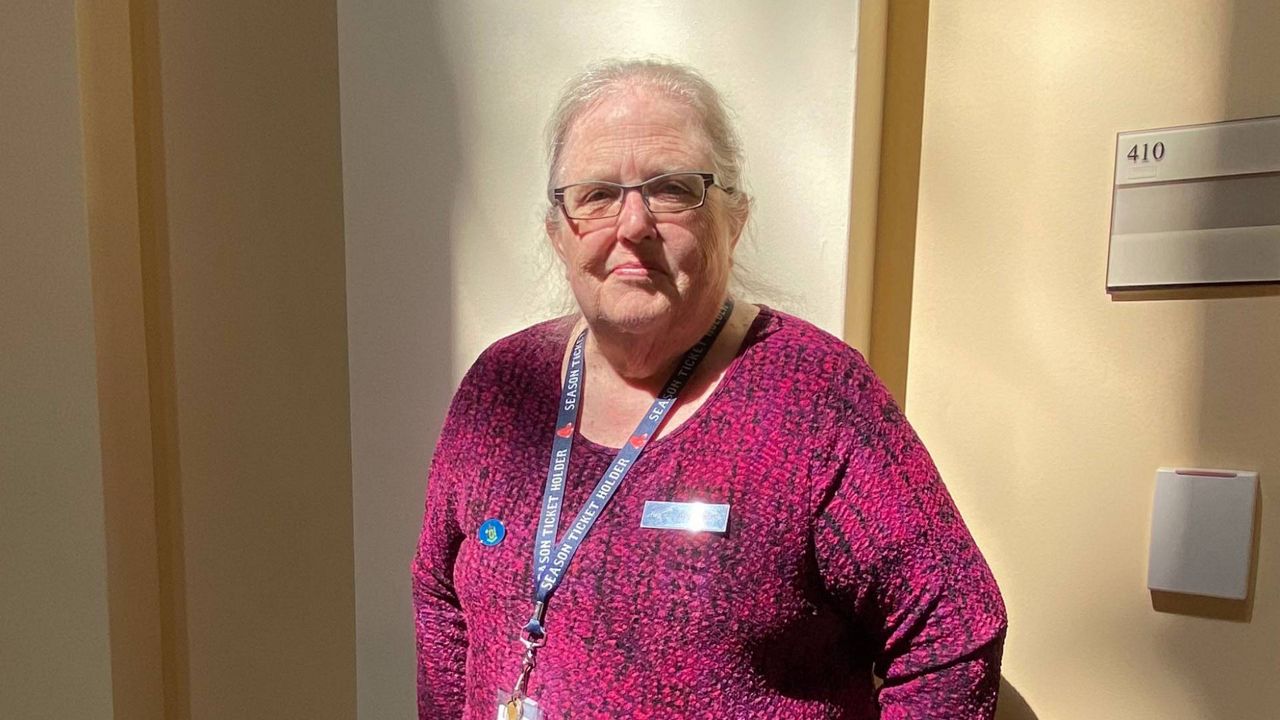
When Rep. Lois Galgay Reckitt first won election to the Maine House, she sponsored an amendment to the state constitution to enshrine the rights of women.
The 2017 state-level equal rights amendment that sought to “explicitly protect against sex discrimination,” failed to pass.
She tried again two years later. Then two years after that. And now, she’s trying one last time with a version of the amendment that would protect “all Maine residents.”
A cancer survivor in her late 70s, Reckitt will be term-limited out of office next spring. A member of the Maine Women’s Hall of Fame who spent 36 years leading Family Crisis Services in Cumberland County, she sees this as her last shot at getting an amendment passed.
She hopes the latest version — inspired by a vote on a similar measure passed in Nevada last fall — will get over the finish line.
“It’s clear that what I was doing was not working,” the South Portland Democrat said during a break at the State House last week.
LD 1412 proposes to amend the state constitution to protect equal rights “based on the actual or perceived race, color, religion, sex, sexual orientation, gender identity, gender expression, age, physical or mental disability, ancestry or national origin of an individual.”
“It includes what I wanted initially and really I have no objection to not discriminating against a whole raft of people,” she said.
The language mirrors the protected classes listed in state law who are covered by the Maine Human Rights Commission.
So why put it in the constitution?
Because the make-up of the Legislature changes every two years and laws can be easily repealed, while the constitution is difficult to amend.
“It’s essentially making more permanent what’s been accepted by the populace and the Legislature as appropriate,” she said.
Reckitt, who was inducted into the Maine Women’s Hall of Fame in 1998, served 15 years on the National Board of Directors of the National Organization for Women.
She co-founded the first chapter of NOW in Maine, the Maine Coalition for Human Rights, Maine Right to Choose and the Maine Women’s Lobby.
For fellow House Democrats, she’s a wealth of knowledge.
“We have this history book in Lois,” House Majority Leader Maureen Terry (D-Gorham) said. “Having her here to be our shining light as to how women are where they are is a huge advantage for us.”
Terry said it will be a challenge to get the constitutional amendment passed with two-thirds support. But she said it’s a way to remind fellow Mainers that women still earn less than men and struggle for equal representation in places like Congress and the State House.
“I think having people like Lois around to remind us of that is incredibly important,” Terry said. “Hopefully she’ll be able to get her point across to more people than she has in the past few years and pass that bill.”
As Reckitt works the halls to gin up the support needed to pass the bill, she’s come up with the campaign slogan “Equality: Let the People Vote.”
That’s because if it passes the Legislature, it will then need to be ratified by Maine voters before it is added to the constitution.
Opposition to previous attempts to protect women from sex discrimination came from the Roman Catholic Diocese of Portland and the Christian Civic League of Maine. Both groups cited concerns that the amendment could be interpreted by the courts as mandating state-funded abortions.
But a leading supporter of the effort is Gov. Janet Mills, who told lawmakers in 2019 that although progress has been made it “has been piecemeal, intermittent and impermanent.”
Mills traveled to Reckitt’s house in December to swear her in to office because she was still recovering from surgery to remove colon cancer.
Reckitt is now back in action at the State House, serving as a member of the Judiciary Committee and sponsoring bills to change state law with regard to commercial sexual exploitation.
When her legislative term ends next spring, she’ll be 80 and ready for a break.
Until then, she’ll continue her fight for equal rights.
“I’ll be terribly disappointed if I do this for eight years and can’t do the single thing I was most determined to do when I came,” she said. “But life goes on.”