




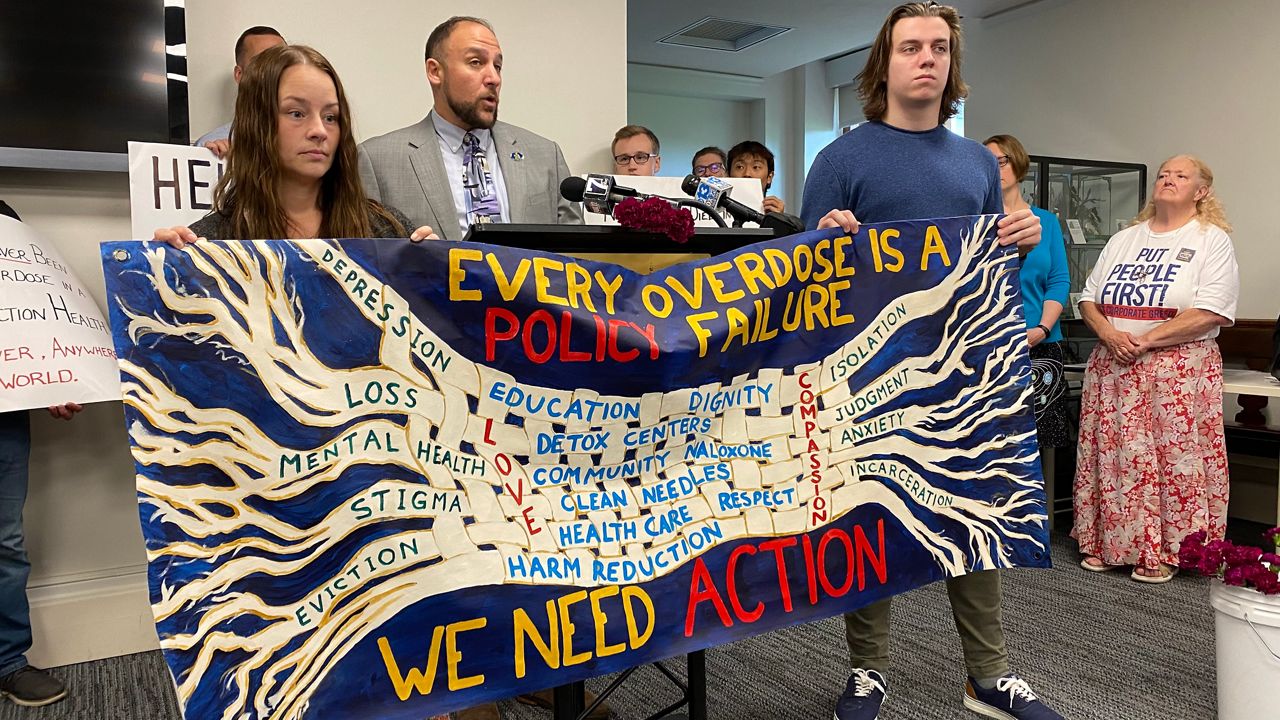
Rep. Grayson Lookner listed the names of seven friends who have died of drug overdoses, recalling lives cut short by substance use disorder.
“None of them could join us today because they are among the thousands who tragically died from preventable opioid overdoses in recent years,” Lookner, a Portland Democrat, said on Thursday. “They were mothers and fathers, sons and daughters, partners, friends and co-workers. They were teammates, roommates, bandmates and soulmates.”
Lookner and several others urged lawmakers to address the state’s overdose crisis by supporting the creation of harm reduction centers, which are sites where people can “self-administer previously obtained drugs,” according to the bill summary.
Last year, an estimated 715 Mainers died of drug overdoses, the third straight record-setting year.
From January through April this year, 201 fatal overdoses have been recorded, according to the Maine Drug Data Hub. By comparison, 215 overdoses were reported in the same period last year.
Lookner’s bill, LD 1364, requires that the harm reduction centers be approved by a municipality. They must provide clean facilities, safe disposal of needles, the overdose-reversing drug Narcan, and medical and social services. It also provides immunity from arrest or prosecution for clients and staff at the sites.
Courtney Gary-Allen, the organizing director of the Maine Recovery Advocacy Project, said the bill carries no cost to Maine taxpayers and the sites would be funded by private foundations or potentially through settlement funds the state has received from opioid manufacturers.
The bill passed the Criminal Justice and Public Safety Committee with six Democrats voting in support and five Republicans in opposition.
Ben Goodman, a spokesman for Gov. Janet Mills, said he would not speculate whether Mills will support the measure, noting that the final version has not yet been passed by lawmakers.
But in April, Gordon Smith, director of opioid response for the state, testified in opposition to the bill on behalf of Mills.
Smith noted that federal law prohibits these facilities and that there’s not enough evidence to show that they help people get into recovery programs.
“Given the lethality of the current drug supply, we should be doing all we can to encourage individuals to find a pathway to recovery, as continuing to use in this environment all too frequently results in a fatal overdose,” Smith wrote to the committee.
He said the administration is supporting syringe service programs, working to increase in-patient and out-patient treatment options, and opening recovery centers across the state.
Advocates for the facilities say there are more than 120 harm reduction centers across the world and that there has never been a fatal overdose at one of them. New York, Rhode Island and Minnesota have established or are in the process of opening the centers.
Gary-Allen said she isn’t concerned about federal interference and that Maine already defies federal law when it comes to cannabis.
“If we can be willing to allow the selling of recreational cannabis regardless of the fact that it is federally illegal, then I think the state of Maine should be willing to save lives as well,” she said.
Lookner said he’s working to gain bipartisan support for the bill, which will hit the House floor in the coming days, in anticipation of a potential veto by Mills.
“There are a lot of Republicans who have been personally affected by this issue,” Lookner said. “It’s not a Democrat or Republican issue. I think we’ll be able to wrangle a significant number of votes from both sides of the aisle to get this through.”