




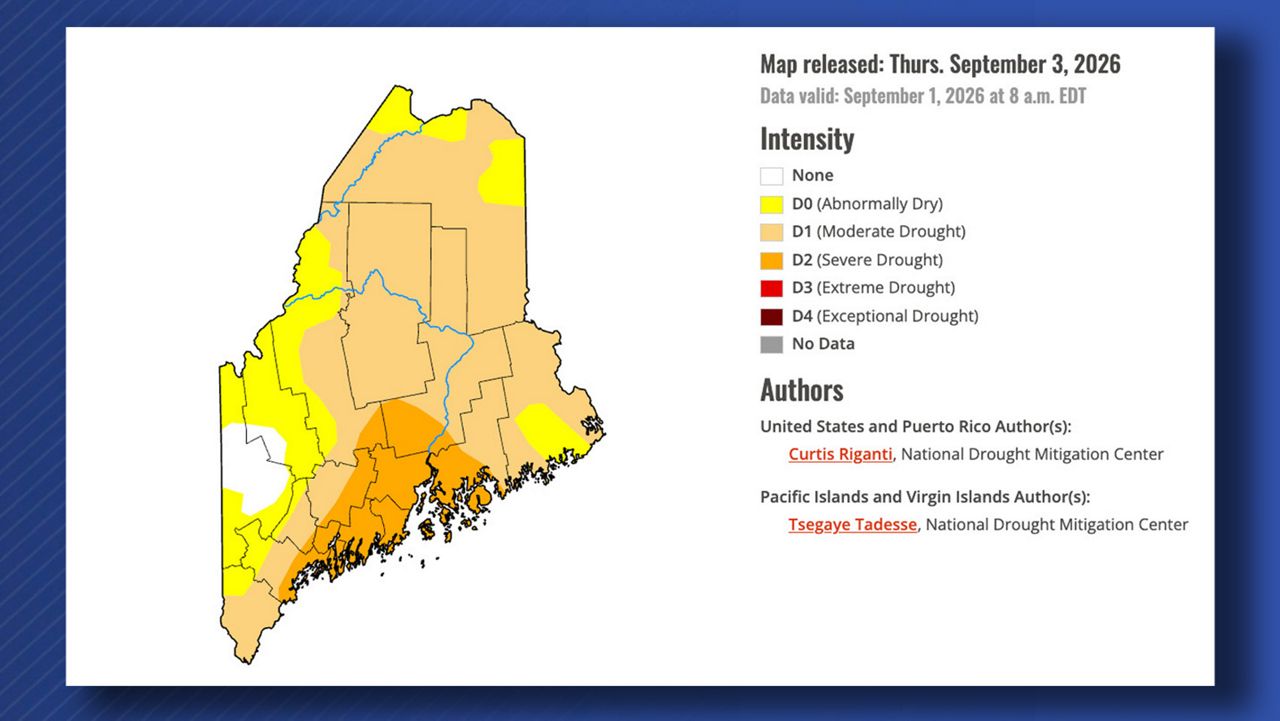
AUGUSTA –– Maine has grown drier and drier over the summer, and there may be a return to the same drought conditions the state faced last year before the end of 2026, including below-average river levels and water tables.
Those were some of the key messages during a Thursday briefing on the state’s current drought conditions. Officials from multiple state and federal agencies presented data and opinions about the water levels in Maine now, and where they might be headed.
“The reason we’re convening today is that the trends are sliding toward more severe drought across more of the state,” said Paul Styslinger, natural hazards planner for the Maine Emergency Management Agency.
Donny Dumont, a meteorologist with the National Weather Service in Gray, noted that drought conditions were “progressively getting worse” along the coast in particular throughout the summer.
Other evidence, he said, suggests the drought is expanding inland, with conditions already mimicking those seen statewide at this time last year.
“Things could still get much worse as we get into the fall season,” he said.
The impacts, officials said, are already noticeable. Claire Briggs, an environmental specialist at the Maine Department of Environmental Protection, said the Androscoggin river basin is doing better than in 2025, but still remains 3.6% below the long-term average depth.
The Penobscot river is 5% below long-term average, the Union River is 17.8% below average and Graham Lake, just north of Ellsworth in Hancock County, is down 1.92 feet from its long-term average, Briggs said.
Nick Stasulis, a supervisory physical scientist at the U.S. Geological Survey, said half the state’s drought-monitoring stations are reporting below or much below normal water levels.
Four of those stations, including one near Augusta, he said, report moisture levels at an all-time low. Groundwater levels, he said, are critically low along the Interstate 295 and Interstate 95 corridors, and some areas have remained below normal since last year.
“In my opinion, that’s the biggest concern as far as water resources go, kind of that long-term groundwater deficit there,” he said.
Other concerns include the health of crops. Officials noted that from 1999-2003, a historically severe drought period cost the state an estimated $32 million in lost crops.
This year’s conditions don’t seem that bad, but heat can lead to evaporation, and Portland had the second-warmest summer this year, while Caribou reported the 13th warmest summer.
That means some farmers may be looking for additional water sources. Tom Gordon, public service coordinator at the Maine Department of Agriculture, Conservation and Forestry, said 85% of farmland in Maine is not irrigated.
Farmers can apply for grants, Gordon said, to help build new wells or water storage ponds, but right now only $300,000 is available, enough to realistically help no more than 15 farms.
“This is really a drop in the bucket,” he said. “We know additional funding is needed.”