




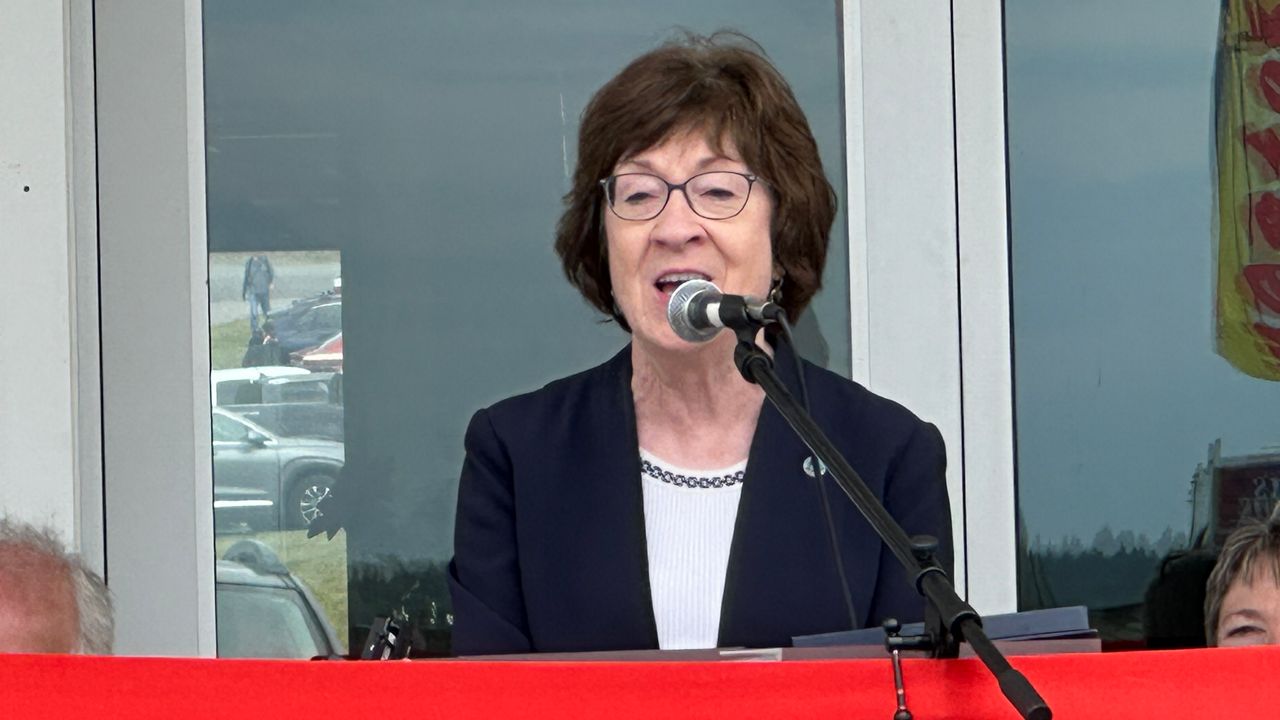
EASTPORT — Sen. Susan Collins said Saturday she’s not optimistic the House and Senate will easily reach an agreement on a tax and budget bill.
Last month, the House passed the “big, beautiful bill” by one vote and President Donald Trump has said he wants it on his desk by July 4. But after an event at the Eastport airport on Saturday, Collins said the bill needs modification.
“I’m not at all confident we can reach an agreement,” she told Spectrum News. “I personally think that the bill should have been divided into two bills.”
The bill seeks to extend the 2017 tax cuts and institute new work requirements for those who get health insurance through Medicaid. Collins said it would have been easier for Congress to deal with one bill extending the tax cuts and another on social service cuts to help pay for it.
She said her primary worry is the potential impacts on rural hospitals.
“I’m concerned that if there are cutbacks in some of the Medicaid programs it could have an adverse effect on our rural hospitals in Maine,” Collins said. “Many of them are barely making it now, financially.”
Collins said she’s hoping to come up with “some sort of fund” to provide assistance to rural hospitals.
Collins, a five term Republican up for reelection in 2026, said she supports the work mandates in the bill that would require childless adults on Medicaid to prove they are working to continue to receive health insurance.
Estimates show that could result in about 50,000 Mainers losing health care coverage through the state’s Medicaid program called MaineCare.
Collins said she hopes the work requirement shifts more Mainers onto private health insurance, but that rural hospitals are concerned about the potential loss of insured patients and proposed changes to the reimbursement formula.
On the tax cuts, Collins said she supports extending the 2017 package. She said the House bill proposes to increase the child tax credit to $2,500 and if the tax cuts are not approved, it will drop back to $1,000.
She said the standard deduction was doubled in 2017 and that as a result, 97% of Mainers take the deduction rather than itemize their taxes.
Collins said she disagrees with a recent Congressional Budget Office analysis that characterized the tax cut package are regressive. The office estimates that the poor would see their incomes reduced by 3.9 percent, largely because they would lose Medicaid and food stamp benefits.
Middle income Americans would see their incomes increase just under 1% and high earners would see their incomes go up by 2.3%, the analysis shows.
Collins said she is open to reducing the tax benefits for the ultra-wealthy.
“I don’t have any problem with allowing the very top rate for the Elon Musk’s of the world, the billionaires to go back up to what it was prior to 2017,” she said. “On balance, I think the tax provisions need some tweaking but are good for families and for small businesses and for our economy and job creation.”