




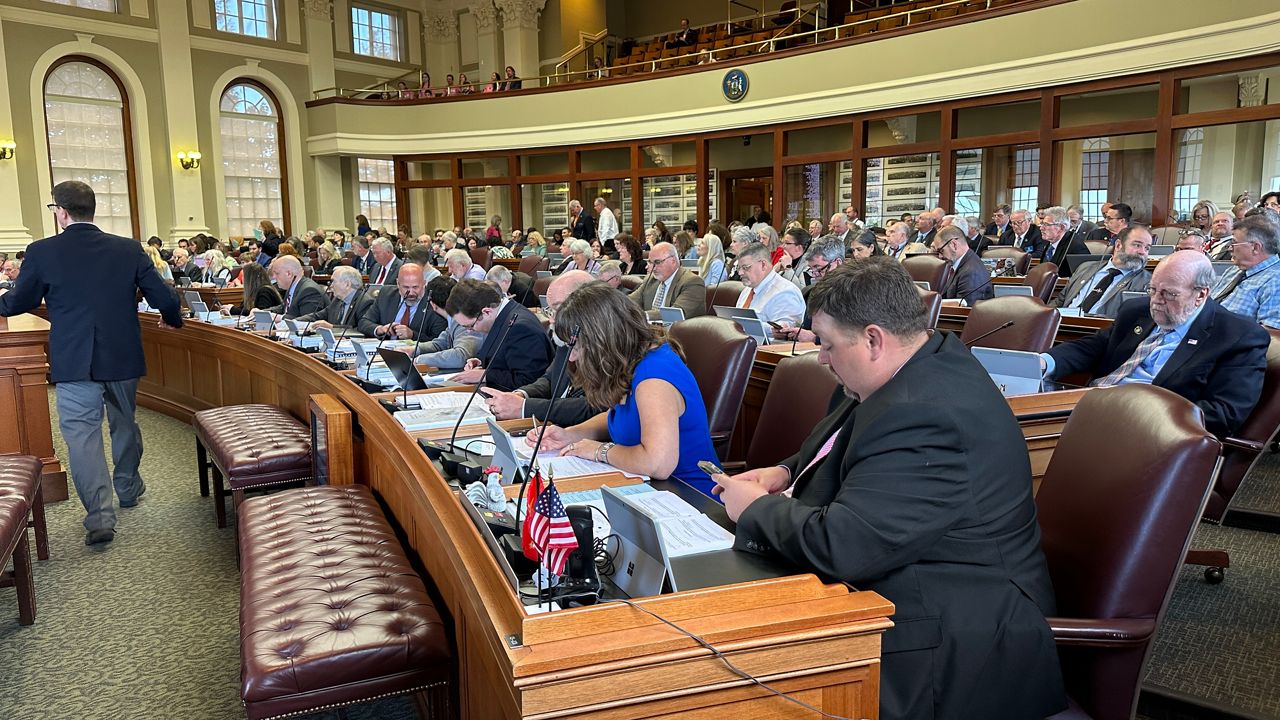
AUGUSTA — When lawmakers return to session on Wednesday, they are likely to consider whether to override bills vetoed by Gov. Janet Mills in recent days.
They are the first batch of bills vetoed this year by the governor, who is traveling in Canada this week and is expected back on Thursday.
Among the bills is a measure to allow agricultural employees to discuss pay and working conditions with other workers. During House debate earlier this year, Republicans argued that it was essentially a bill to open the door to unionization.
But Democrats said it was necessary because federal law allows farm owners to fire agricultural employees for discussing pay and working conditions.
In her veto letter, Mills said the bill would implement a “complicated new set of labor laws that will require a lawyer just to understand.” She laid out the difficulties facing farmers, including climate change, PFAS contamination and inflation.
She cited statistics that show Maine has lost more than 1,100 farms since 2012.
“Now is not the time to impose a new regulatory burden on our agricultural sector, and particularly not family-owned farms that are not well positioned to know and understand their obligations under a new such law,” she wrote.
The bill, LD 588, passed the House 74-71 on the final vote, making it unlikely that lawmakers can muster enough votes to override the governor’s veto. It takes two-thirds to override.
Other bills vetoed:
LD 958, An Act to Prohibit Eminent Domain on Existing Tribal Land Trusts. In the veto letter, Mills explains her veto by saying that she prefers to work with the state’s four tribes on specific issues, rather than blanket laws. She said this bill would “permanently deny” the state’s ability to take small portions of tribal land for road and bridge projects. She said existing imposes strict limits on the state’s ability to take tribal land.
LD 1328, An Act to Create Culturally Appropriate and Trauma-Informed Housing and Recovery Services. The bill would require MaineHousing to oversee two recovery centers for those with substance use disorder. Mills writes that MaineHousing’s mission is to help people “rent, repair, and heat their homes” and that recovery services is beyond the scope of the agency’s mandate.
LD 1731, An Act Regarding the Advisory Board for the Maine State Ferry Service. In her veto letter, Mills says the bill gives the advisory board “quasi-managerial” power that properly rests with the Maine Department of Transportation.
LD 1802, An Act to Implement the Recommendations of the Maine Commission on Public Defense Services to Clarify When an Indigent Criminal Defendant is Entitled to Counsel at State Expense. Mills writes that the bill will expand the responsibilities of the state’s new public defense system at a time when it is already struggling to keep up with its caseload.
The Senate is scheduled to be in session at 9 a.m. Wednesday, followed by the House at 10 a.m.