




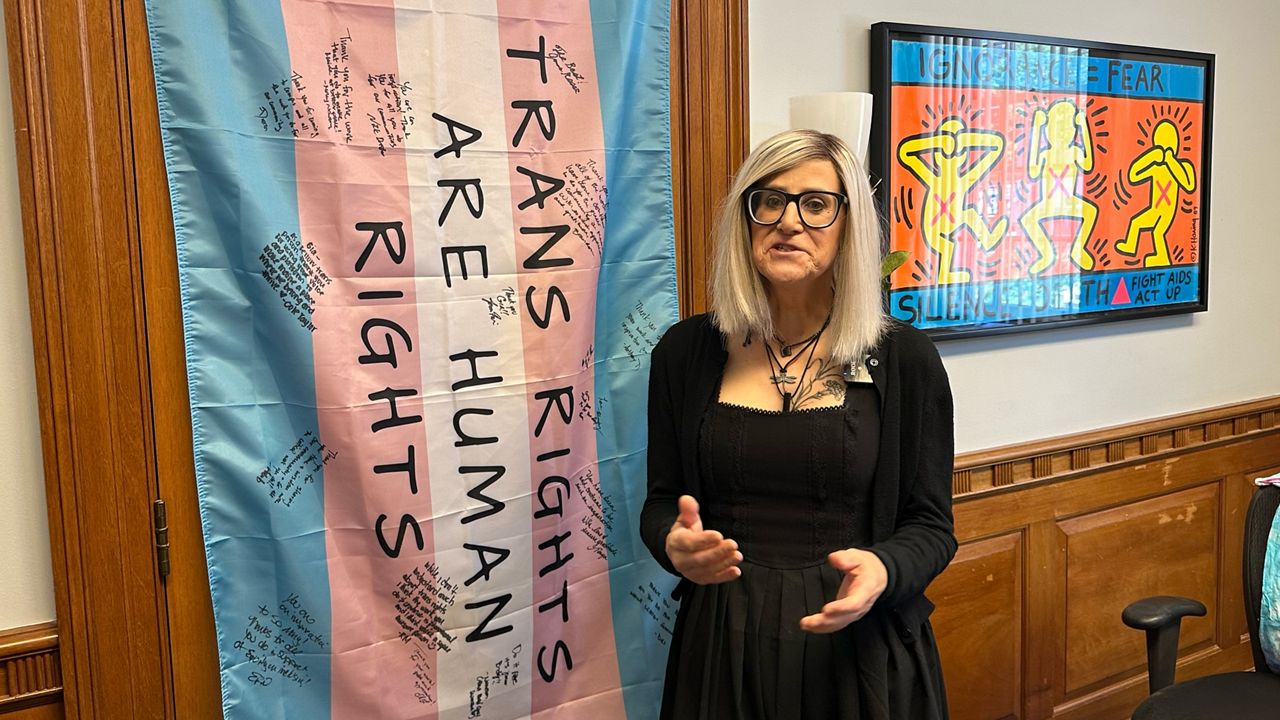
PORTLAND – A Maine activist is worried that the Trump Administration is eliminating LGBTQ+ data-collecting programs at the federal level.
“Data going away just sort of tries to hide that we even exist, and erases us from existence,” said Gia Drew, executive director of EqualityMaine.
Drew’s comments come after the release of a study from UCLA documenting the number of people in the U.S. who identify as transgender.
According to the study, more than 2.8 million people nationwide identify as transgender.
Of those, 11,000 adults identify as transgender in Maine, roughly 1% of the population. The study also found that 2,900 children aged 13-17 identify as transgender. That figure represents just over 3.5% of the state’s population in that age group.
The study cited the U.S. Centers for Disease Control and Prevention’s Behavioral Risk Factor Surveillance System and the Youth Risk Behavior Surveillance System. Both systems, the study’s authors wrote, have been collecting data related to gender identity for some time.
But both systems and similar programs and projects appear to be on the chopping block.
A memo from the U.S. Office of Personnel Management dated Jan. 29, 2025, states the intent by the Trump Administration to “end federal funding of gender idealogy.”
The memo, written by then-Acting Director Charles Ezell, cited President Donald Trump’s executive order, “Defending Women from Gender Ideology Extremism and Restoring Biological Truth to the Federal Government (Defending Women).”
The order was part of what led to a fiery public confrontation back in February between Trump and Gov. Janet Mills, who publicly stated she was refusing to go along with it.
Ezell’s memo instructed federal agencies to, among other things, “Review all agency programs, contracts, and grants, and terminate any that promote or inculcate gender ideology,” and begin working “to close/end all initiatives, offices, and programs that inculcate or promote gender ideology.”
In February, the Williams Institute cited this memo as proof the administration was attempting to mothball any efforts to collect data related to LGBTQ+ issues, including gender identity.
“The removal of such data from the public record and the loss of future data would set the United States decades backward to a time when little was known about the current demography, health, and well-being of the 14 million LGBT people in the United States,” Ilan Meyer, a scholar of public policy at the Williams Institute, wrote at the time.
Drew agreed, saying the data can be helpful in a number of areas, particularly health care, and she worried about what the closing down of such programs will mean going forward.
“The idea of not even asking these questions anymore is a real concern of ours, that that data isn’t going to be there anymore, at least in the short term,” she said.
Drew, who has been keeping track of recorded transgender data in Maine for some time, said data collected on the state level matches the institute’s numbers, so there were no big surprises, but the data is still useful.
“I think for a lot of people who aren’t in the weeds on LGBTQ issues, or data, it might have been shocking to know just how many transgender people there are,” she said.
Drew said she found it interesting to see a larger percentage of transgender people among teens than adults, and noted it said something about how attitudes toward transgender people vary with age.
“There’s definitely a generational issue where young people are more apt to be open around looking around at gender and sex as very sort of, a spectrum, if you will, rather than really narrow ‘this or that,’” she said.
Drew said she was a teacher when she came out as transgender about 15 years ago. When asked what the reception was like, she said, “bumpy,” adding that some parents had some “discomfort” with the idea.
Drew said data like the figures produced by the Williams Institute can only help to educate people about gender identity, hopefully making it easier for others to come out as transgender in the future.
“Sometimes there’s an invisibility around being LGBTQ in this world, or being trans specifically, so I think it’s always helpful to get some actual, real numbers,” she said.