




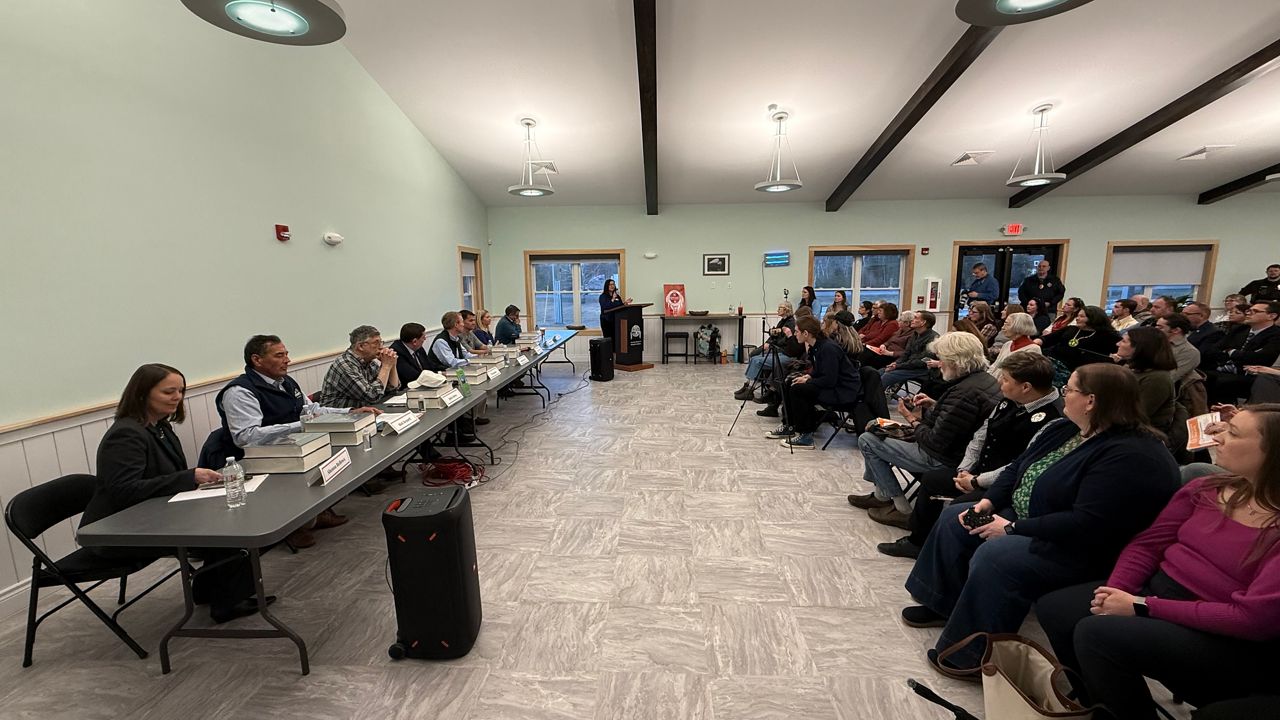
HOULTON — Eight candidates for governor fielded questions about the future of the Wabanaki nations at a forum in Houlton Thursday night.
Tribal sovereignty, which allows indigenous tribes to self-govern, stood out as a key talking point.
“I want to thank tribal leaders who have stood beside me while we have been at the state, at the federal government, and really highlighting the importance of tribal sovereignty, self-determination, and the unique status that we have as tribal nations,” Tribal Chief of the Houlton Band of Maliseet Indians Clarissa Sabattis said in her opening remarks. “I think that is something that whoever comes into this office as governor, I hope, can really understand.”
Out of the 574 federally recognized tribes in the U.S., the Wabanaki Tribes are the only ones not fully recognized.
The candidates at Thursday’s forum, hosted by the Wabanaki Alliance and the Houlton Band of Maliseet Indians, all said they support tribal sovereignty.
“Tribal sovereignty will be good for Maine’s tribal nations. It will also be good for Maine,” said Secretary of State Shenna Bellows, a Democrat. “It will bring economic development, it will bring healthcare, it will bring environmental protections, and I am passionate about this.”
Bellows was joined by fellow democrats Hannah Pingree, the former house speaker, former Senate President Troy Jackson, Dr. Nirav Shah and Angus King III, the son of the U.S. senator.
Retired state worker John Glowa, home builder Derek Levasseur, and Sen. Rick Bennett were the independents at the forum.
“Why would anybody who lives in this state of Maine, in state government or federal government, oppose fair and equitable treatment of the federally recognized tribes that are within our state borders,” said Bennett.
According to the organizers of the forum, Republican candidates for governor were invited but did not attend.
Candidates also touched on questions of restoring access to federal laws for tribes and funding Wabanaki studies in schools.
“There’s a proud culture and heritage and history in our state of the Wabanaki nation,” said King. “There’s also a fairly shameful component of that history, and I think it’s critical that every Maine child understands that history.”
This was another point of agreement.
“I absolutely would support fully funding this program so that it could be robustly and uniformly taught in every school in the state of Maine,” said Pingree.
Candidates were also faced with the question of whether they would support tribal funding going directly to Wabanaki Nations.
“To the question of allowing the money to come directly to the tribes, yeah, absolutely,” said Jackson. “Especially where the other tribes get it directed from the federal government. I would want it to work exactly the same way.”
Several candidates emphasized this as an essential issue.
“I would restore the ability of the Wabanaki Nations to get the full funding that they deserve from the federal government,” said Shah. “If every other tribal government in the country can benefit from that full funding, then the Wabanaki Nations should, as well.”
But, from beginning to end, much of the forum revolved around sovereignty.
“Another thing that I want to do is to bring sovereignty to what we shouldn’t have to bring sovereignty to,” said Levasseur. “This is your right. Your God-given right. Your birthright.”
Leaders of Maine’s four federally recognized tribes testified on two pieces of legislation relating to the issue just last month.
“Basically, I think we’re all equal,” said Glowa. “We should all be treated equal. And we need a government that does that.”