




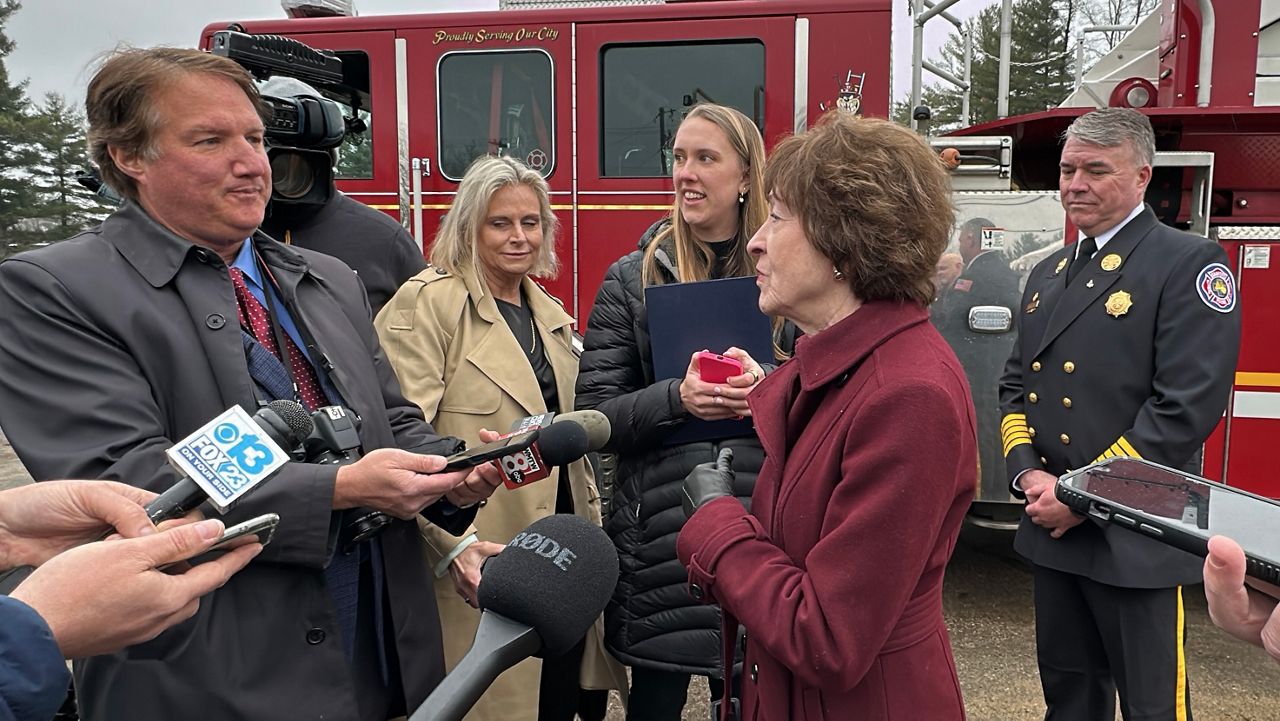
SANFORD –– U.S. Sen. Susan Collins (R-Maine) said she does not support a ground war with Iran right now, and that the president will need to make his case to Congress if he wants to go forward with deploying troops.
“Based on the briefings I’ve had so far, I do not support boots on the ground,” she said.
Collins spoke about Iran, the partial government shutdown and the upcoming election in remarks after attending a groundbreaking ceremony for a new fire headquarters in Sanford Tuesday afternoon.
Collins said it’s important to prevent Iran from developing a nuclear weapon, but “it’s a whole other layer when we’re talking about deploying ground troops.”
Collins said she would support a congressional war power resolution wanting hostilities to cease if boots are put on the ground. Even then, she said, the president would need to make a strong case for the need to deploy soldiers.
“The president should not be taking that step without a specific authorization from Congress, an authorization that I’m not willing to provide based on the information I now have,” she said.
Collins continued to blame Democrats trying to block DHS funding for the partial government shutdown. Democrats have been saying since early 2026 in response to ICE operations nationwide last year that they would not support funding for DHS.
“The American people support law enforcement, they support border security, they do not support ICE terrorizing our streets and killing American citizens,” Senate Minority Leader Chuck Schumer (D-N.Y.) told the Associated Press in January.
Sen. Angus King, an independent who caucuses with Democrats, also voted for the partial shutdown.
“I hate shutdowns, but I cannot in good faith vote for a bill that funds the Department of Homeland Security, specifically ICE, under these circumstances,” King wrote in a Jan. 29 statement.
Collins said she has already supported what she called “guardrails” for ICE agents, including requiring body cameras and sending the inspector general to inspect detention areas.
“Those provisions were already in the bipartisan bill that unfortunately the Democrats blocked at the last moment,” she said.
The bill, she said, also includes additional training for ICE agents, particularly relating to dealing with protestors. She said the current batch of ICE agents needed more training.
“What happened is the administration hired many new employees for ICE and deployed them after a very brief training period and I think that was a mistake,” she said.
Collins added that blocking DHS funding also could stop investigations into crimes such as child exploitation, human trafficking and drug smuggling. She also noted the blocked bill controls paychecks for TSA agents, along with funding for departments such as FEMA, the civilian portion of the U.S. Coast Guard, the U.S. Secret Service and the U.S. Cybersecurity and Infrastructure Security Agency.
“I think we’ve got to get this department fully funded and operating,” she said.
Collins also discussed her bid for re-election. When a reporter noted she would, if reelected, be 79 years old at the end of her sixth term, she laughed off comments that age might be a factor in the election. She pointed to her record of never missing a single vote and now, in her fifth term, she is approaching her 10,000th vote in the Senate.
“That pretty well speaks to my energy,” she said.
Reporters also asked about recent polling in the Maine Democratic Primary. A March 26 poll from Emerson College in Boston shows oyster farmer Graham Platner with a lead of 27 percentage points over Gov. Janet Mills. The poll also found that while both Platner and Mills had an edge over Collins in the general election, Platner was favored more.
On Tuesday, Collins said she had “no idea” which candidate she would ultimately face, and shrugged off the data.
“I think the only poll that counts is the one on Election Day,” she said.