




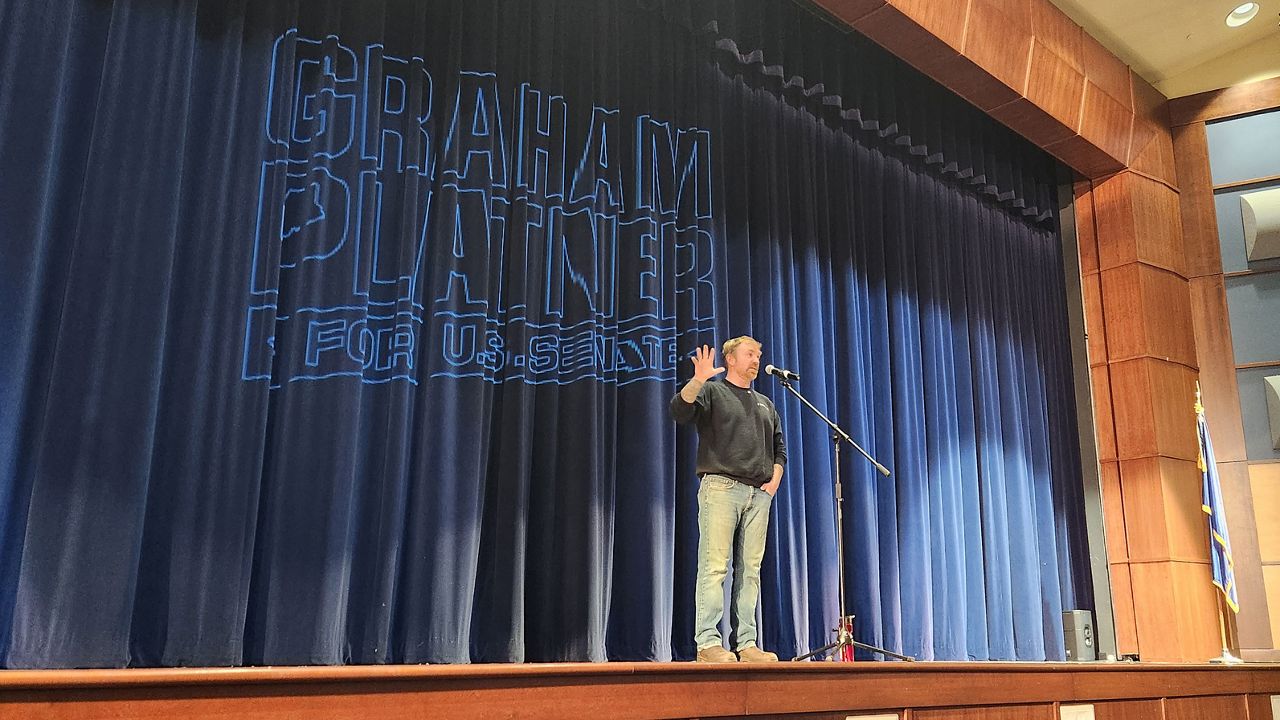
YORK, Maine — U.S. Senate hopeful Graham Platner took to the stage in York Friday, telling a crowd of supporters he didn’t believe in the Iran War, did support ranked-choice voting at the federal level and has turned away from the “hyper-masculine” culture of his military service.
Platner is challenging Gov. Janet Mills for the Democratic nomination for U.S. Senate, with polling showing him at times to be leading Mills. If he wins, he’ll be challenging incumbent Republican Sen. Susan Collins this fall.
On Friday, the York Community Auditorium was nearly three-quarters full as Platner addressed the crowd. He spoke from his blue-collar roots, decrying a system in Washington that he said is serving the wealthy and powerful at the expense of working-class Mainers.
“The path we are on is entirely unsustainable,” he said.
On the war in Iran, Platner said he believed the war wouldn’t make America more secure, and Maine voters are telling him they think the war is “magnificently stupid.”
“I have been all over the state of Maine over the past month, two months or so,” he said. “Nobody thinks this is a good idea.”
Many of Platner’s talking points were met with cheers and applause. During a brief question-and-answer session with the audience toward the end, he addressed accusations that he had made misogynistic comments in the past.
Platner referred to his military service, including three tours in Iraq as a U.S. Marine and one tour in Afghanistan with the U.S. Army National Guard. He called the military culture “hyper-masculine.” After leaving the service, however, he said he worked with a veterans’ organization and heard multiple stories from former service members about sexual trauma.
“It was a realization to me that my lived experience was incredibly narrow, and I had some very narrow views that did not reflect the reality of most other people,” he said. “I did what I think any healthy human being is supposed to do: You learn new things and you change how you think about stuff.”
When asked about ranked-choice voting, Platner said he approved of its use in Maine elections, and would also support it at the federal level.
“’First past the post’ is not a good system of elections,” he said.