




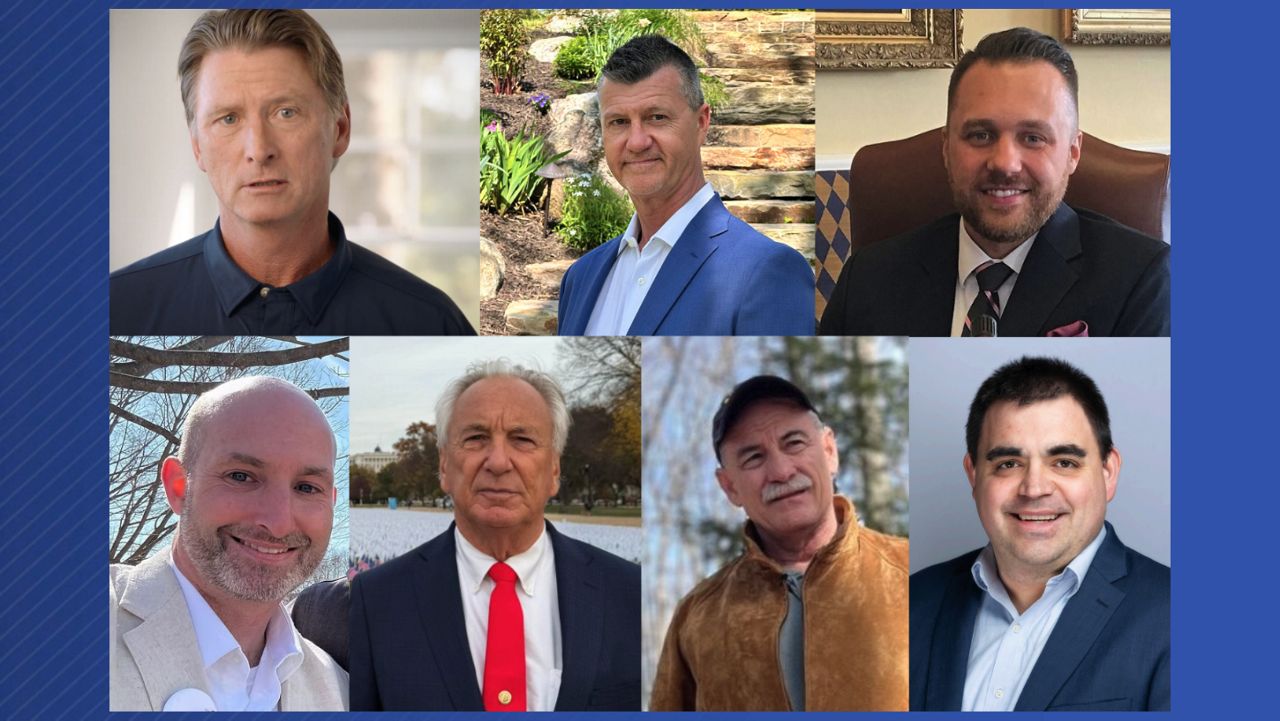

With all seven Republican gubernatorial candidates sharing a stage for the first time in a televised debate ahead of the June 9 primary election, their positions on issues such as energy and housing costs underscored their alignment. Many also agreed that their opponent Bobby Charles, present for the critiques this time, is offering up what they see as nearly impossible campaign promises.
Wednesday night’s debate, hosted by the Maine State Chamber of Commerce and News Center Maine, was the first televised debate Charles, the perceived frontrunner, attended after refusing to appear for two last week because low-polling candidate Robert Wessels hadn’t qualified for one.
The first debate centered on taxes and state spending. The second gave more insight into the candidates’ plans for healthcare and education. Some of those topics came up again Wednesday.
Charles, an attorney from Leeds and former federal government official, fell in line with many of the other candidates on some issues, including calling for work requirements for MaineCare, the state’s Medicaid program.
But his plans for taxes and the state budget drew scrutiny from his rivals.
If elected, Charles said he’d eliminate income taxes (which currently make up about half the state’s revenue) over the course of a four-year term. He’s also publicly called for cutting $4 billion out of the state budget, which Garrett Mason said would tank the state’s economy.
“I mean, I can stand up here and say I’m going to eliminate $6 billion, $7 billion, and just click bait the heck out of it,” said Mason, who served as Maine Senate majority leader during Gov. Paul LePage’s administration. “But the fact of the matter is, if you can’t get even Republican legislators to join you in that budget quest, Bobby, you can’t get it done. And so, what you need to do is you need to actually go ahead and do reasonable cuts.”
Charles listed off some of the places he’d start making his cuts: the state’s non-competitive contract awards; funding for “illegal alien” housing, electronic benefits transfer cards and MaineCare; and “opening up all the books.”
Comparatively, the other candidates promised cuts ranging from $1 billion to $2 billion from the state budget — Wessels included, who said Wednesday he’d cut $2 million in his first budget cycle.
Wednesday’s debate was framed by a long-term economic roadmap that the Maine State Chamber of Commerce, one of the sponsors of the debate, and the Maine Development Foundation released earlier this week.
The report calls for improving the state’s competitiveness as a place to do business and growing the workforce by reducing energy costs and making housing more affordable, among other proposals. The report also mentions aligning new digital and interstate commerce regulations with peer states (appearing to refer to the business communities’ opposition to a strict proposal for a comprehensive data privacy law).
Candidates were questioned about energy prices and housing, though they broadly offered up the same goals of cutting regulations and moving the state away from solar and wind subsidies.
Housing
All of the candidates expressed a desire to cut regulations and fast track permitting to try to make housing more affordable in Maine.
“We’ve got to simplify the process,” said David Jones, who owns F.O. Bailey Real Estate in Falmouth.
Charles again emphasized that he’d cut the income tax, as well as property taxes, and funding for housing for immigrants who aren’t legally present in the country.
He and Owen McCarthy, a health industry entrepreneur and University of Maine trustee from Gorham, spoke about investing in trade programs in schools. McCarthy also mentioned zoning reforms. “It’s hard to build custom modular,” he said. “We need zones where it’s easier to do that.”
Ben Midgley, the former president of Planet Fitness, said he’d expedite permitting for the Department of Environmental Protections and Department of Transportation, as well as allow for outside consultant review to expand staff capacity.
Jonathan Bush, a health technology entrepreneur who is the nephew of the late President George H.W. Bush, similarly said he’d “delegate permitting to the private sector instead of these poor souls in Augusta.” He, Wessels and others also mentioned reducing permit times and, overall, increasing housing supply.
“I don’t think it’s enough to just say we’re going to build more housing,” Mason said.
One of the first things Mason said he’d do as governor is work with banks and credit unions on offering more portable mortgages, which allow homeowners to transfer their existing mortgage balance and interest rate to a new property.
Energy
“Renewable energy requirements go out the door, into the shredder. Wind and solar subsidies go into the shredder,” Bush said. “This entire environmental virtue signaling on working people’s expense must go.”
That comment just about sums up where most of the candidates stand on renewables, though Midgley had a slightly different take.
“I’m fine with renewables,” he said, “as long as they don’t do it on the backs of Maine rate payers.”
On a similar note, Mason said he’d take an “all of the above energy approach, the cheapest possible thing.”
Most of the candidates said they’d get rid of Net Energy Billing, increase hydro power, support small nuclear reactors and expand natural gas pipelines. Charles added, “I believe that wood and biomass have an extraordinary future in this state.”
Who won the 2020 presidential election?
The final question of the debate got at whether the candidates ascribe to President Donald Trump’s false claims that he won the 2020 election over former Democratic President Joe Biden.
Charles: “I’m a constitutionalist. There’s no going back in history. Joe Biden.”
Jones: “Biden.”
Mason: “Joe Biden was sworn in as president in 2021.”
McCarthy: “Unfortunately, Biden.”
Midgely: “Biden.”
Wessels: “We need election integrity so we can answer questions like that going forward with a strong answer.”
Bush: “I don’t know why you decided to make us all so sad on the last question. Yeah, Biden won.”