




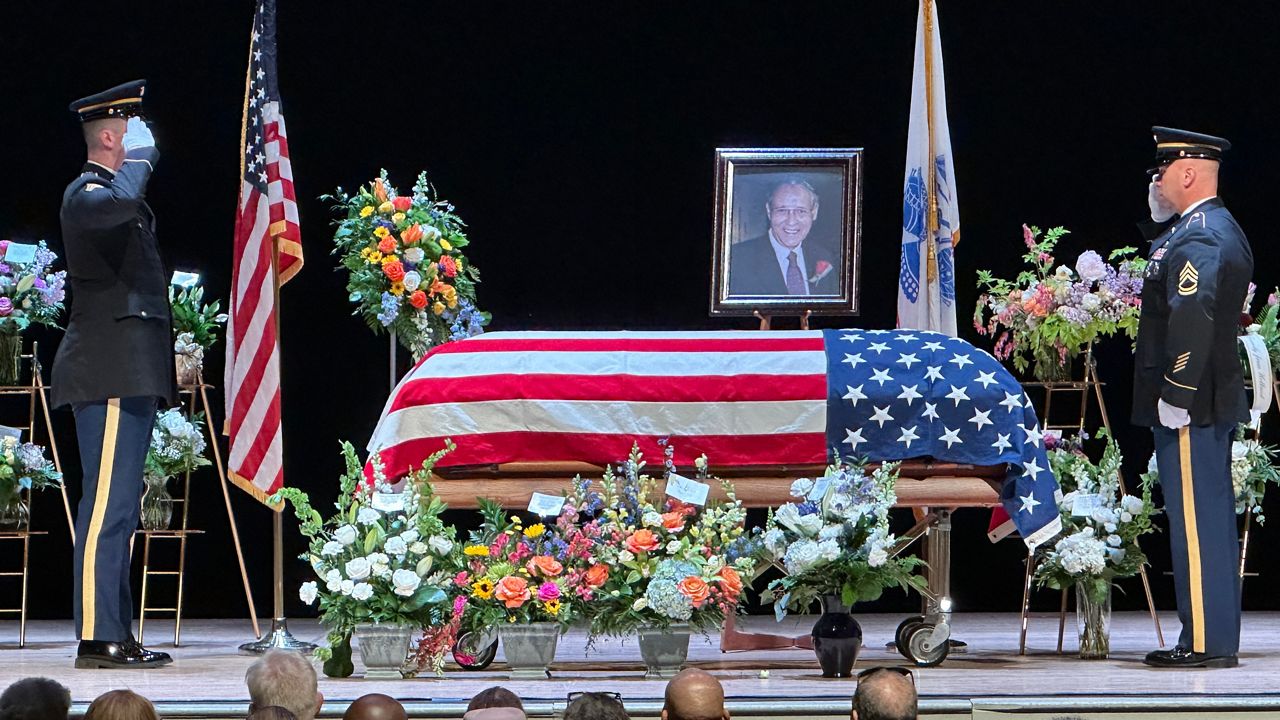
PORTLAND — Mainers honored the life and legacy of Gerald Talbot on Thursday, recalling his impact as the state’s first Black legislator and as a fighter for civil rights.
“Gerald Talbot’s thirst for justice was never satisfied,” said Gov. Janet Mills.
Hundreds gathered in Merrill Auditorium to remember the accomplishments of a man who experienced his own discrimination in housing and went on to change state laws to help others.
Sen. Mark Lawrence (D-Eliot) called Talbot a “liberal lion” who inspired others to continue the fight for equality.
“The courage, the determination, the humility, the persistence, the ability to get involved and say I’m not going to accomplish everything, I’m going to find this thing and do it,” Lawrence said.
Born in Bangor in 1931, Talbot died May 9 at the age of 94.
An Army veteran, Talbot registered Black voters in the South in the 1960s, according to his obituary. He attended the March on Washington in 1963, and when he got home, worked to revive the NAACP in Maine.
Talbot served on a task force that helped create the Maine Human Rights Commission, worked to pass the Maine Fair Housing Act, and in 1972 became the first African American elected to the Maine Legislature, his obituary states.
Just five years later, he introduced the state’s first gay rights legislation and went on to serve on the Maine State Board of Education.
He and his wife Anita had four daughters, including former House Speaker Rachel Talbot Ross. Surrounded by her sisters, Talbot Ross spoke lovingly about her father and his dedication to keeping Black history alive in schools, at Rotary Clubs and in the State House.
“He wanted future generations to learn, to ask questions and to understand that Black history is Maine history,” Talbot Ross said. “And Maine history is American history.”
Portland Mayor Mark Dion spoke of working with Gerald Talbot for decades, first as a police officer investigating hate crimes. He said Talbot made an immeasurable impact on his life over the years.
“Despite his own scars, he continued to push others up, that is what good men do,” Dion said. “They introduce you to your own goodness.”
The celebration of life includes traditional hymns and prayers, a military tribute and remembrances from family and friends.
Penobscot Nation leader Donna Loring, who served in the state Legislature as a tribal representative, said the Wabanaki people looked up to Talbot and hoped his work would help them make progress on their own fight for equality.
“In many ways, Jerry Talbot became a beacon in the darkness for Wabanaki people,” she said. “Jerry Talbot made this state honest, more just and more humane than before he walked into the Legislature in 1972.”