




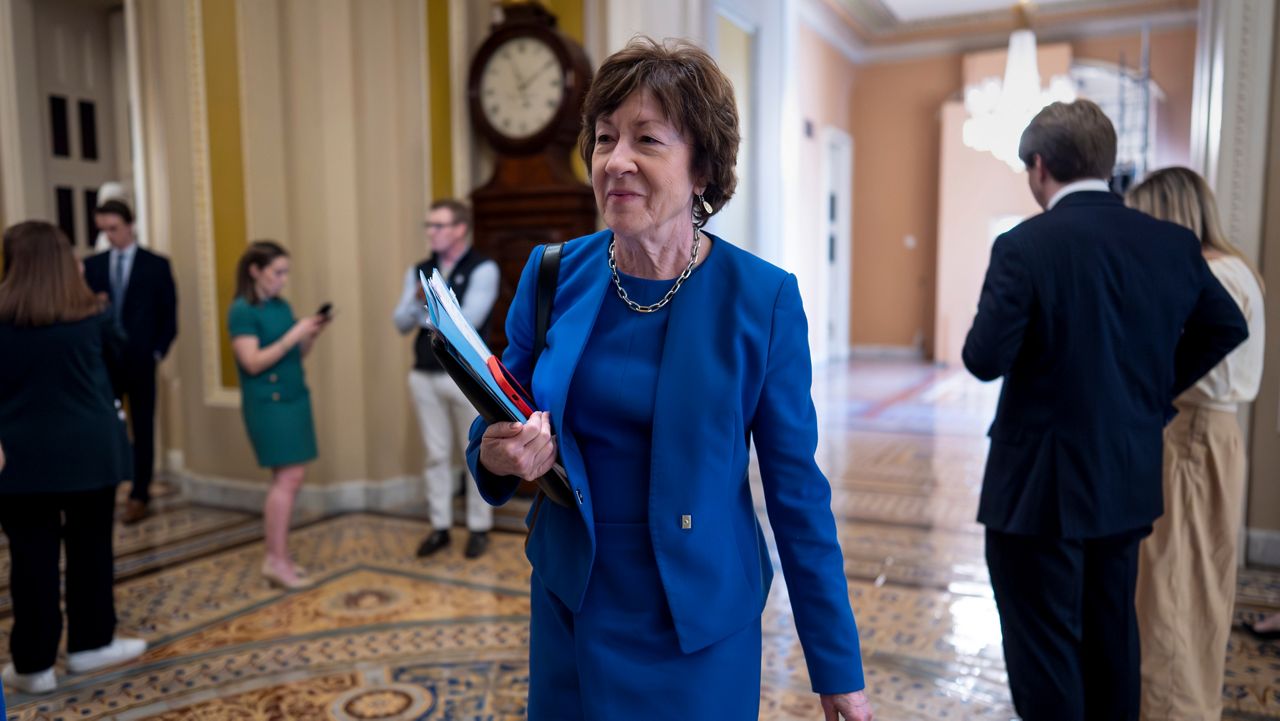

Four years ago today, the U.S. Supreme Court overturned Roe vs. Wade, the 1973 ruling that established a national right to abortion. In the majority of that decision was Justice Brett Kavanaugh, who Republican U.S. Sen. Susan Collins of Maine had voted to confirm after he had told her the landmark decision was “settled law.”
Collins’ challenger for her Senate seat, Graham Platner, and other Democrats are hoping to make her vote for Kavanaugh a sticking point during her first reelection campaign since the overturn of the constitutional right to abortion. Her opponents are hammering that theme Wednesday, with the Maine Democratic Party hosting a press conference about Collins’ record and planned protests at the senator’s Portland office.
It is to be seen whether abortion rights will energize voters in the November election. But how the candidates are discussing the issue in this hugely expensive and potentially consequential race for the balance of power in U.S. Congress also illuminates their different strategies to win over Mainers.
Collins is sticking to what’s previously worked for her: pointing out the times she’s broken from her party and touting her ability to deliver for Maine, particularly federal funding. Meanwhile, Platner is working to chip away at that persona, reproductive rights being one piece of the puzzle.
The fact-check
Last week, Collins told reporters that she didn’t regret supporting Kavanaugh’s nomination, which Platner’s campaign and Maine Democratic Party pounced on in new ads.
Then on Monday, the same day Planned Parenthood’s advocacy arm held an event endorsing Platner in Portland, Collins misrepresented that vote in an interview with Fox News, prompting her opponents to again call her out.
Misstating the vote total that overturned Roe v. Wade, Collins said she disagreed with the court’s 6-3 decision, explaining that it would’ve been overturned regardless of Kavanaugh’s vote.
But the high court’s decision involved two distinct vote counts. The 6-3 vote upheld the Mississippi law at the center of the case, while a 5-4 vote — with Kavanaugh on the majority side — explicitly ended the constitutional right to abortion.
Collins’ office has also disputed that she was the deciding vote to confirm Kavanaugh. While she broke an earlier deadlock in the upper chamber, Kavanaugh was ultimately confirmed 50-48, with a Republican senator absent.
Following both of those recent comments, Collins pivoted to her support of justices who had wanted to maintain Roe. Overall, the senator has voted for seven of the nine justices on the current court, so she both helped confirm most of the justices who overturned it and those who dissented.
Planned Parenthood’s pivot
While Collins said she didn’t regret voting for Kavanaugh, she said she disagreed with his decision to overturn Roe. She’s one of few remaining GOP members of Congress who support abortion rights.
“Obviously, I’m disappointed in that decision, which turned abortion issues back to the states,” Collins said last week. “It has not had an impact on the state of Maine in that Maine actually expanded its law.”
Since the overturn of Roe v. Wade, Maine has passed laws to allow abortions at any time during pregnancy if deemed medically necessary by a doctor, require private insurers to cover abortion, and protects the state’s health professionals who provide reproductive and gender-affirming care from being targeted by other states’ bans (deliberations of which resulted in a bomb threat at the State House), among others.
The high court decision still resulted in confusion and fear among providers and patients about the legality of abortion care, and Democratic elected officials have noted that state laws are at the whim of a given administration.
During the Monday press conference, Alexis McGill Johnson, president and CEO of Planned Parenthood Action Fund, also spoke about the 20 states that have banned some or all abortions since the overturn of Roe, saying Platner is needed to secure a majority in the Senate and change that overall landscape of abortion access.
Platner has not yet released a policy plan on reproductive rights but has said publicly that he would push to reinstate Roe v. Wade and codify the federal right to abortion. Planned Parenthood Action Fund previously endorsed Gov. Janet Mills, who suspended her bid for U.S. Senate in April.
Planned Parenthood has not always discounted Collins from its work to further reproductive freedom.
The organization honored Collins as a champion of reproductive health care issues in 2017 and Collins’ spokesperson Blake Kernan pointed to a Planned Parenthood memo from 2025 titled “Senator Susan Collins’ long history of supporting Planned Parenthood and access to essential health care,” which noted the senator’s co-sponsoring of a codification of Roe v. Wade in 2022.
When asked about the organization’s prior work with Collins at the press conference, McGill responded, “I think that senator Collins is a fair weather feminist at best.”
“I think that she is conveniently pro-reproductive freedom when it suits her,” she added, “and when she has to make tough choices, like supporting justices like Brett Kavanaugh, she chooses to go the other way.”
The competing pictures
McGill’s response echoes an oft-repeated critique of Collins, that she’s often “very concerned” about issues but doesn’t cast votes to rectify them. That is a pattern Platner’s campaign (as well as a new anti-Collins political action committee — the Very Concerned PAC) is trying to underscore.
Collins, meanwhile, continues to promote what she sees as her political dominance and how it has benefited the state.
In the Fox News interview, Collins shifted the conversation to point out her independent moments compared to others in the GOP — though the host pointed out Collins has voted with Trump 94% of the time.
When asked what she thought of Mainers who still supported Platner despite the controversies, Collins said, “It surprises me,” before adding, “I understand that people are having a difficult time right now economically. That’s why I’ve worked so hard to bring $1.5 billion back to the state of Maine during the past five years.”
That’s also been a focus of outside groups running pro-Collins ads highlighting the earmarks she’s secured, including for rural healthcare.
On the other hand, Platner has tried to draw attention to other ways the senior senator’s decisions have impacted affordability and healthcare access for Mainers.
“It’s about the fact that she also has allowed for the dismantling of access to healthcare across this country,” Platner said during the press conference with Planned Parenthood on Monday, echoing a theme he has highlighted in campaign ads. “You don’t actually have a right to something if you can’t realistically materially access it.”