




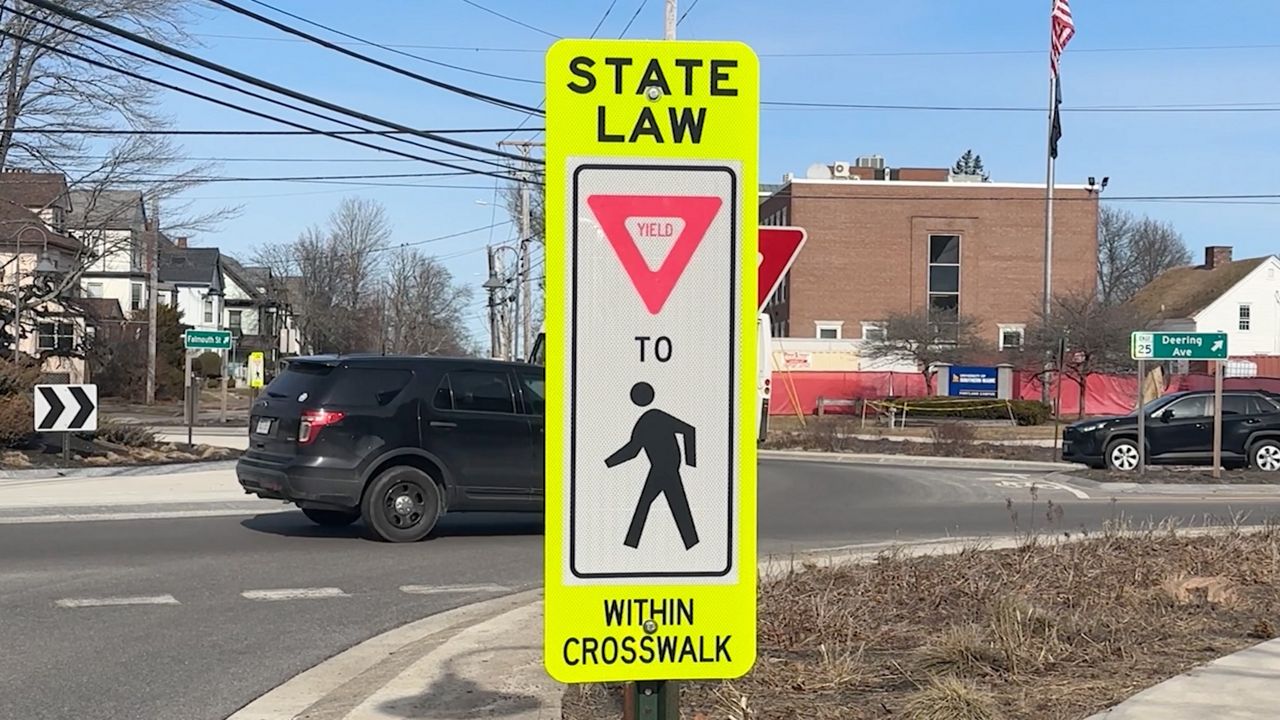
With March not even half over, Portland has already experienced more fatal pedestrian accidents on its streets than the city has seen in the previous 10 years, and the Portland City Council wants to do something about it.
The council voted unanimously earlier this month to adopt a resolution to do more to protect pedestrians in the city.
“I think that we know that this is a very, very serious issue and there is some immediate steps that we need to take,” Councilor Regina Phillips said at the March 3 meeting.
The council is also considering adopting a framework for change that has become popular in other cities both in Europe and the US.
The moves are drawing applause from regional groups advocating improvement, including the Greater Portland Council of Governments and the Bicycle Coalition of Maine.
GPCOG has compiled data on pedestrian-related accidents going back as far as 2003. It shows that, from January through March, there have not been more than four fatal vehicle accidents involving pedestrians from 2003 until this year, when the city recorded six.
The latest happened on Sunday, March 2, at about 9:15 p.m. near the intersection of Forest Avenue and Walton Street. According to Portland Police, a 57-year-old Portland man was struck by a car driven by a 22-year-old South Portland woman.
“As the driver of the car attempted to render aid, the man was struck by a second vehicle driven by a 62-year-old Portland man,” police said in a statement, adding that the pedestrian later died of his injuries.
That incident in part prompted the council the following evening to pass a resolution pledging multiple courses of action, including addressing lighting issues, enforcement of speed limits, public awareness campaigns and distribution of reflective safety gear.
The resolution is not binding, but along with its pledges, the council is also considering adopting Vision Zero, a road safety and design philosophy that could guide new policies and changes to existing roads in the city.
Cashel Stewart, regional transportation planner at GPCOG, said Vision Zero began in the 1990s in Sweden before spreading throughout Europe. Since adopting it, the number of deaths on the roadways in Sweden alone every year has dropped from 600 to less than 200.
“It’s a huge drop, and that’s why Vision Zero is catching on here,” he said.
Stewart called the concept “a multi-prong approach” that focuses on safer drivers and safer road designs. GPCOG has been so impressed by Vision Zero that it has drawn up its own action plan based on the philosophy and is now pitching it to municipalities in the region.
Yarmouth, Stewart said, has already chosen to adopt the plan, and if Portland follows suit the plan could drive multiple changes throughout the city.
“In Portland that might mean looking at snow removal, they might be looking at intersection redesign, they might be looking at temporary traffic installations, called demonstration projects,” Stewart said. “That’ll be up for debate and for them to figure out on their own using the Vision Zero action plan as a starting point.”
Paul Drinan, active transportation director for the Bicycle Coalition of Maine, said for municipalities nationwide, not just Portland, a new mindset is necessary.
“The big problem here is road design,” he said. “Our roads have been designed for over a hundred years to move cars as quickly and efficiently as possible, and we’re realizing now through data capture that we made a mistake and we need to redesign our roadways so they’re safer for everyone.”
That means, among other things, using the road itself to control speed, not just relying on speed limits and enforcement. For example, Drinan said, wider roads encourage drivers to drive faster no matter what the speed limits, while drivers instinctively slow down on narrower roads. Speed bumps and speed tables also help reduce speeds, he said, which in turn reduce the number of fatalities.
“The Number One factor in all of these situations is speed, hands down,” he said. “There are other contributing factors, but if someone gets hit by a cement truck traveling 10 miles an hour, I’m willing to say they’re not going to die. It’s only when a vehicle is traveling over 30 mph or if that cement truck is going 30 and runs over a pedestrian they’ll be dead.”
The city council has addressed pedestrian safety in the past. In October, the council passed a resolution to begin work on making High and State Streets two-way roads. Right now, the parallel streets are used as a quick way to get from Interstate 295 to the Casco Bay Bridge and back. Residents who live on both streets have complained that traffic moves way too fast through their neighborhoods.
City officials pointed out that there have been other changes in recent years, too. For example, said City Spokesperson Jessica Grondin, GPCOG’s own Vision Zero presentation cites several examples of existing projects in the city that have already helped improve pedestrian safety.
That includes the intersection of Falmouth Street, Deering Avenue and Brighton Avenue, near the University of Southern Maine campus, which used to be an ordinary signaled intersection. Drivers often passed through the intersection traveling at 35 mph.
Starting in 2021, however, that intersection was replaced with a rotary and clearly marked crosswalks. By definition, Stewart said, the rotary forces drivers to slow down and pay attention to people crossing the street.
“What we’re seeing here at Deering’s Corner roundabout is the crash severity reduced,” he said. “So there are still crashes, but we aren’t seeing fatalities and serious injuries.”
In addition, Drinan noted the proper use of speed bumps and speed tables on Stevens Avenue and Capisic Street have controlled speed in residential areas and, more importantly, near schools.
Both Stewart and Drinan acknowledged the city has taken steps, with Stewart saying, “They have been working toward Vision Zero somewhat indirectly for a long time,” but officially the city has not yet adopted GPCOG’s action plan.
Drinan said he hopes the city will adopt Vision Zero, and said the March 3 resolution was an encouraging sign that the city is considering doing even more to keep people safe on city streets.
“Unfortunately, it took a tragedy to get the city to adopt this resolution but now that they have adopted this resolution and they’re considering Vision Zero, we want to support them and work with them as much as we can to make our streets safer,” he said.