




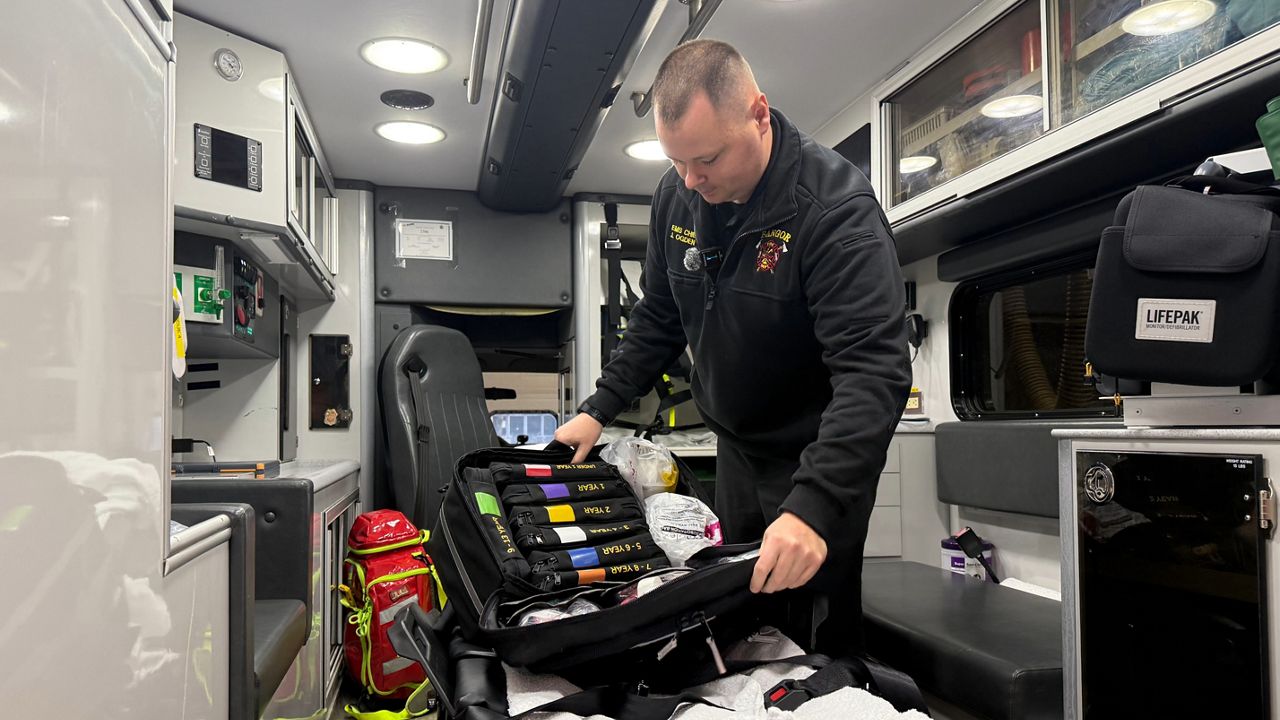
BANGOR — Bangor’s first responders are now better equipped for urgent calls involving children.
The department recently acquired new pediatric equipment thanks to a Maine EMS Blue Ribbon Stabilization Grant that’s awarded by Maine Emergency Medical Services.
According to the department, it is the only one in Penobscot County and one of only six in the state that has the Handtevy emergency care equipment.
“It’s reassurance to the family and to our providers knowing we have this technology at our disposal,” said Jeremy Ogden, EMS division chief of the Bangor Fire Department.
The gear includes pediatric bags that are color-coded to correspond with a child’s age. This means there is a bag for infants, one for 1-year-old children, one for 2-year-old children and so on.
“Everything we need to treat that patient — proper size airways, proper sized intubation tubes, proper size IV catheters — all of it is size-specific for that patient,” said Ogden. “With pediatrics, it’s very specific.”
Ogden said the department has enough gear to stock their five ambulances, three of which are staffed, and two are on reserve.
They also have a new app that tailors treatment plans to the child’s age.
“With pediatric patients, there’s a lot of medication math involved based on the patient’s weight. Whereas with adults, it’s more standardized,” said Ogden. “So, having the ability for the provider to pull up that information quickly can make a big difference in a life-and-death situation.”
Ogden said it’s important to note that first responders seen using a phone or tablet while on duty are still doing their jobs.
“This is new technology, so if providers show up to a call involving a pediatric patient and they’re on their phone or they’re on the iPad, please know that they’re not being distracted,” said Ogden. “They’re ensuring that they have the proper information at their fingertips.”
Ogden added that only around 3% of the approximately 8,500 medical calls they respond to each year involve children. But, when they do, he said it is often an emotional setting where tools like these can be a timesaver and help ensure accuracy.
“We don’t have a lot of pediatric patients, but when we do respond to them, it’s often a high-stress situation, not only for the pediatric patients and their family, but our providers as well,” said Ogden.