




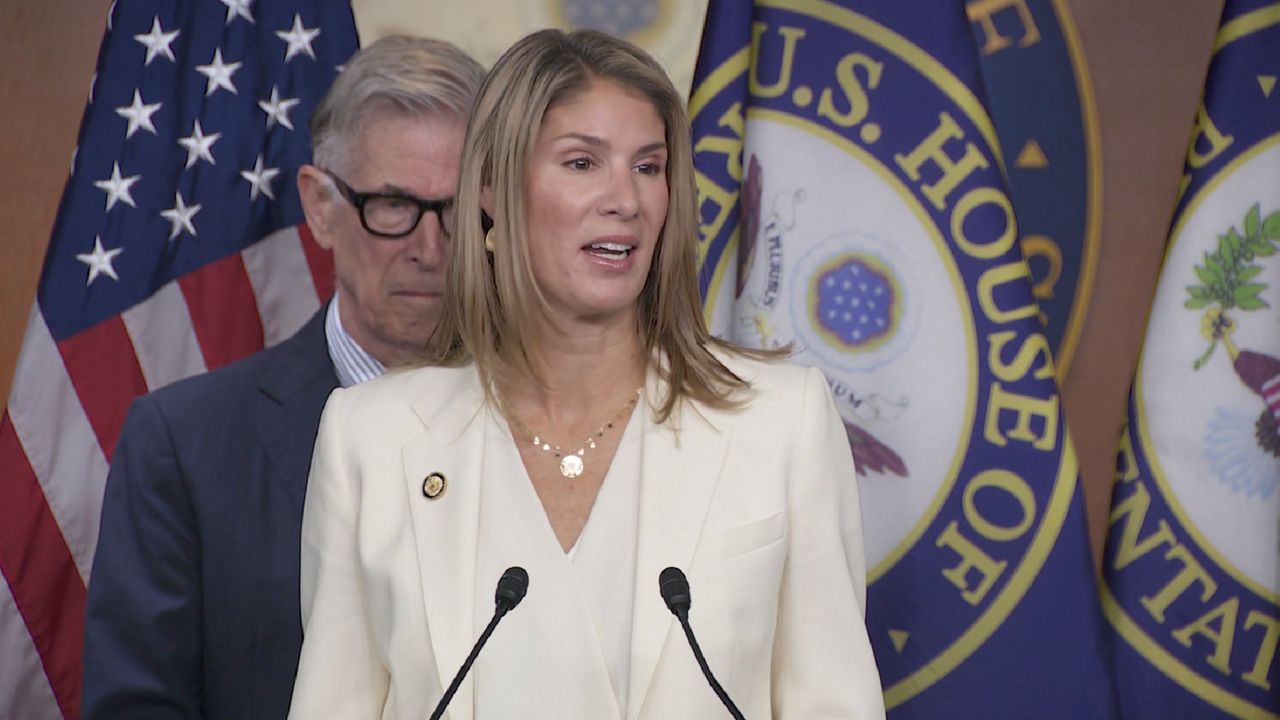
A major bipartisan effort to regulate artificial intelligence at the federal level is being tossed aside as its Democratic architect prepares to unveil a more aggressive piece of legislation ahead of her party regaining control of Congress in January.
Rep. Lori Trahan of Massachusetts is reworking the FRONTIER Act without the collaboration of her Republican co-sponsor, Rep. Jay Obernolte of California, according to a source familiar with the plan.
The current bill, a relatively middle-of-the-road approach, requires third-party auditing of frontier labs (like OpenAI), creates a new undersecretary for AI security within the Department of Commerce, and outlines a process for the federal government to halt development and deployment of models when an imminent catastrophic risk is detected.
Crucially for many Republicans, it also stops states from passing their own laws in certain areas that the bill already addresses, like requirements for what developers must report to the government.
Trahan’s new proposal, expected to go public in the coming weeks, would instead structure AI safety regulation in the same way minimum wage works – federal law as the floor, with states able to stack their own requirements on top.
Her office calls this “an effort that reflects the message voters sent in the election.”
A spokesperson for Obernolte did not respond to multiple requests for comment.
The change in the federal-state relationship in this AI legislation closely matches a view shared by the group Americans for Responsible Innovation, whose president, Brad Carson, once served as a Democratic congressman.
“If states want to go farther in demanding transparency and protections for their residents, that should be okay,” said Chris MacKenzie, the group's VP of communications.
The retooled bill is also perhaps a reaction to the strong political wins for Democrats in state capitals across the country last week.
With five flipped governors’ seats, the majority of the nation’s governors now belong to the party. Many legislatures have shifted to the left as well.
“I think the political landscape is a factor,” MacKenzie said. “But more than which party won control of different state legislatures and Congress, we’re looking at a legislative year where we saw kind of broad, cross-partisan tech backlash play out at the polls.”
With Republicans losing power in the House and Senate, Trahan no longer needs the same robust bipartisan support to pass her bill come January – though President Trump could still exercise veto power and the Senate has its filibuster.
This is a marked change from the political reality that existed just two weeks ago.
In pushing the initial FRONTIER Act this summer and fall, the Massachusetts Democrat went to great lengths to win GOP support for her legislation.
Most notably, she and Obernolte released a joint statement praising Trump’s accord with industry leaders to ensure the safe development of AI models.
“The accord embraces several principles at the heart of our bipartisan FRONTIER Act: robust internal risk management, strong corporate governance, and independent third-party evaluation," the two members of congress wrote.
Now, Trahan is going it alone, changing legislation to fit an era where it could pass without her having to work much across the aisle, a move the congresswoman predicted during a press conference with a state lawmaker in September.
When asked if there would be a “better” version of the FRONTIER Act if Democrats take control in Washington following the midterms, Trahan replied that “if that calculus changes, and while there’s certainly parts that I’d want to make a little bit stronger, we would love to have the room to do that.”
Even with a more Democrat-friendly regulation bill expected, Republican support for AI regulation in general has not necessarily evaporated.
GOP Rep. Scott Franklin of Florida, a co-sponsor of the FRONTIER Act, said in a statement to Spectrum News Tuesday that, while he’d welcome progress on the original bill before the end of the year, his “focus is on getting the policy right, whether that’s during the remainder of this Congress or in the next.”